Future-Proof Your Product: Avoiding Common Pitfalls in MVP Development Strategy for 2025
Introduction: The Imperative of Future-Proofing MVPs in 2025's Dynamic Landscape
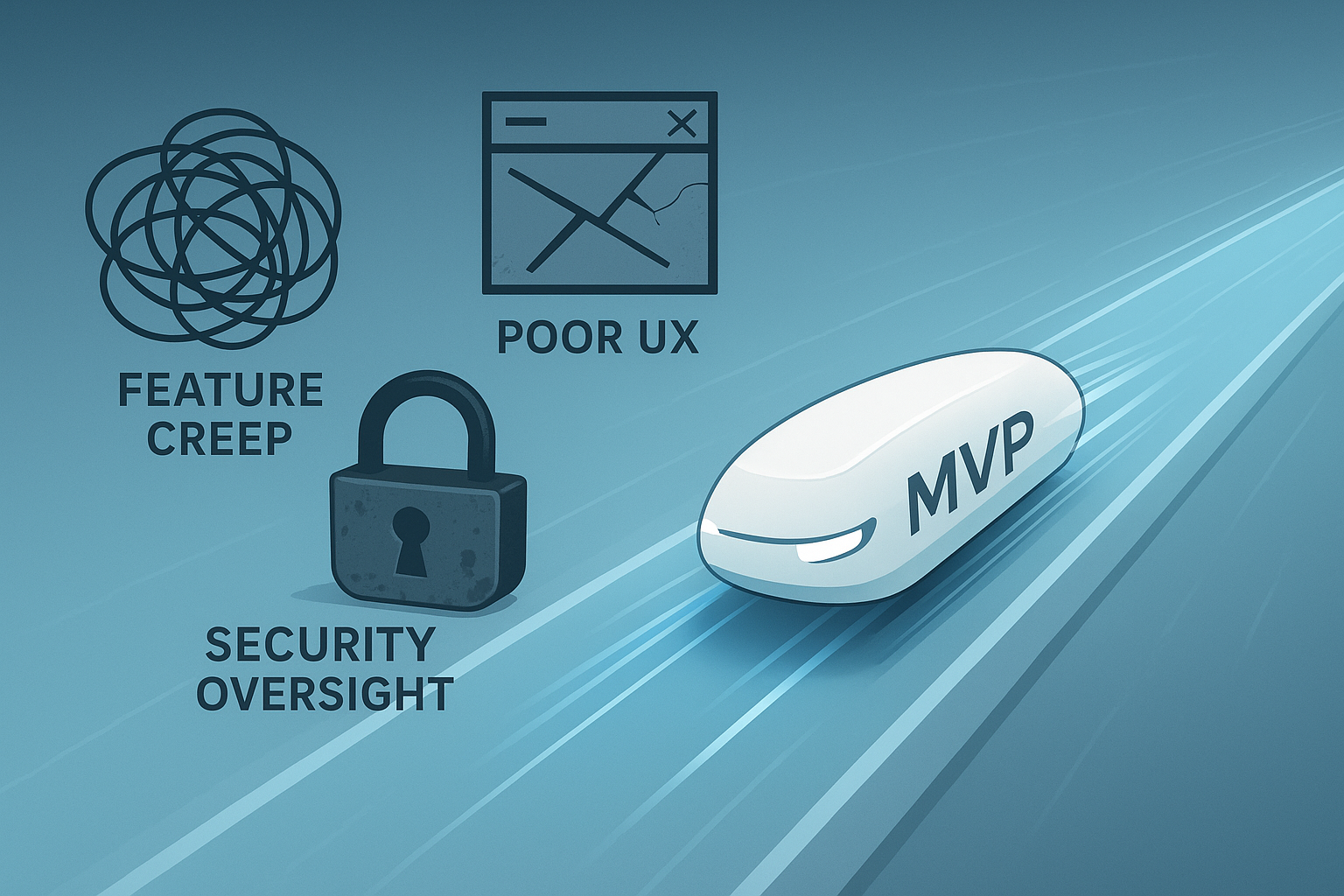
Pitfall 1: Overbuilding the 'Minimum' – The Peril of Feature Creep
It’s the most common trap for passionate founders: the temptation to add “just one more feature.” This impulse, born from a drive for perfection, is the primary source of feature creep—a silent killer that transforms a lean Minimum Viable Product into a bloated, delayed project. Remember, the 'V' in MVP stands for Viable, not a vast catalogue of functionalities.
Every non-essential feature you add pushes your launch date further into the future. While you’re debating nice-to-haves, your competitors are already in the market, capturing users and collecting invaluable feedback. This isn't just a delay; it's a forfeiture of your most critical asset: speed. Feature creep also injects immense uncertainty into your budget and timeline, turning a clear path to launch into a stressful, endless development marathon.
The antidote is ruthless prioritization. Before adding anything beyond the absolute core function, ask a single, brutal question: "Can we validate our primary business hypothesis without this feature?" If the answer is yes, it gets deferred. Your first version isn't meant to be a perfect, all-encompassing product. It’s a surgical tool designed to test one thing: does your core idea solve a real problem for a real audience? Get that answer in weeks, not months.
Pitfall 2: Neglecting Deep Market Validation and User Problem Definition
Founders often fall in love with their solution, not the user's problem. This is a fatal but common error. The result is a beautifully engineered product that solves a problem nobody has, leading to the dreaded sound of crickets at launch. You can't "future-proof" a product that has no present-day demand.
In 2025, deep validation isn't about running endless surveys or focus groups. While helpful, true validation is behavioral. It answers one question: will someone use your product to solve their problem? Many teams get this backward, spending months building a feature-rich "perfect" product based on speculation, trapping themselves in an endless development cycle. This isn't just slow; it's expensive guesswork.
The most effective strategy is to ruthlessly define the single, most painful problem your user faces. Then, isolate the absolute minimum set of features required to solve it. Your MVP isn't a smaller version of your final app; it's a focused experiment designed to prove your core hypothesis. By building and launching this stripped-down version with extreme speed, you replace assumptions with real-world data. This velocity is your greatest strategic advantage, allowing you to learn and iterate while competitors are still stuck in planning meetings.
Pitfall 3: Ignoring Emerging Technologies and AI Integration Potential
In 2025, dismissing AI as "too complex for an MVP" is a strategic blunder. The fear is understandable: founders envision massive, custom-built models that drain budgets and delay launch indefinitely. This all-or-nothing thinking is a trap that allows more agile competitors to capture the market.
Future-proofing your product doesn’t mean building a revolutionary AI from day one. It means validating the demand for an AI-powered feature with ruthless efficiency. The smart move is to identify the single most impactful AI enhancement for your user and test it using a simple, off-the-shelf API. Can a GPT-powered summary improve your core workflow? Can a basic recommendation engine increase engagement?
By integrating a pre-built tool, you sidestep the endless development cycle and astronomical costs of building from scratch. This approach allows you to launch a seemingly sophisticated product in a matter of weeks, not years. You get to test your hypothesis with real users and gather data on what they actually value. This intelligence is invaluable, providing the certainty you need before committing to a larger-scale, custom AI build down the road. It’s about being lean, fast, and learning before you invest heavily.
Pitfall 4: Poor UX/UI Design – Underestimating User Expectations
A common, dangerous myth is that "Minimum Viable" is an excuse for "Minimum Usable." In 2025, this couldn't be further from the truth. Today's users have high standards, and they won't struggle through a confusing or frustrating interface to find your app's value. Bad UX is a silent killer; it creates false negatives, where users abandon your product not because the core idea is flawed, but because they simply can't figure it out. You'll get no data, no feedback—just silence.
Future-proofing your MVP means rejecting the notion that good design has to be a slow, expensive process. The goal isn't to win design awards; it's to eliminate friction. This requires a ruthless focus on clarity and established design patterns that users already understand. Your interface should provide a clean, intuitive, and professional pathway directly to the core feature you are testing.
This approach transforms design from an endless creative bottleneck into a strategic tool for speed. By prioritizing usability over unnecessary embellishments, you create a product that users can engage with immediately. This allows you to get the crucial, high-quality feedback you need to validate your concept while your competitors are still debating shades of blue.
Pitfall 5: Inadequate Feedback Mechanisms and Iterative Development Cycles
An MVP that launches without a clear, immediate plan to gather and act on feedback is not a strategic asset; it's a shot in the dark. The most common—and crippling—mistake is treating the initial launch as the finish line. In reality, it’s the starting gun for the most critical phase: learning.
Many founders build their product in a silo for months, launch, and only then begin to think about collecting user insights. This delay is fatal. The market moves in weeks, not quarters. Your goal must be to shrink the gap between "launch" and "learn" from an agonizingly slow cycle into a tight, rapid loop.
Future-proof your product by embedding feedback mechanisms from day one. This isn't just about adding a contact form. It’s about creating a disciplined process for user interviews, analytics review, and prioritizing the next micro-iteration. Every day you operate without this data, you are allowing speculation to drive your business. A truly effective MVP strategy is defined not by the perfection of its first version, but by the speed at which it can evolve based on real-world evidence. This relentless momentum is what separates thriving products from forgotten ideas.
Pitfall 6: Overlooking Security and Data Privacy from Day One
It’s a tempting shortcut for founders: "We'll worry about security after we get traction." This mindset treats data privacy as a feature to be added later, rather than the foundation upon which your entire product rests. In 2025, with regulations like GDPR and CCPA setting a global standard, this is a fatal error. A single data breach, even in an early-stage MVP, can irrevocably shatter user trust and kill your startup before it has a chance to grow.
Future-proofing your product means baking in security, not bolting it on. This isn't about building an impenetrable digital fortress that delays your launch for months; that’s just another form of feature bloat. Instead, it requires ruthless prioritization of the essentials. A production-ready MVP must include secure authentication, encryption for sensitive data (both in transit and at rest), and a clear, honest privacy policy.
Getting these fundamentals right from the start provides certainty. It prevents the catastrophic technical debt and rework that lead to the very delays and budget overruns you're trying to avoid. By establishing a baseline of trust from day one, you build on a solid foundation, allowing you to focus on user feedback and growth instead of future crisis management.
Pitfall 7: Failing to Define Clear, Measurable Success Metrics (KPIs)
Launching an MVP without Key Performance Indicators (KPIs) is like setting sail without a compass. You’re moving, but you have no idea if you’re heading toward your destination or into a storm. Before a single line of code is written, you must answer one critical question: What does success look like in the first 30 days?
Your initial KPIs shouldn't be about vanity metrics like total downloads. They must be tied directly to your core business assumption. Are you trying to validate that users will sign up for your service? Your primary KPI is the user sign-up rate. Are you testing if your core feature is compelling? Track the percentage of users who complete that specific action—your activation rate. Other powerful early-stage metrics include daily active users (DAUs) and week-one retention.
Defining these targets upfront forces ruthless prioritization. If a feature doesn't directly impact your primary KPI, it doesn't get built in the first version. This data-driven clarity is non-negotiable. It replaces subjective debates with objective data, allowing you to learn and iterate with speed while others are still stuck in planning meetings. It turns your launch from a hopeful guess into a strategic experiment.
8. Mismanaging Stakeholder Communication and Team Alignment
Misalignment is a silent killer of momentum. When founders, investors, and development teams aren't on the same page, chaos isn't far behind. The culprit is rarely malice; it’s the lack of a single, authoritative plan. Feedback trickles in from all directions, each stakeholder championing a "must-have" feature. This "death by a thousand small requests" is the primary cause of scope creep—the insidious force that pushes timelines from weeks into months and completely obliterates budgets.
The solution isn't more meetings or complex project management software; it's radical clarity and discipline from day one. Before a single line of code is written, the core feature set for the MVP must be defined, agreed upon, and effectively locked. This document becomes the constitution for your initial build, the north star that prevents deviation.
This requires conviction. Your job as a founder isn't to satisfy every stakeholder's wish list. It's to execute a ruthlessly prioritized plan designed to validate a single, critical business assumption. Establish a clear process for new ideas: capture everything, but explicitly park anything outside the initial scope for V2. This protects your timeline, eliminates financial uncertainty, and ensures you get to market fast enough to get the only feedback that truly matters—from your first users.
Pitfall 9: Skipping Early Monetization Strategy and Business Model Validation
A surprisingly common pitfall is treating monetization as a "phase two" problem. Founders often obsess over user acquisition, assuming they can figure out how to charge for it later. This is a direct path to building a popular hobby, not a sustainable business.
Your MVP’s primary job isn't just to prove you can build a product; it's to prove you can build a business. The willingness of a user to pay is the strongest form of validation you can receive. Without it, you’re operating on pure speculation, investing time and capital into an unproven financial model. You risk building features for an audience that will never become customers.
Instead of deferring, integrate your core monetization strategy from day one. This doesn't require a complex billing system. It means ruthlessly prioritizing the test of your core value exchange. A simple pricing page that gauges intent, a “Founder’s Tier” for early adopters, or a basic checkout for one key feature is enough. The goal is to get a clear "yes" or "no" on your business model in the shortest possible timeframe. This focus on validating the entire business—not just the tech—is what separates startups that thrive from those that run out of runway chasing vanity metrics.
Pitfall 10: Lack of a Clear Long-Term Product Roadmap and Vision
It's a paradox: you need a North Star, but a detailed five-year plan can be an anchor that sinks your startup before it even sets sail. Many founders confuse a "roadmap" with a long list of features. This confusion is the direct cause of bloated initial builds, endless delays, and spiraling budgets.
Your vision isn't a feature list; it's the fundamental problem you are solving for a specific audience. Your roadmap shouldn't be a rigid, multi-year Gantt chart. Instead, think of it as a series of core hypotheses you need to test, starting with the most critical one.
The purpose of your MVP is to test that first, foundational hypothesis. Everything else is noise.
A powerful vision gives you the clarity to be ruthless. It helps you answer one question for every potential feature: "Is this absolutely essential to validate our core assumption right now?" If the answer is no, it gets cut. This is non-negotiable. Building a lean, focused MVP in weeks—not months—allows you to replace your roadmap's speculation with hard user data. This data then illuminates the true path forward, ensuring your next step is based on certainty, not guesswork.
Conclusion
Conclusion: Building Resilient MVPs for Sustained Success Beyond 2025
Tired of endless development delays and budget overruns? Launch your production-ready MVP in just 14 days with MVPExpert's fixed-price solution. Book your free project consultation today.

Børge Blikeng
AuthorHelping startups build successful MVPs for over 5 years