SaaS MVP Cost vs. Full Product: The Real Price Tag Your Startup Can't Ignore
The High Stakes of SaaS Development - Avoiding the Budget Black Hole
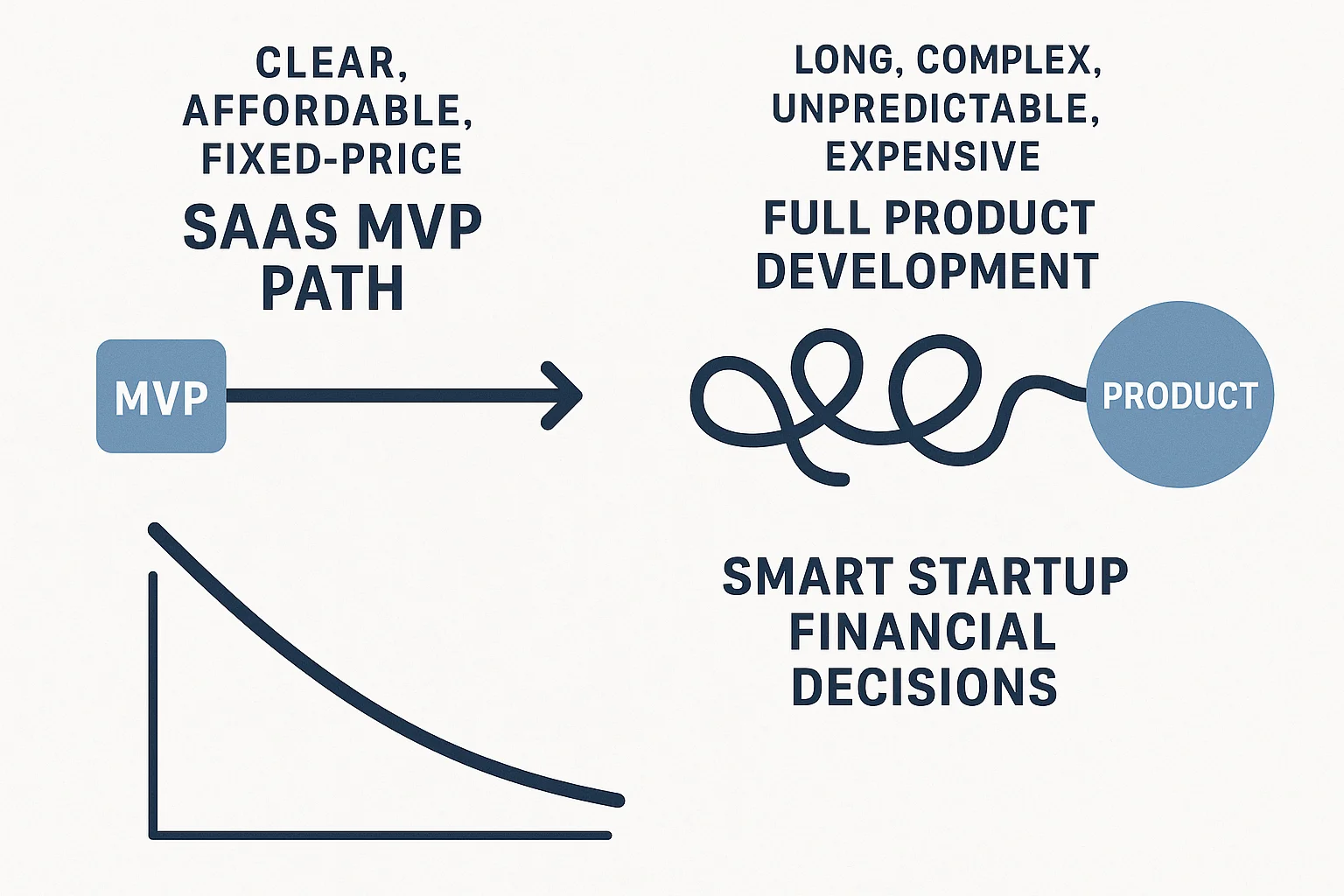
For a non-technical founder, the most terrifying question is, “How much will this really cost?” You envision your perfect, full-featured product, but the path to building it often becomes a financial black hole—a nightmare of scope creep and ballooning timelines. This is the dangerous gamble of the traditional “full product” approach. But what if you could swap that massive risk for guaranteed market validation? An MVP isn't just a stripped-down app; it's your most strategic financial move. It’s about launching a core solution quickly to prove your idea with real users before sinking your entire budget. This article directly compares the unpredictable, six-figure-plus journey of a full build against the certainty of a fixed-cost, guaranteed 14-day MVP launch. To truly demystify the real price tag and understand how to get to market smarter and faster, consider exploring MVP Cost: Forget Vague Estimates, Here’s the Fixed Price to Launch in 14 Days.
The Elusive "Full Product" Cost: A Black Hole for Budgets
Every founder has a vision for their perfect, feature-rich product. But when you try to build that complete vision from day one, the budget often spirals into a black hole. The "full product" approach is a high-stakes gamble where the final bill is almost always a mystery, making it impossible to forecast accurately. The cost becomes elusive due to a dangerous combination of factors. First is "scope creep"—the seemingly small requests to "just add one more feature" that accumulate, each one demanding more design, development, and testing. These additions often uncover unforeseen technical complexities, delaying progress. Suddenly, what was planned as a six-month project stretches to a year or more. This endless development cycle means you’re continuously burning cash on developer salaries, project management overhead, and mounting infrastructure costs, all before earning a single dollar. An initial quote of $100,000 can easily swell to over $250,000, with no guaranteed launch date in sight. This isn't just a budget overrun; it’s your entire startup runway vanishing on unproven assumptions. To avoid committing to a path with no financial finish line, it’s critical to understand that a more strategic approach exists: the fixed-price MVP. For a deeper dive into how this model offers clarity and control, ensuring you validate your core idea without betting the farm, explore the 5 Fixed-Price MVP Benefits That Guarantee Your Launch & De-Risk Your Startup.
Defining Your MVP: What Really Constitutes a Minimum Viable Product?
An MVP isn’t just a "lite" version of your grand vision; it's a strategic surgical strike designed to help you Validate Your Startup Idea: The Founder's Step-by-Step Guide to Building an MVP. Its purpose is not to impress but to learn. The goal is to build the smallest possible product that allows you to test your most critical assumption: "Will people pay for a solution to this problem?" This disciplined approach is your best defense against the endless development cycles and spiraling costs that sink startups. Forget the long list of "nice-to-have" features. A true MVP is defined by ruthless prioritization. It’s not about what you can build, but what you must build to get validated learning from real users. Anything else is waste.
Use this checklist to cut through the noise and define your essential product:
- The One Problem: What is the single, most painful problem you are solving?
- The One User: Who is the specific early adopter that feels this pain most acutely?
- The One Solution: What is the absolute minimum feature set required to solve that one problem for that one user? (e.g., create an account, perform one core action, see the result).
- The One Metric: What single metric proves your idea has legs? (e.g., 10 paying customers, 50 active users).
Answering these questions transforms your MVP from a vague concept into a concrete, buildable specification. This clarity is what enables a fixed scope, a predictable timeline, and a guaranteed launch, saving you from the financial quicksand of building a product nobody has validated.
Key Cost Drivers for Any SaaS Development Project
Navigating SaaS development costs can feel like estimating a project with no end date. For a non-technical founder, this uncertainty is a significant risk. The final price tag isn't arbitrary; it's a direct result of specific decisions you make. Understanding these key drivers is crucial to controlling your budget and launching efficiently.
- Scope & Feature Complexity: This is the single biggest factor. Every feature, from a simple user profile to a complex data analytics dashboard, adds development hours. A full-fledged product often includes dozens of "nice-to-have" functionalities that can bloat the budget and timeline indefinitely. A strategic MVP, by contrast, focuses only on the core feature set needed to solve one critical problem for your first users, drastically reducing initial complexity and cost.
- Third-Party Integrations: Your SaaS doesn't live in a vacuum. Integrating with external services like Stripe for payments, Twilio for messaging, or a CRM like HubSpot is standard practice. Each integration adds a layer of technical complexity and requires development time to implement, test, and maintain, directly impacting the overall project cost.
- Development Approach & Timeline: Traditional development often involves hourly billing and flexible timelines, which can easily lead to "scope creep" and spiraling budgets. An open-ended project is the ultimate budget killer. A fixed-price, fixed-timeline approach fundamentally changes the dynamic, forcing ruthless prioritization and providing absolute cost certainty. This turns a risky financial gamble into a predictable strategic investment to validate your idea in the market.
For a comprehensive look at these factors and to truly get How Much Does a Basic MVP Cost in 2025? The Fixed-Price Answer, adopting a fixed-price strategy is often the clearest path.
The Typical Cost Range for a SaaS MVP: A Realistic Look
Let’s cut to the chase: pinning down a single cost for a SaaS MVP is notoriously difficult. A quick search reveals ranges from a mere $5,000 to over $100,000. This massive variance isn't helpful; it's a red flag highlighting the inherent risk in traditional development models, especially for non-technical founders. The final bill is often a mystery until it's too late.
To give you a realistic picture, here's how the costs typically break down based on who you hire:
- Freelance Developers: $5,000 - $20,000. This is the cheapest route, but it carries the highest risk of miscommunication, missed deadlines, and scope creep that inflates the final cost.
- Small to Mid-Sized Agencies: $20,000 - $60,000. The most common path, but often a trap. Most agencies bill hourly or by sprints, turning your 3-month project into a 6-month financial drain. Your initial quote is rarely your final price.
- Large Development Firms: $60,000+. While they offer comprehensive services, their processes are slow and their overhead is built into a price tag that’s usually overkill for a first version designed for market validation.
The critical takeaway isn't the price range itself, but the uncertainty tied to it. The goal of an MVP is fast, affordable validation. An unpredictable timeline and a variable budget defeat that purpose. The smarter financial question isn't 'How much will it cost?' but 'How can I get a guaranteed result for a predictable, fixed price?'
Beyond Development: The Essential Costs of Launching Your SaaS
Your development budget is just the ticket to the game; it doesn't cover playing it. The real test of your financial planning comes from the operational costs required to actually acquire and support customers. Getting this wrong is how promising products fail before they even launch. A traditional "big bang" launch forces you to spend heavily on these areas based on assumptions. In contrast, an MVP approach allows you to validate your idea first, ensuring every dollar spent beyond development is on a proven concept. This is the single biggest financial advantage of starting small and smart.
For a detailed breakdown of what to expect when planning your initial investment, including current market insights, consult resources like 2025 MVP Costs: Demystifying Your Basic Minimum Viable Product Budget.
Consider these essential post-development costs and how an MVP de-risks them:
- Infrastructure & Hosting: A full-featured product often requires over-provisioning expensive servers on platforms like AWS or Azure, guessing at user load. An MVP starts lean, scaling hosting costs directly with actual user growth, not hopeful projections.
- Marketing & Sales: Launching a full product demands a significant upfront marketing budget for a wide audience. An MVP launch is hyper-focused, concentrating on targeted outreach to secure your first crucial users and gather feedback—an investment in learning, not just advertising.
- Core Software Stack: This includes your CRM, analytics, and customer support tools. Instead of locking into expensive annual contracts for software you think you'll need, an MVP model lets you leverage free tiers and scale your toolset as revenue and complexity grow.
- Legal & Administrative: While incorporation and basic legal documents are always necessary, the complexity and cost escalate with a feature-rich product. An MVP simplifies these requirements, deferring major legal expenses until you have a validated business model.
SaaS MVP vs. Full Product: A Side-by-Side Cost Comparison (Scenarios)
To truly grasp the financial difference, let's move from theory to practical scenarios. For a non-technical founder, understanding where your capital is going—and the risks involved—is paramount. The numbers below illustrate not just a difference in scale, but a fundamental difference in financial risk and time-to-market between a strategic MVP and a traditional full product build.
| Category | Strategic MVP (Fixed-Cost Model) | Traditional Full Product (Variable Cost Model) |
|---|---|---|
| Core Development | Solves one core problem for one user type. | Aims to solve multiple problems for several user types. |
| Est. Cost | $15,000 - $25,000 | $75,000 - $150,000+ |
| UI/UX Design | Standard, user-friendly interface. | Bespoke design system, advanced animations. |
| Est. Cost | $3,000 - $5,000 | $15,000 - $30,000+ |
| QA & Testing | Manual testing on core user flows. | Extensive automated and manual testing suites. |
| Est. Cost | $2,000 - $4,000 | $20,000 - $40,000+ |
| Timeline | Guaranteed: 2-4 Weeks | Estimate: 6-12+ Months |
| Risk Profile | Low: Fixed price protects against scope creep. | High: Prone to budget overruns and delays. |
| Total Est. Cost | ~$25,000 (Predictable) | ~$110,000 - $220,000+ (Unpredictable) |
The contrast is stark. The full product path isn't just more expensive; its variable nature means the final bill is an unknown. This is the "endless development cycle" where budgets evaporate before you ever validate your idea. An MVP provides absolute cost certainty and a guaranteed launch date, transforming your initial investment from a high-stakes gamble into a calculated business decision. You get to market faster, gather crucial user feedback, and start generating revenue, all while avoiding the financial black hole of a premature, full-scale build.
Strategies to Drastically Reduce Your MVP Development Costs Without Sacrificing Quality
Cutting costs shouldn’t mean cutting corners, especially for non-technical founders. The key is to eliminate uncertainty and waste, not features, enabling you to launch a high-quality product without the risk of a runaway budget. In fact, strategic decisions made before a single line of code is written are where the most significant savings come from. For instance, many startups find success with focused, rapid development models, such as those detailed in articles like [MVP Development For Startups: Launch in 14 Days for a Fixed $4,990]. By prioritizing speed and validation, you can effectively manage your budget and achieve your launch goals.
Here are seven strategies to make it happen:
- Solve One Problem, Perfectly: Resist the urge to build everything. Your MVP must solve one critical pain point for one specific user. Every additional feature adds exponential cost and complexity, delaying the crucial market feedback you need.
- Insist on a Fixed-Price Agreement: Avoid the "time and materials" trap that leads to budget overruns. A fixed-scope, fixed-price model provides absolute cost certainty and forces ruthless prioritization. You'll know exactly what you're getting and when, eliminating financial surprises.
- Use No-Code to Validate First: Build a clickable prototype with no-code tools to test your user flow and core assumptions. This pre-validation step costs a fraction of actual development and prevents expensive rework based on flawed ideas.
- Leverage Pre-built Components: Don’t reinvent the wheel for standard functions like user logins or payment processing. Using battle-tested, pre-built solutions drastically accelerates your timeline and reduces development hours.
- Prioritize Functional UX Over Polished UI: A clean, intuitive, and fast user experience is paramount. Complex animations and pixel-perfect custom designs can wait. A straightforward interface is cheaper and faster to build and is what users value most initially.
- Choose a Standardized Tech Stack: Partner with a team that has a proven, repeatable technology process. This removes guesswork and the risk of choosing an obscure or inefficient stack, ensuring a stable and scalable foundation.
- Launch to a Private Beta: A massive public launch is expensive. Start by inviting a small, targeted group of users. This minimizes initial server costs and provides a controlled environment for gathering invaluable, high-quality feedback.
The Strategic Advantage: Why an MVP is a Smarter Financial Decision for Founders
The traditional path to building a SaaS product is a high-stakes gamble. Founders often spend 6-12 months and an unpredictable budget chasing a "perfect" version one, only to discover their core assumptions were wrong upon launch. This "build it and they will come" strategy is the single most expensive mistake a startup can make. The real cost isn't just the initial developer invoice; it's the spiraling expenses from feature creep and the massive opportunity cost of not learning from real users.
An MVP flips this model from a high-risk gamble to a calculated investment. It replaces the endless development cycle and budget uncertainty with a fixed-cost, fixed-timeline project, often realized through structured offerings like Fixed Price MVP Development Packages: Your Predictable Path to Product Launch, designed for one purpose: market validation. By focusing capital on testing your core hypothesis with a real, functional product in a matter of weeks, you gain three critical financial advantages:
- Capital Efficiency: You validate your idea for a fraction of a full build's cost, preserving funds for scaling what works.
- Risk Mitigation: You avoid sinking your entire budget into an unproven concept.
- Accelerated ROI: You get to market faster, enabling you to generate revenue and user data that justifies future investment.
This isn't just about spending less; it's about spending smarter to build a business on a foundation of proof, not assumptions.
Predictability and Precision: Understanding the Fixed-Price MVP Model
For non-technical founders, the most terrifying part of development is the unpredictable nature of cost. Traditional agency models, often based on hourly rates, present budgets as "estimates." This creates a fundamental conflict of interest: the longer a project takes, the more the agency gets paid. It’s a recipe for scope creep, where small feature additions gradually inflate your budget and push your launch date into the distant future. This financial uncertainty can sink a startup before it ever reaches the market.
The fixed-price MVP model is the antidote to this chaos, directly addressing the unpredictable nature of cost and hidden fees as explored in The True Cost of an MVP: How to Eliminate Hidden Fees with a Fixed-Price Model. It’s not just a pricing structure; it’s a strategic framework that enforces discipline and aligns incentives. By agreeing on a single, fixed cost for a clearly defined set of core features, you eliminate financial surprises. The risk of overruns shifts from you to the development partner, whose success is now tied to delivering efficiently and on schedule. This approach transforms your MVP from a potential money pit into a predictable strategic asset. You know exactly what will be delivered, precisely when it will be ready, and exactly how much it will cost. This gives you the clarity and confidence to plan your marketing, sales, and fundraising efforts around a guaranteed launch date, ensuring your capital is used for growth, not just endless development.
Making the Right Choice: Achieving Financial Certainty for Your SaaS Journey
The path you choose for your SaaS launch isn't just a technical one; it's a critical financial decision that can define your startup's future. You stand at a crossroads: the traditional "full product" approach, fraught with budget overruns and shifting timelines, or the strategic MVP launch, designed for speed, validation, and fiscal control.
The "build-it-all" mindset is a high-stakes gamble. It assumes you know precisely what customers will pay for, risking significant capital and 6-12+ months of development before you get a single piece of market feedback. This often spirals into an endless cycle of feature creep and escalating costs, draining your resources before you even have a product to sell – a common 'horror story' many startups face. To better understand how to avoid these budget and contract pitfalls when considering your development approach, whether it's an MVP or a fixed-price model, explore MVP Budget vs. Fixed-Price Contract: How to Avoid Both Horror Stories.
In contrast, a strategic MVP is a calculated investment. It prioritizes launching a core, validated solution quickly, providing a clear, fixed cost and a predictable launch date. This isn't about building less; it's about building smarter, de-risking your venture, and securing your financial footing from day one.
To make the choice clear, consider the two paths side-by-side:
| Factor | Traditional Full Product Build | Strategic Fixed-Cost MVP |
|---|---|---|
| Budget | Unpredictable, prone to overruns | Fixed, predictable investment |
| Timeline | 6-12+ months, often delayed | Rapid launch in weeks |
| Risk Profile | High: building unvalidated features | Low: validating the core concept |
| Market Feedback | Delayed until after full launch | Immediate, actionable data |
| Financial Certainty | Low | High |
Choosing the MVP path isn't a compromise; it’s the definitive move to achieve financial certainty and start generating revenue faster.
Secure Your Startup's Future with a Transparent & Predictable Launch
The debate between a SaaS MVP and a full product extends far beyond initial development costs. The real price tag your startup can't ignore is the catastrophic risk of investing heavily in a solution the market doesn’t want. A feature-rich initial build is a high-stakes gamble that can exhaust your resources on an unvalidated concept. In contrast, an MVP is a strategic investment in learning, minimizing financial exposure and accelerating your time-to-market. For instance, resources like SaaS MVP: How to Launch in 14 Days for a Fixed $4,990 illustrate how quickly you can launch to unlock the invaluable user feedback needed to build a product customers will actually pay for. Therefore, your crucial next step isn’t to dream up more features. It’s to ruthlessly define your core problem and scope a lean, focused MVP that can validate your vision and secure your path to sustainable growth.
Stop the endless development cycle and get your idea validated with our predictable 14-day fixed-price MVP. Book your free project consultation today.

Børge Blikeng
AuthorHelping startups build successful MVPs for over 5 years