The Real Cost to Build an MVP for a Mobile App: A 2024 Breakdown
What is an MVP and Why is it Crucial for Mobile Apps?
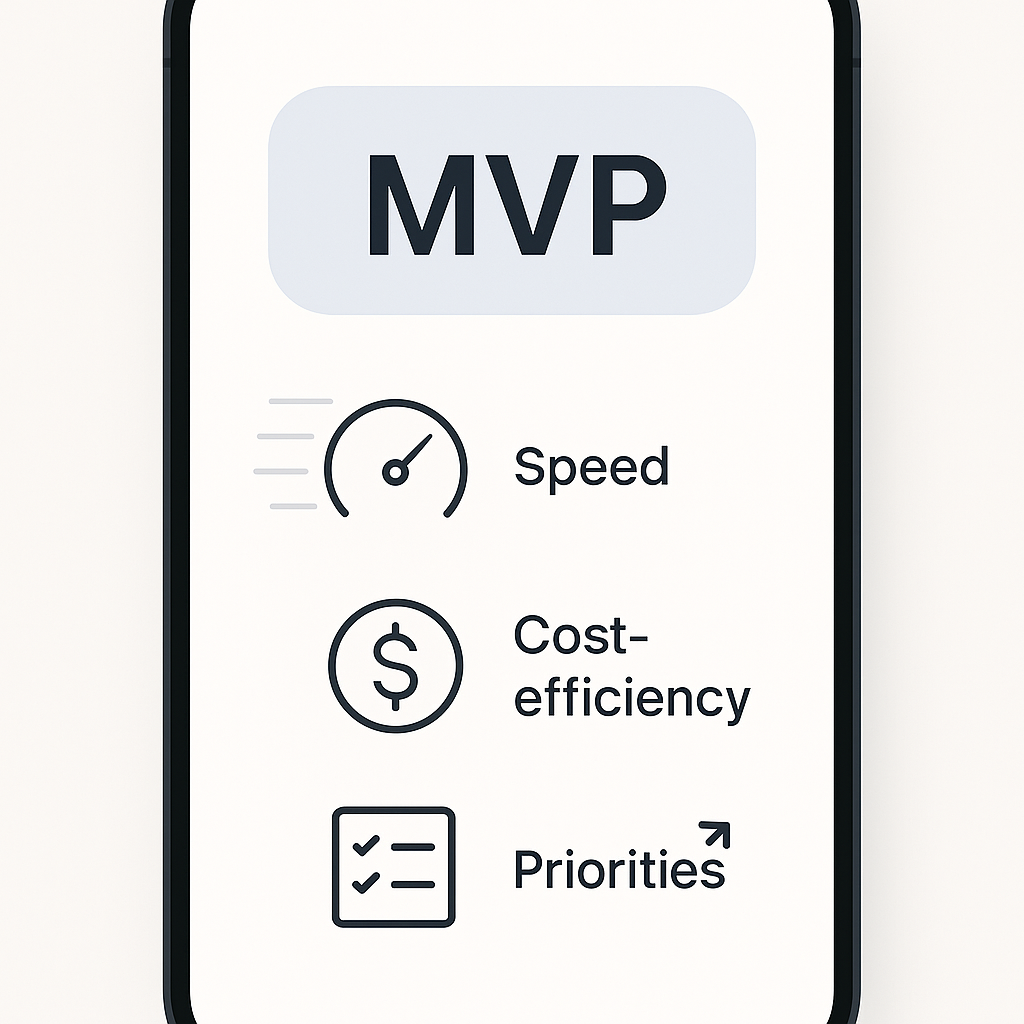
A Minimum Viable Product (MVP) isn't a buggy demo or a half-finished app; it's a strategic tool designed to answer the single most important question for any founder: will people use and pay for this? It is the simplest, functional version of your app that delivers core value to your first users. The goal isn't to launch with every feature you’ve ever imagined, but to launch with the one feature your users can't live without.
This approach is your strongest defense against the two things that kill most app ideas: feature bloat and the endless development cycle. The MVP process forces you into ruthless prioritization. Instead of building ten features moderately well, you build one core feature exceptionally well. This laser focus is what prevents projects from dragging on for months and spiraling into a budget nightmare. By defining a tight, fixed scope, you transform development from a source of financial anxiety into a controlled, strategic launchpad.
Ultimately, the most critical function of a mobile app MVP is to get you out of the boardroom and into the real world. Launching quickly allows you to replace assumptions with real user data, giving you the clarity needed to iterate and build a product people truly want while your competitors are still stuck in planning meetings.
Key Factors Influencing Mobile App MVP Development Costs
Navigating the cost of a mobile app MVP is less about the final number and more about taming the variables that cause budgets to spiral and timelines to stretch indefinitely. For founders, controlling these factors is the difference between launching successfully and getting trapped in development limbo.
The single greatest threat to your budget is feature creep. An MVP's power lies in its disciplined, ruthless focus. Every proposed feature must answer one critical question: "Is this absolutely essential to validate my core business assumption and attract my first users?" Anything else is a distraction that adds cost and delays the real-world feedback you desperately need.
Your development approach is equally critical. To avoid the budget nightmares that cripple promising startups, you must move from speculation to certainty. An open-ended hourly billing model is a recipe for disaster. The smartest approach is to lock in a fixed scope for a fixed price. This enforces discipline, eliminates financial anxiety, and puts the focus back on what matters: launching quickly.
Finally, technical complexity—such as choosing native vs. cross-platform development, intricate backend logic, or integrating multiple third-party APIs—will directly influence the final cost. By prioritizing simplicity and speed, you not only reduce upfront costs but also gain an unfair advantage by getting to market while your competitors are still planning.
The Discovery Phase: Laying the Foundation for Your MVP
The discovery phase is a critical fork in the road. It’s where great ideas either gain unstoppable momentum or enter the "endless development cycle" that kills so many promising startups. Forget the traditional approach of months-long meetings and 100-page specification documents; that’s a recipe for analysis paralysis.
The sole purpose of an MVP’s discovery phase is to achieve absolute clarity through ruthless prioritization. Instead of asking, "What features could we build?" the only question that matters is, "What is the single, core problem we are solving, and what is the minimum required to prove people will use our solution?"
A successful discovery phase doesn't end with a vague estimate and a loose timeline. It culminates in a rock-solid, non-negotiable scope of essential features. This clarity is the key to avoiding the budget nightmares that plague founders. By defining a fixed scope, you can demand a fixed price and a firm deadline.
This intense, focused approach isn’t about cutting corners; it’s about creating certainty. It allows you to move from ideation to execution with speed, giving you the unfair advantage of getting real user feedback while your competitors are still stuck in planning meetings.
UI/UX Design: Visualizing and Structuring Your App's Experience
UI/UX design isn't about winning awards; it's about creating the most direct path for your first users to find value. User Experience (UX) maps this core journey, while User Interface (UI) provides the visual layer.
This stage is a minefield for feature bloat. Many founders try to design for every conceivable edge case, which is a direct path to the endless development cycle. The disciplined approach is ruthless prioritization: map only the single, critical user flow needed to validate your core hypothesis. This clarity prevents you from building a beautiful, complex app that nobody actually needs.
On the UI front, chasing a unique, pixel-perfect design is a primary cause of spiraling costs and missed deadlines. For an MVP, speed is your unfair advantage. A clean, professional, and intuitive interface built on established design systems is more than enough to look credible and gather feedback. Committing to a lean, well-defined design scope is essential to avoid budget nightmares and provides the certainty required to launch quickly and start learning from real users—which is the entire point.
Core Feature Development: Prioritizing
This stage is the primary battlefield where startup dreams either forge a path to reality or perish in the fog of "feature creep." The impulse to add “just one more feature” is the single greatest threat to your timeline and budget. To avoid the endless development cycles that cripple promising apps, you must practice ruthless prioritization.
This isn't about building a weaker product; it's about building a smarter one. The goal of your MVP isn’t to do everything—it's to do one thing perfectly to validate your core business assumption. Ask yourself: what is the single problem my user is hiring this app to solve? Anything that doesn't directly serve that answer is noise.
To prevent the budget nightmares that stem from an expanding scope, the most effective strategy is to define a non-negotiable feature set upfront. This transforms development from a source of endless financial anxiety into a predictable, fixed-cost asset. It provides the certainty needed to move forward with confidence. By launching a lean, powerful product in weeks—not months—you gain the ultimate unfair advantage: real user feedback while your competitors are still debating their roadmaps.
Must-Haves
When defining your MVP, what you exclude is more important than what you include. The most common mistake founders make is building a Swiss Army knife when a simple, sharp blade would have done the job. To avoid this trap, your non-negotiable list must contain only three things:
-
A Single Core Feature: Identify the one critical problem your user is “hiring” your app to solve and build only that. Forget the “nice-to-haves” and social integrations for now. If your app is for booking dog walkers, the only must-have is the ability to successfully book a dog walker. Everything else is a distraction.
-
A Complete User Journey: A user must be able to get from Point A (signing up) to Point B (achieving the core value) without friction. It must be a complete, functional loop, even if the path is basic.
-
Clean, Usable Design: Your app doesn’t need to win design awards, but it must be intuitive and professional. A clean, usable interface builds trust and ensures users can actually test your core feature.
This ruthless focus is your greatest defense against feature creep—the primary driver of endless delays and budget nightmares. By defining this tightly constrained scope, you can demand a fixed timeline and a predictable cost, eliminating the financial uncertainty that sinks most startups. The goal isn't to launch the perfect app; it’s to launch a functional one quickly to start learning from real users.
Platform Choice: iOS, Android, or Cross-Platform Development
A frequent stumbling block for founders is the iOS vs. Android debate, but for an MVP, this question often misses the point. The real goal isn't platform perfection; it’s speed to validation. Committing to native apps for both platforms from day one effectively doubles your project's complexity, inflates your timeline, and stretches your budget thin before you’ve even earned your first user. This is a classic recipe for the endless development cycle that kills promising ideas.
The savviest approach involves ruthless prioritization. Ask yourself: where can I get the fastest feedback? For many, this means launching on a single platform where your target audience is most active. An even more efficient strategy is using a cross-platform framework like React Native or Flutter. This allows you to build a single codebase that serves both iOS and Android users, dramatically cutting development time and cost.
Remember, the purpose of an MVP is to test your core assumptions with real people. Choosing the path that gets your app into their hands the quickest is the ultimate unfair advantage. You can always build out a dedicated native version later, funded by the revenue and insights from your successful MVP.
Backend Infrastructure: Building the App's Digital Backbone
The backend is the invisible engine of your app—handling data, users, and all the logic that makes things work. For founders, it's also where projects often fall into a black hole of complexity, delays, and spiraling costs. The single biggest mistake is over-engineering for a hypothetical future, trying to build a system for a million users when you don’t yet have one. This is the path to the endless development cycle.
The key to an effective MVP backend is ruthless prioritization. Ask yourself: what is the absolute minimum your backend must do to validate your idea? Does it need to authenticate users and store their profiles? Process one type of core transaction? That's it. That's your scope.
Instead of building a custom fortress from scratch, a lean approach leverages modern Backend-as-a-Service (BaaS) platforms or lightweight frameworks. This strategy does more than just accelerate development; it provides certainty. To avoid the budget nightmares that kill promising startups, you must insist on a tightly defined backend scope. This is the only way to lock in a fixed timeline and cost, transforming a source of risk into a launch-ready asset in weeks, not months.
Quality Assurance and Testing: Ensuring a Flawless Launch
Many founders view Quality Assurance (QA) as a final, time-consuming hurdle. When handled traditionally, it can become the very bottleneck that introduces endless delays and budget creep. The key for an MVP isn’t exhaustive, enterprise-level testing—it’s strategic validation.
This means ruthlessly focusing QA efforts on the single, critical user path. Can a user sign up, perform the app's core function, and achieve the promised value without friction? This is the primary question that needs a confident "yes" before launch. To avoid the budget nightmares that plague startups, your testing plan must be as disciplined as your feature list, scoped tightly against only what is essential.
By concentrating on ensuring a stable, bug-free core experience, you guarantee that initial user feedback is about your idea, not about technical glitches. This disciplined approach prevents testing from becoming an indefinite roadblock. It allows you to launch with speed and certainty, gathering crucial market data while competitors are still stuck in prolonged QA cycles, perfecting features nobody may want.
Deployment and Initial Launch Costs
Crossing the development finish line doesn’t mean you’re done spending. The final push to get your app live involves several essential costs. First are the mandatory platform fees: the Apple Developer Program runs $99 per year, while a Google Play Console developer account is a one-time $25 fee. You’ll also need to budget for server hosting and a domain name.
However, the most dangerous cost at this stage isn't the server bill—it's unplanned time. To avoid the budget nightmares that cripple promising startups, deployment must be a swift, predictable event, not a new phase of development. If an MVP isn't truly "production-ready," this final step can devolve into a chaotic cycle of bug fixes and configuration issues, adding weeks to your timeline and thousands to your budget.
This is where ruthless prioritization pays off. A tightly scoped, efficiently built app is ready for a clean launch, eliminating last-minute surprises. The strategic goal is to get your product into the hands of real users immediately. Every day spent wrestling with deployment is a day you’re not getting the user feedback needed to validate your idea—while a competitor might be. A predictable launch is the hallmark of a disciplined process focused on speed and certainty.
Post-MVP Considerations: Maintenance and Future Iterations
Launching your MVP isn’t the finish line; it’s the starting gun. While you’ve successfully avoided the initial traps of over-building and over-spending, a new set of financial realities now begins. Budgeting for ongoing maintenance—which typically runs 15-20% of the initial development cost annually—is crucial for covering hosting, security patches, and essential bug fixes.
However, the real challenge lies in how you approach future iterations. After a successful launch, the temptation is to build everything at once, falling straight back into the endless development cycle your MVP was designed to avoid. This is where most startups stumble.
The solution is to let your first users guide you. Their feedback is gold—it tells you exactly which core feature to build next. Treat each new iteration as another focused sprint with a ruthlessly prioritized scope and a defined timeline. This disciplined approach prevents the feature bloat and budget nightmares that kill momentum. The same certainty and speed that defined your initial launch must become the blueprint for your growth, ensuring you continuously build what the market actually wants, not just what you think it needs.
Conclusion
Tired of unpredictable MVP costs? Get your production-ready MVP in 14 days for a fixed $4,990. Book your free project consultation today.

Børge Blikeng
AuthorHelping startups build successful MVPs for over 5 years