Updated Jan 2026 — for founders trying to stay under budget (and avoid “required add-ons” after signing).
TL;DR
- $10k rarely means “done”: many agencies scope it as a starter build + paid add-ons.
- Hidden costs: integrations, admin panel, QA, production deployment, and post-launch fixes.
- Best move: define a tight MVP scope + launch date upfront, then iterate based on real users.
The Allure and Ambiguity of the $10k MVP
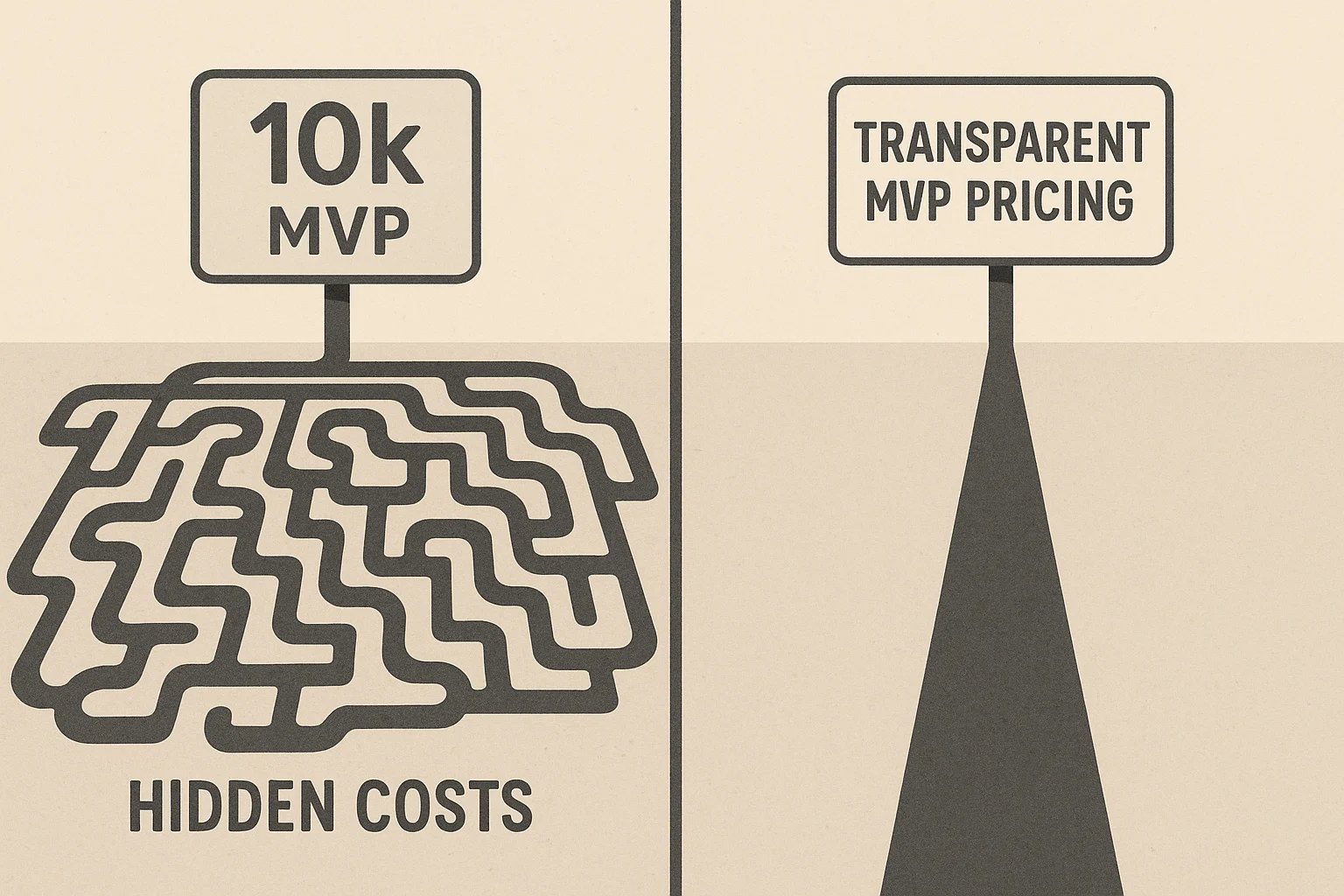
You've budgeted $10,000 to build your Minimum Viable Product (MVP), a smart starting point for validating your app idea. But what does that $10k really get you from a traditional agency? Often, it buys a vague scope, unexpected "required" add-ons, and frustrating delays that push you over budget and past your launch window. As explored in MVP Agency: Why The Typical $10k-$100k Cost & Vague Timelines Are A Trap, that initial quote is rarely the final price. We believe in a different approach. Instead of an ambiguous $10k project that can easily balloon to $15k or more, we offer a guaranteed, transparent alternative. Our fixed-price $4,990 MVP package delivers exactly what you need to launch in just weeks—with no hidden fees or surprise invoices. Let’s break down the true cost of a typical $10k MVP and show how our streamlined process provides launch certainty for a fraction of the price.
Decoding the $10k MVP Promise: Setting Realistic Expectations
The "$10,000 MVP" is a powerful promise. For many founders, it feels like the perfect, accessible entry point to bring an idea to life. But what does that figure truly get you? When you peel back the layers of a typical agency proposal, the picture often becomes less clear. To hit this attractive price point, significant compromises are almost always necessary, and the initial quote is rarely the final price. Be prepared for a product built on a foundation of trade-offs.
A standard $10k package often includes:
- A Hyper-Focused Feature Set: Expect one or two core user flows and basic user authentication. Anything more complex, like a robust admin dashboard, advanced analytics, or multiple third-party integrations, will be considered an "add-on."
- Template-Driven Design: Custom UI/UX is time-intensive. This budget typically covers a pre-built visual theme with your logo and brand colors, not a unique, user-tested interface designed from scratch.
- Minimal Quality Assurance (QA): Rigorous testing is one of the first things cut to reduce costs, leaving you to discover bugs after launch—when they’re most damaging to your reputation.
- Zero Post-Launch Support: The project often ends the day the code is delivered. Any bug fixes, server maintenance, or minor updates will require a new, separate budget.
The biggest risk isn't the features you don't get, but the uncertainty you buy into. The real cost hides in vague scope definitions that lead to unexpected invoices. To truly understand MVP costs and avoid the pitfalls of vague estimates, consider exploring resources like MVP Cost: Forget Vague Estimates, Here’s the Fixed Price to Launch in 14 Days.
Core Deliverables and Inherent Limitations for a $10k Budget
A $10,000 budget forces you to walk a tightrope, making critical trade-offs between essential features and a fixed price. To meet this number, development agencies must aggressively limit scope, often pushing crucial components into a "Phase 2" that you'll be pressured to fund later. You’re not buying a complete, market-ready product; you’re buying a starting point with significant compromises.
For a more transparent and cost-effective approach to launching a minimal viable product, consider exploring a detailed guide on options like a Fixed Price MVP for Startups: The Complete Guide to a $4,990, 14-Day Launch.
So, what does that starting point realistically look like in the typical $10,000 scenario? Here’s a typical breakdown of what you can expect to be included versus what is almost always an extra cost.
What's Typically Included:
- Basic UI/UX Design: Wireframes and a simple, often template-based, visual design.
- User Authentication: Standard login, registration, and password reset capabilities.
- One Core Feature Loop: The absolute minimum functionality to test your primary hypothesis (e.g., creating and viewing a post).
- Simple Database & Backend: The foundational structure to support that single core feature.
- Deployment to a Staging Server: A private environment for you to test the app.
What's Usually Left Out (The "Hidden" Costs):
- Third-Party Integrations: Payment gateways (Stripe), email services, or analytics.
- Admin Panel: A dashboard for you to manage users and content.
- Thorough QA Testing: Basic checks are done, but comprehensive bug hunting is rare.
- Production Deployment: The process of getting your app live for real users.
- Post-Launch Support: Any bug fixes or maintenance required after delivery.
This approach creates inherent risk. The features you assumed were standard become expensive add-ons, and the timeline for a truly market-ready product stretches indefinitely.
Technology Stacks and Development Approaches Suitable for a $10k MVP
For a $10k budget, the choice of technology is less about specific programming languages (like Python vs. JavaScript) and more about the development approach. Indeed, the very question of what constitutes a 'tech stack' for an MVP can be misleading; as one piece insightfully asks, The $5,000 MVP Tech Stack? You're Asking the Wrong Question.
The wrong approach can burn through your budget before you even have a testable product. The goal is maximum validation with minimum waste. You're not building a forever-product; you're building a learning-machine.
To achieve this, developers often use a mix of open-source frameworks, pre-built components, and rapid development platforms. This strategy focuses on speed and cost-effectiveness over building everything from scratch. Below is a breakdown of common approaches and their trade-offs for a lean MVP.
| Approach | Best For | Speed to Launch | Scalability | Key Trade-off |
|---|---|---|---|---|
| No-Code / Low-Code | Validating core logic & user flows with minimal features. | Fastest (Days to Weeks) | Low | Limited customization; potential vendor lock-in. |
| Template-Based | Apps with standard features (e.g., marketplaces, social). | Fast (Weeks) | Medium | Design is constrained; unique features are hard to add. |
| Lean Custom Code | Unique concepts requiring specific features or logic. | Moderate (1-2 Months) | High | High risk of scope creep and budget overruns. |
For a fixed budget, the most reliable path is one that minimizes unknowns. A lean custom code approach, while flexible, introduces significant risk of delays and hidden costs. The fastest and most certain path to launching a high-quality MVP within this budget involves leveraging pre-built, battle-tested systems and templates. This prioritizes getting your core idea into users' hands quickly, allowing you to validate your business assumptions without getting bogged down in a complex, expensive custom build.
The Essential Trade-offs: What You Must Sacrifice to Stay Within $10k
Hitting a $10k budget isn't about finding a cheap developer; it's about making strategic sacrifices. To validate your idea quickly, you must be ruthless in cutting scope. This isn't about building a weaker product, but a more focused one. Think of it as trading complexity now for market feedback sooner. If you're aiming for an even more aggressive budget, you might find valuable insights in resources like How to Get an MVP Built For Under $5000: The Guaranteed $4,990 Plan.
Here is the reality of what you must give up to stay on budget:
-
❌ Custom UI/UX Design
You'll forgo a pixel-perfect, branded design system created from scratch. This process involves weeks of wireframing, mockups, and custom front-end coding.
✅ Your Alternative: Leverage a clean, professional UI kit or template. This ensures a great-looking, intuitive user experience without the high cost and long timeline of bespoke design. -
❌ Multiple Platforms (Native iOS/Android)
Building and maintaining separate codebases for both Apple and Android is double the work and well outside a $10k scope.
✅ Your Alternative: Launch a responsive web application first. It works on any device with a browser, allowing you to reach the widest audience for initial validation. -
❌ "Nice-to-have" Features
Social logins, complex admin dashboards, multiple user roles, and in-app notifications must be cut.
✅ Your Alternative: Isolate the single, critical workflow that solves your user's core problem. Everything else is a distraction until you prove that people want your solution.
Unmasking the Hidden Costs: Fees Agencies Often Don't Mention (Pre-Launch)
That initial $10,000 quote can feel like a solid, all-inclusive number, but the reality is often different. Many hidden costs can inflate your budget before a single user ever logs in. These pre-launch fees are frequently bundled into vague "setup" charges or emerge as surprise invoices, eroding your capital and timeline. To truly understand The True Cost of an MVP: How to Eliminate Hidden Fees with a Fixed-Price Model and ensure your budget isn't eroded, as a non-technical founder, knowing what to ask about is your best defense.
An agency's initial quote rarely covers the full scope of pre-development work. Be prepared for costs that are considered "prerequisites" to the actual build. Before you sign a contract, demand clarity on these often-unmentioned expenses:
- Paid Discovery Workshops: Is the initial strategy and feature-mapping session included, or is it a separate, billable engagement costing thousands?
- Design & Asset Licensing: Who pays for the premium UI kits, stock photography, custom icons, or font licenses required to make your app look professional?
- Project Management Software: Will you be billed for user seats or access to the agency’s project management tools like Jira or Asana?
- Third-Party Service Setup: The quote may cover integrating a payment gateway like Stripe, but does it include the hours spent setting up the account, configuring security rules, and running initial tests?
- Initial Environment Configuration: The cost to set up and configure your cloud hosting environment (e.g., AWS, Heroku) is a common "extra."
A truly transparent development partner will have clear, upfront answers to these questions, ensuring your fixed price is truly fixed and your path to launch is certain.
Beyond the Build: Understanding Post-Launch Costs and Ongoing Expenses
Launching your MVP is the starting line, not the finish line. A common pitfall for founders is underestimating the recurring expenses required to keep the application running, secure, and ready for users. The initial build cost gets you in the game, but these ongoing costs are what keep you playing. For a comprehensive look at what to expect and to effectively demystify your overall MVP budget, including both upfront and recurring expenditures, check out 2025 MVP Costs: Demystifying Your Basic Minimum Viable Product Budget.
Be prepared for these essential post-launch expenses:
- Server & Database Hosting ($20 - $150+/month): Think of this as the digital rent for your app's home on the internet. Costs vary based on your traffic and data needs, scaling up as your user base grows. Services like AWS, Google Cloud, or Heroku are common choices.
- Third-Party API Subscriptions ($10 - $200+/month): Your app likely relies on external services for core functions like sending emails (SendGrid), processing payments (Stripe), or handling maps (Google Maps). Many offer a free tier, but you'll pay as your usage increases.
- Essential Maintenance & Bug Fixes (Varies): Software requires upkeep. This includes critical security patches, operating system updates, and fixing unexpected bugs that surface with real-world use. Without a plan, this can lead to surprise hourly bills.
- Domain Name & SSL Certificate ($15 - $75/year): These are your app's web address and the basic security padlock (HTTPS) that users expect. They are relatively small but mandatory annual costs.
Is Your $10k MVP Truly Valuable? Assessing ROI and Practicality
A $10,000 price tag feels substantial, but its value isn't guaranteed. As a founder, your primary goal isn't just to launch an app—it's to launch a learning machine. The true Return on Investment (ROI) for your first product is measured in validated feedback: are you solving a real problem people will pay for? The risk with a typical $10k MVP is that in trying to stretch the budget across too many features, you get a product that’s wide but shallow. It might technically work, but if it’s slow, buggy, or confusing, you won’t get the clear user data you need. You'll spend your entire budget and be left with ambiguous results, unsure if the idea failed or just the execution.
True value lies in speed and clarity. A practical MVP gets you a definitive answer from the market as quickly as possible, much like the focus on rapid, fixed-cost deployment seen in MVP Development For Startups: Launch in 14 Days for a Fixed $4,990.
Before committing your funds, use this checklist to assess whether your proposed build is a smart investment or just a costly experiment.
Value Assessment Checklist:
- Speed to Feedback: How many weeks until this is in a real user's hands? (Every extra week is a risk).
- Core Problem Focus: Does it solve one user problem exceptionally well, or many problems poorly?
- Technical Foundation: Is the codebase solid enough to build upon, or is it a dead-end "throwaway" build?
- User Experience: Is it intuitive enough to provide immediate value without a lengthy tutorial?
The Typical $10k MVP Scenario: A Realistic Timeline and Potential Delays
For a $10k budget, most agencies will quote an optimistic 6-8 week timeline. In reality, this is where a non-technical founder's budget and patience are most at risk. The initial plan rarely survives contact with the actual development process, which often unfolds with significant, unbudgeted delays.
Here’s where that 8-week timeline typically breaks down:
- Weeks 1-3: The Feedback Spiral. Initial designs and wireframes go back and forth. Without a rigid system for feedback, your valuable input can lead to scope creep and redesigns, pushing the coding start date back by weeks.
- Weeks 4-7: Development Hurdles. The agency’s developers, often juggling multiple projects, hit unforeseen technical snags. The "simple" feature you discussed turns out to be complex, or bugs from hastily written code require significant rework, creating a bottleneck.
- Weeks 8-10: User Acceptance Testing (UAT) Chaos. You get the first "finished" version, but it doesn't work as you envisioned. The subsequent bug-fixing and change requests add unplanned weeks to the project, eating into your launch window.
- Week 11+: Deployment Nightmares. The final hurdle—submitting to the App Stores or configuring servers—can bring its own set of rejections and technical issues that were never accounted for in the original quote.
What begins as a two-month sprint easily stretches into a four-month marathon, draining momentum and capital. The key takeaway is that without an ironclad, fixed-scope process, a predictable launch date at this price point is more of a hope than a guarantee. This highlights the crucial need for transparent and rapid development strategies, such as a Rapid App Development for Startups: The 14-Day, Fixed-Price Launch Plan, to avoid these common pitfalls.
A Transparent Alternative: The MVPExpert $4,990 Package – Guaranteed Value and Launch Certainty
After navigating the murky waters of typical development quotes, the idea of a $10k budget can feel like a gamble. Scope creep, hourly billing, and surprise invoices for "unforeseen complexities" often turn that initial estimate into a much larger financial commitment. This uncertainty is precisely what stalls great ideas.
But what if you could eliminate the risk entirely? Imagine a clear, all-inclusive package where the price is fixed and the deliverables are guaranteed from day one. This model is designed for one purpose: speed-to-validation. Instead of a vague estimate, you get a concrete plan. This kind of transparency is exemplified by services like Fixed-Price MVP Development: Launch Your App in 14 Days for $4,990.
Here’s what a truly transparent alternative typically includes:
- A Clickable, High-Fidelity Prototype: Finalize your vision before a single line of code is written.
- Core Feature Development: Includes user authentication, database setup, and the essential functionality to test your hypothesis.
- A Fully Deployed Application: Your MVP goes live on a secure server, ready for your first users.
- Guaranteed Launch Timeline: Go from concept to market-ready product in a matter of weeks, not months.
- Zero Hidden Fees: The price you agree to is the final price. Period.
This approach swaps financial guesswork for launch certainty. It’s not just about building an app; it’s about providing a reliable, risk-free path to get your business off the ground and in front of customers, giving you the concrete data needed for your next move.
Comparing Value: $10k Ambiguity vs. MVPExpert's Fixed-Price Certainty
When you have a $10,000 budget, the path you choose is critical. It's not just about the final product, but the journey to get there. While one route is based on vague estimates and hourly rates, often leading to unpredictability, the other offers a clear, predictable destination, such as with [Fixed Price MVP Development Packages: Your Predictable Path to Product Launch]. Let's break down the real-world value difference between these approaches.
Comparing a typical $10k project using hourly or estimated billing against a Fixed-Price MVP Package reveals stark differences: with hourly, final costs often exceed $10k, timelines are prone to delays and scope creep due to vague initial scopes, and the agency focuses on billing hours, leaving the founder with high financial risk. In contrast, a Fixed-Price MVP Package offers a guaranteed final price, a fixed delivery date for a fast launch with precisely defined core features, and a development team focused entirely on shipping your product, thereby shifting the financial risk from you to the development partner.
The perceived flexibility of an hourly-billed $10k project is often a trap for non-technical founders, creating a dynamic where you bear all the risk of delays and cost overruns; every 'small change' or unexpected bug inflates the final invoice and pushes back your launch. Conversely, a fixed-price package shifts the risk from you to the development partner, forcing discipline and ruthless prioritization on both sides and ensuring the focus remains squarely on the essential goal: launching a high-quality, core product on a predictable schedule and budget. This isn't about getting less; it's about getting exactly what you need—launch certainty—without the financial anxiety.
Choose Transparency and Guaranteed Value for Your MVP Launch
The allure of a $10,000 MVP is strong, but as this article on MVP Development Cost for Startups: The One Fixed Price You Need to Know explains, this figure often represents only the tip of the iceberg. As we've explored, the true cost extends far beyond the initial code, encompassing critical but frequently omitted expenses. These "hidden" fees—ranging from ongoing server maintenance and third-party API subscriptions to essential post-launch support and marketing—can quickly inflate your budget and jeopardize your project's viability.
Your next step is to approach agency proposals with informed scrutiny. Arm yourself with this knowledge and demand a transparent, line-item breakdown that accounts for the full product lifecycle, not just the launch. Ask pointed questions about ongoing operational costs and support plans. By looking beyond the sticker price, you can find a true development partner and build a financial roadmap that ensures your MVP doesn’t just launch, but thrives.
Tired of hidden fees and uncertain outcomes? Get transparent pricing and guaranteed value with our $4,990 MVP. Book your free project consultation today.

Børge Blikeng
AuthorHelping startups build successful MVPs for over 5 years