Updated Jan 2026 — for founders who need cost clarity before they burn runway on “estimates”.
TL;DR
- There’s no “average” MVP cost: scope + integrations + design + team model drive it.
- Hourly pricing = uncertainty: scope creep turns “estimates” into overruns.
- Best move: define a tight MVP scope, launch, then iterate based on real usage.
Decoding the MVP Cost Conundrum for Startups
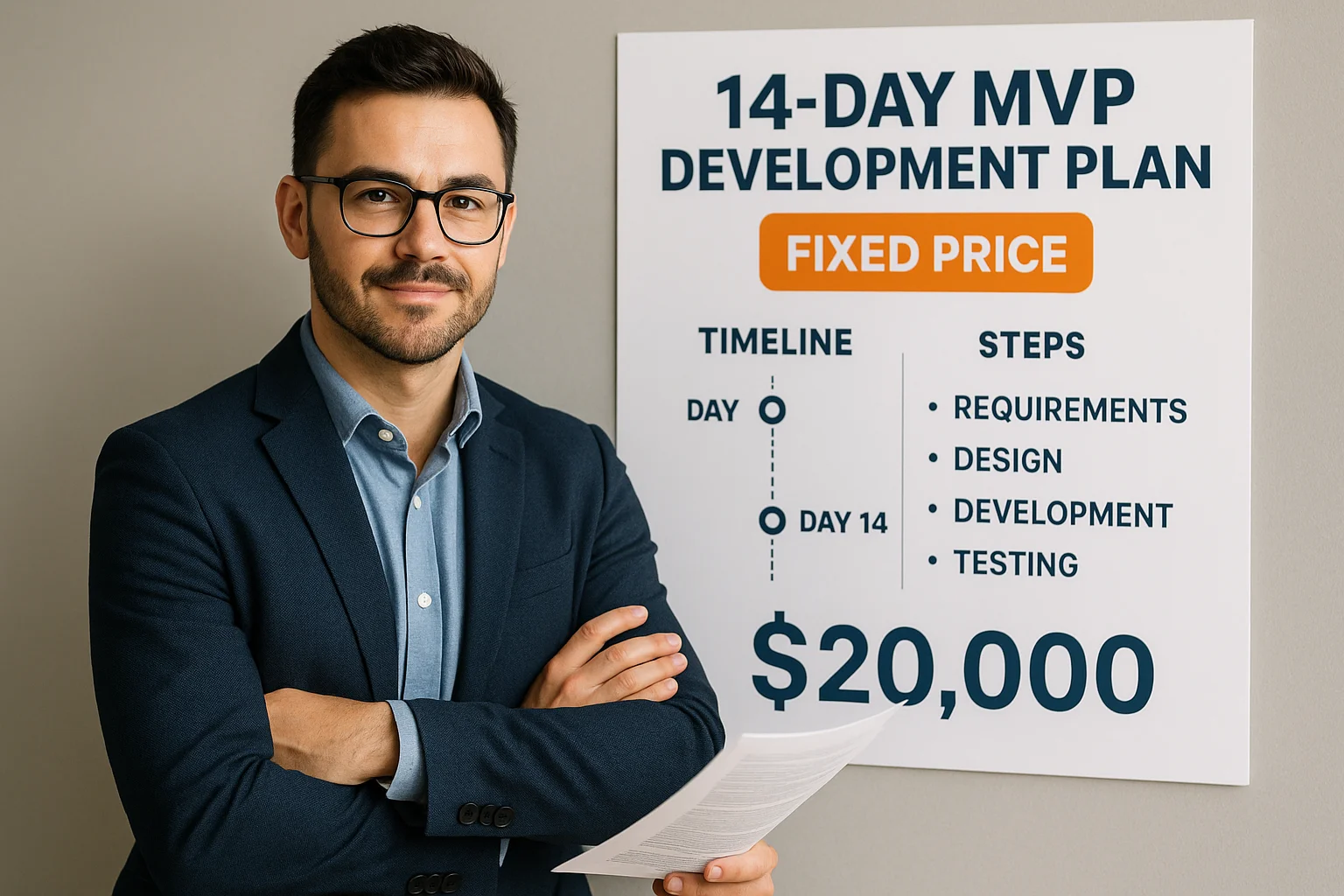
As a startup founder, you’ve asked the most critical early-stage question: "What will my MVP cost?" You've likely been met with a frustratingly wide range, from $10,000 to over $100,000, or a vague hourly rate that guarantees uncertainty. This isn't just unhelpful; it's a trap. Variable pricing models are a recipe for scope creep, blown budgets, and launch delays that can kill a venture before it even starts. Fortunately, there's a solution that cuts through the noise and provides the certainty you need: MVP Cost: Forget Vague Estimates, Here’s the Fixed Price to Launch in 14 Days. This fixed-price, 14-day MVP development model offers the absolute cost certainty and speed-to-market your new business requires to test its core idea and gather crucial user feedback.
The Elusive "Average Cost": Why a Single Number Doesn't Exist for MVP Development
If you’ve searched for the “average cost” of an MVP, you've likely found a dizzying range of figures, from a few thousand to over six figures. This isn't a lack of transparency; it's because a true "average" is a myth. Asking for the average MVP cost is like asking for the average cost of a building. Are we talking about a garden shed or a skyscraper? The components and purpose are fundamentally different. Similarly, every MVP is a unique combination of variables. The complexity of your core feature—is it a simple data display or a complex AI-powered recommendation engine? The level of design polish, the choice of technology, and the development team's location and experience all drastically impact the final price. A product requiring third-party integrations, secure payment processing, and a custom user interface will naturally cost more than a simple landing page with a form. This variability is the core problem with traditional development models. They force founders into a world of hourly rates and vague estimates, making financial planning feel like pure guesswork. The initial quote often becomes a starting point for budget overruns, introducing significant risk right when you can least afford it. This challenge is precisely why understanding the pitfalls is crucial, as highlighted in resources such as MVP Agency: Why The Typical $10k-$100k Cost & Vague Timelines Are A Trap. The elusive average cost isn't the real issue. The fundamental challenge is the uncertainty inherent in a pricing model based on endless variables. Startups don't need an average; they need certainty.
Unpacking the Variables: Key Factors That Drive MVP Development Costs Sky-High
Trying to budget for an MVP can feel like playing darts in the dark. The "it depends" answer from most development agencies is a red flag, signaling a journey into a maze of variables designed to inflate your final bill. The truth is, spiraling costs aren't random; they are a direct result of a fundamentally broken and unpredictable development model that often introduces hidden fees. The most notorious culprit is feature creep. What starts as a lean, focused product slowly bloats as "just one more thing" is added. Each seemingly small addition creates a domino effect, complicating the code, extending timelines, and draining your runway. Next is technical complexity and design. Over-engineering your first version with trendy but unnecessary technology or spending weeks on pixel-perfect designs that your first users won't notice are common traps. This premature optimization serves developer curiosity more than your business goals. Finally, the traditional hourly billing model itself is the biggest variable. When you pay for time instead of a defined outcome, there is little incentive for speed. Every meeting, every delay, and every revision directly adds to a bill with no ceiling. These factors aren't just line items; they are symptoms of a system that favors ambiguity over certainty, leaving you to carry all the financial risk. To truly eliminate these hidden fees and gain certainty, exploring alternative models like a fixed-price approach is crucial. For a deeper dive into understanding these challenges and how to overcome them, read The True Cost of an MVP: How to Eliminate Hidden Fees with a Fixed-Price Model.
The Problem with Ambiguity: How Variable Pricing Leaves Startups in the Dark
Ask ten development agencies for an MVP quote, and you'll likely get ten wildly different answers, often presented as a massive range from $10,000 to over $100,000. This isn't transparency; it’s a trap. This variable pricing model, typically based on hourly rates or vague project estimates, is fundamentally flawed for early-stage startups. It creates a dynamic where your budget is constantly at risk. Every new feature idea, every minor pivot, and every unexpected technical hurdle translates directly into more billable hours and a higher final cost.
This ambiguity forces you to gamble with your most critical resource: your runway. The incentive for the development partner becomes misaligned with yours; the longer the project takes, the more they get paid. You're left managing a moving target, trying to forecast costs that can spiral with any deviation from an initial, often incomplete, plan. This isn't just a financial risk—it's a strategic one. Delays caused by budget renegotiations and scope creep mean your competitors are gaining ground while you're stuck in development limbo.
Founders need certainty and speed, not a financial partnership that feels like a blank check. Your initial product launch shouldn't be a leap of faith into a financial black hole. There is a more predictable, disciplined approach to getting your MVP to market without the guesswork.
Navigating the Landscape: Different MVP Development Approaches and Their Hidden Costs
When building an MVP, founders typically weigh three paths: hiring freelancers, building an in-house team, or partnering with a development agency. Each comes with significant hidden costs that go far beyond the initial quote.
Freelancers may seem like the most affordable route, but the true cost lies in your time. The hours spent managing disparate individuals, bridging communication gaps, and the ever-present risk of a key developer disappearing can derail your project, turning a low initial price into a costly, delayed launch.
An in-house team offers control but comes with immense, slow-burning expenses. Beyond hefty salaries and benefits, you'll spend months and thousands on recruitment before a single feature is built. This is a massive, long-term financial commitment to an idea that has yet to be validated by the market.
Traditional agencies often operate on hourly rates, a model that can incentivize delay. What starts as a reasonable estimate frequently balloons due to "scope creep," extended timelines, and endless revision cycles. Their success becomes tied to billable hours, not your launch speed.
The common flaw in these approaches is crippling uncertainty. For a startup, this unpredictability is the real enemy. The most expensive path is the one that wastes months of market opportunity. The smartest approach is one that eliminates this risk by providing absolute certainty on both your timeline and your financial investment.
Beyond Budget Cuts: Conventional Strategies for Reducing MVP Costs and Their Limitations
When looking to lower the initial price tag of an MVP, many startups turn to a familiar playbook of cost-cutting tactics. The conventional wisdom often involves hiring freelance developers, opting for a cheaper junior team, or outsourcing to the lowest-bidding overseas agency. Some even turn to no-code platforms, hoping to bypass development costs entirely. While these approaches can reduce the initial invoice, they almost always introduce hidden costs that sabotage your launch. For a deeper dive into understanding and demystifying the budget for your basic Minimum Viable Product, it's worth exploring resources like 2025 MVP Costs: Demystifying Your Basic Minimum Viable Product Budget.
Managing a fragmented team of freelancers consumes a founder’s most valuable asset: time. Relying on junior talent can lead to a slow, buggy product that requires constant supervision and future rework. Similarly, the cheapest outsourcing options often result in communication breakdowns, endless revisions, and missed deadlines that erode your first-mover advantage.
Even no-code tools, while great for simple prototypes, have a critical limitation: they don’t scale. Once your product gains traction and requires custom features, you’re forced into a costly and time-consuming rebuild from scratch.
Each of these strategies trades a clear upfront cost for unpredictable risks and delays. They create a false economy, where you save money now only to pay for it later in lost momentum, market opportunity, and a flawed product that fails to impress early users.
The Search for Certainty: Why Startups Deserve a Predictable MVP Investment
For a startup founder, the MVP development process can feel like a high-stakes guessing game. You’re told the cost “depends” on a dozen variables, and you’re presented with hourly rates or vague estimates that leave your budget dangerously exposed. This uncertainty is more than just inconvenient—it's a direct threat to your runway. When your financial commitment is a moving target, every small change or unforeseen delay risks turning your investment into a black hole. This traditional, variable-cost model is fundamentally misaligned with a startup's needs. It incentivizes delays and rewards inefficiency, placing all the financial risk squarely on your shoulders. You are forced to spend precious time managing budgets and worrying about scope creep instead of focusing on product strategy and customer feedback. Your first major business decision shouldn’t be a gamble; it should be a calculated, fixed investment. For entrepreneurs seeking a clearer, de-risked approach, Fixed Price MVP Development Packages: Your Predictable Path to Product Launch offer a tangible solution. Knowing the exact cost and timeline upfront transforms your MVP from a liability into a strategic asset. This financial clarity allows you to de-risk the entire venture, preserve capital for marketing and growth, and plan your next steps with confidence. True innovation requires a stable foundation, and for a startup, that foundation begins with a predictable, guaranteed cost to get your product to market.
Introducing the Solution: Our Fixed-Price, 14-Day MVP Promise
Tired of the “it depends” answer? The endless variables and hourly rates that make budgeting for your MVP feel like a high-stakes gamble are part of a broken model. This financial uncertainty doesn’t just strain your runway; it paralyzes decision-making and delays your launch. It’s time to move past the guesswork and embrace absolute clarity. Imagine knowing the exact cost and launch date of your MVP before a single line of code is written. We've engineered a development approach that delivers precisely that: a fully functional, market-ready MVP for one fixed price, delivered in just 14 days. This isn't about cutting corners; it's about surgical precision. To understand how we achieve this, explore our insights on Fixed Price MVP: The Guaranteed 14-Day Path to Launch Your App. This model provides the ultimate cost predictability, allowing you to allocate resources with confidence and eliminate the fear of surprise invoices or budget spirals. This disciplined, time-boxed process forces ruthless prioritization, ensuring your product is built around the single most critical feature that solves your core user problem. You get a high-quality, focused product into the hands of real users faster than traditional agencies can schedule a kickoff meeting. It’s the smartest way to de-risk your venture, accelerate your learning, and trade financial anxiety for the strategic advantage of speed and certainty.
What Our Fixed-Price MVP Includes (and What It Doesn't): Setting Clear Expectations
Forget vague estimates and the risk of ballooning budgets. The power of a fixed-price model lies in its absolute clarity, allowing you to focus on your business, not on tracking developer hours. This clear approach is key to how we Define MVP Scope for a Fixed Price: The Guaranteed 14-Day Launch Plan and guarantee a rapid launch. Our fixed-price engagement delivers a complete, market-ready web application designed to validate your core business hypothesis. This includes the essential user journey—from user authentication (signup/login) to performing the key action that provides value. We build a clean, intuitive user interface on a scalable foundation and deploy it to a live server. You receive a tangible, working product that real customers can use, not just a set of wireframes or a clunky prototype. This is the leanest version of your vision, built to gather real-world feedback immediately. To achieve this speed and certainty, we are disciplined about what we exclude. This isn't the phase for 'nice-to-have' features, complex third-party integrations, or building separate native mobile apps for iOS and Android. The goal is to eliminate scope creep and focus ruthlessly on the single most important function of your product. This strategic limitation isn't a drawback; it's our core strength. It’s how we get you from idea to validated learning in the fastest, most capital-efficient way possible.
Beyond Launch: Essential Post-MVP Development Costs Every Startup Must Plan For
Launching your MVP is a monumental achievement, but it’s the starting line, not the finish. A common pitfall for startups is failing to budget for what comes next. Post-launch expenses are not optional; they are the engine for growth and must be planned for with the same diligence as the initial build. First, consider the recurring operational costs. This includes server and infrastructure hosting on platforms like AWS or Google Cloud, which scales with user traffic. You’ll also have monthly subscriptions for essential third-party services—payment gateways, analytics tools, and marketing automation APIs. More significantly, your budget must cover continuous development. The “P” in MVP stands for Product, and products require constant care. This means allocating resources for inevitable bug fixes and performance maintenance to keep users happy. But the largest post-launch investment is iteration. The core purpose of your MVP is to generate user feedback, which then fuels the development of new features and improvements. This is where an uncertain, lengthy initial build becomes a liability, eating into the capital you desperately need for this crucial learning and growth phase. By launching a lean, focused product quickly, you ensure your post-launch development spend is guided by real data, turning unpredictable costs into a predictable roadmap for success. For a comprehensive guide on navigating this critical phase and understanding how to effectively move beyond your initial product, explore resources like Beyond the MVP: A Founder's Roadmap to Scaling and Iteration.
Your Path to a Predictable MVP and Sustainable Growth
While the idea of a single, fixed price for MVP development is an attractive starting point, the true takeaway is that the cost is a dynamic range, not a static number. The final investment is shaped by your project's unique variables: the complexity of its core features, the composition and location of your development team, and the technology stack you choose. The only "fixed price you need to know" is the one tailored specifically to your well-defined scope.
Therefore, your immediate next step isn't to search for a universal cost, but to meticulously outline your MVP's essential functions. By prioritizing must-have features, you can create a clear project brief. With this in hand, you can confidently engage with a development partner to secure a precise, actionable estimate that transforms your vision into a viable product with a predictable budget.
Eliminate the stress of variable pricing and secure your predictable MVP with our fixed-price, 14-day solution. Book your free project consultation today.

Børge Blikeng
AuthorHelping startups build successful MVPs for over 5 years