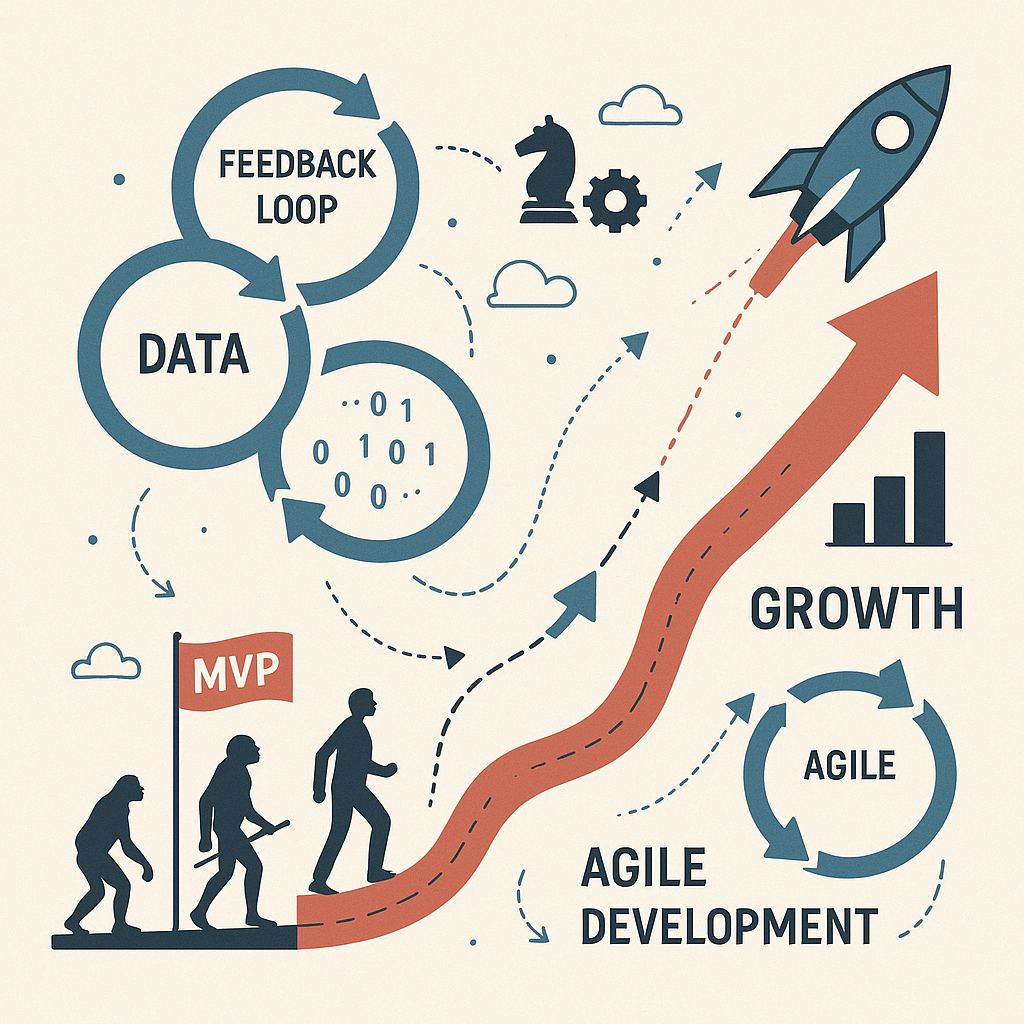
TL;DR: What to do after your MVP launches
- Validate product-market fit signals (retention + “must-have” interviews)
- Build a feedback loop (qual + quant)
- Prioritize with data (avoid feature-bloat)
- Scale the team and infrastructure when the numbers justify it
Validating and Deepening Product-Market Fit
Congratulations, your MVP is live! You launched in 14 days, not 14 months, which means you’re already ahead of the curve. Now, the real work begins: transforming that initial traction into true product-market fit (PMF). This phase is a delicate dance between two types of crucial feedback: quantitative and qualitative.
Your analytics dashboard provides the “what.” Track hard metrics like user retention, activation rates (are users completing the core action?), and early churn. Are people sticking around after day one? This data is the unfiltered truth of user behavior and tells you if the core loop is compelling.
However, data can't tell you the “why.” This is where you must get out of the building. Actively interview your early adopters. Ask open-ended questions: “What problem were you trying to solve when you found us?” or Sean Ellis’s famous question: “How would you feel if you could no longer use our product?” Listen for emotion and urgency. Strong PMF isn't just usage; it's dependence. When users describe your product as a “must-have” and their feedback aligns with your retention data, you’ve found the signal. This validated learning is your roadmap for the next iteration, ensuring you scale features that users genuinely need and love.
Establishing Robust Customer Feedback Loops
Your MVP is live—congratulations! You’ve successfully escaped the endless development cycle. But the launch isn't the finish line; it's the starting pistol for the most critical race: the race for user insight. This is where robust customer feedback loops come in. They are your direct line to reality, transforming your MVP from a static product into a dynamic, evolving solution that truly serves your market.
Move beyond a simple "Contact Us" form. A powerful feedback system integrates multiple channels to capture the full picture. Combine qualitative methods like direct user interviews, in-app pop-up surveys (using tools like Hotjar or Userback), and community forums with quantitative data from analytics platforms and user behavior tracking. Analyze support tickets not just as problems to solve, but as a goldmine of usability friction points.
The key is the "loop": collect feedback, analyze it for patterns, prioritize it against your business goals, build the necessary iterations, and—crucially—communicate those updates back to your users. This disciplined process prevents feature bloat and ensures your roadmap is dictated by genuine user needs, not founder assumptions. It’s the engine that powers intelligent scaling and keeps you building what people will actually pay for.
Data-Driven Prioritization for Feature Development
Your MVP is live—congratulations! Now, the real work begins. You're flooded with user feedback, feature requests are piling up, and your own list of "nice-to-haves" is growing. The temptation to act on every piece of feedback is immense, but this is precisely the path that leads back to the endless development cycle and wasted resources your MVP was designed to avoid.
The antidote is a ruthless commitment to data. Your MVP’s primary job wasn't just to exist; it was to become a data-generation engine. To prioritize effectively, you must blend two types of insights:
- Quantitative Data (The "What"): Use analytics to see what users are actually doing. Track feature adoption rates, identify drop-off points in user funnels, and monitor engagement metrics.
- Qualitative Data (The "Why"): Go beyond the numbers. Conduct user interviews, analyze support tickets, and read survey responses to understand the context and motivation behind user actions.
By combining these insights, you can move from a "gut-feel" roadmap to a strategic one. Use a simple framework like RICE (Reach, Impact, Confidence, Effort) to score potential features. This data-first approach ensures you continue the lean principles of your launch, focusing development power only on what demonstrably moves the needle for your users and your business.
Mastering Iterative Development Cycles and Sprints
Your MVP launch wasn't the finish line; it was the starting gun. The same discipline that took you from idea to production-ready in 14 days is your greatest asset for scaling. This is the essence of iterative development: a continuous loop of building small, targeted improvements, measuring their impact with real user data, and learning what to build next.
Treat your post-launch development like a series of mini-sprints, typically one to two weeks long. Each sprint should have a single, clear goal derived directly from your first users' feedback. Is everyone asking for a new filter option? Make that your next sprint. Are users confused by the onboarding flow? Dedicate a sprint to simplifying it. This approach keeps your momentum high and your focus sharp.
This Agile methodology is your best defense against the "endless development cycle" and scope creep that bankrupts promising startups. By focusing on one high-impact feature at a time, you ensure every dollar and development hour is spent building what your customers actually want, not what you think they want. It’s how you evolve your lean MVP into a robust, market-leading product without losing your financial or strategic footing.
Building a Scalable Technical Infrastructure
A common fear for founders is that an MVP built for speed will crumble under the weight of success. The "move fast and break things" mantra often leads to significant technical debt, forcing a costly and time-consuming rewrite just as the business gains traction. At MVPExpert, we build with the future in mind, ensuring your initial investment becomes the foundation for growth, not a disposable prototype.
Our choice of a modern, serverless-oriented tech stack is deliberate. We leverage frameworks like Next.js and platforms like Supabase precisely because they are designed for scale. Next.js provides exceptional performance and SEO benefits from the start, handling increased traffic with powerful server-side rendering and static generation. Supabase offers a robust backend-as-a-service, meaning your database, authentication, and serverless functions can scale automatically without you needing to manage complex server infrastructure.
This architecture isn't just about launching fast; it’s about growing smart. As you gather user feedback and are ready to iterate, you can build new features on this solid, modular foundation. You avoid the dreaded "re-platforming" project that stalls momentum and drains capital. Your roadmap can focus on adding value to your users, confident that the technical groundwork can handle the growth to come.
Strategic Team Expansion and Culture Cultivation
You launched your MVP by ruthlessly prioritizing what matters. Apply that same lean, strategic discipline to growing your team. Resisting the urge to hire too quickly is your next big test. Just as you avoided the "endless development cycle" for your product, you must now avoid creating a bloated payroll that drains your runway before you’ve validated your growth path. Don't hire for roles you might need in a year; hire for the problems you need to solve right now.
Initially, focus on bringing in versatile, T-shaped individuals. These are resourceful generalists with deep expertise in one area (like marketing) but the agility to contribute across others (like customer support). Your first key hires should be obsessed with closing the feedback loop—think customer success, community management, or a data-savvy marketer. Their mission is to amplify the user's voice, providing the critical data needed to guide your next development sprint and prove market demand.
This philosophy is the bedrock of your company culture. Culture isn't about office perks; it’s the shared operating system for your team. From day one, build a culture rooted in the principles of your MVP: a bias for action, data-driven decision-making, and intense customer-centricity. Foster radical transparency by sharing key metrics, roadmap decisions, and learnings openly. By embedding the ethos of speed and validation into your organizational DNA, you create a team built for efficient, sustainable scaling.
Financial Planning for Sustained Growth
You’ve successfully launched your MVP, sidestepping the spiraling budgets and endless timelines that sink most startups. Securing your launch with a fixed-price build was your first major financial victory, but the fiscal discipline can’t stop there. As you move beyond the initial product, your financial strategy must evolve from a one-time build cost to a dynamic plan for sustainable operations.
Your focus now shifts to unit economics. The most critical questions are no longer about development features, but about business viability: What is your Customer Acquisition Cost (CAC)? How much is a user worth over their Lifetime (LTV)? Answering these will dictate your marketing spend and prove your business model.
Your new budget must account for recurring operational expenses: marketing campaigns, scalable hosting, customer support, and essential software subscriptions. Crucially, you also need to earmark funds for iteration. The data and feedback you’re collecting are worthless without the capital to act on them. Create a clear cash flow forecast to understand your runway—how many months you can operate before needing more funding. Applying the same lean, no-waste principles that guided your MVP development to your financial management is the key to converting a successful launch into a scalable business.
Scaling Marketing and Sales Strategies
You launched your MVP in 14 days by focusing on the essential; your marketing and sales efforts should begin with the same lean-sprint mentality. Just as you avoided building features no one wants, you must now avoid spending on channels that don’t deliver. Your first users aren't just validation—they're your go-to-market roadmap.
Start by analyzing your early adopters. Where did they come from? What messaging resonated? This data is your goldmine. Instead of a wide, expensive marketing blitz, run targeted "Marketing Sprints." Dedicate a small, fixed budget and a two-week timeline to test a single channel—whether it’s targeted LinkedIn outreach, a niche Google Ads campaign, or founder-led content on a specific platform.
Measure everything. The goal isn't just leads; it's learning. A campaign that fails but reveals your target audience uses different keywords is a win. This creates a powerful feedback loop where marketing insights and sales conversations directly inform your next product iteration. Once you identify a channel that provides a repeatable, scalable source of customers, double down. This iterative approach ensures your growth engine is built on validated results, not expensive guesswork, mirroring the very principles that got your MVP to market.
Monitoring Key Performance Indicators (KPIs) Beyond Vanity Metrics
Congratulations, your MVP is live! The initial surge of sign-ups and social media mentions is exhilarating. But these are often vanity metrics—numbers that feel good but don’t guide your next steps. At MVPExpert, we build your product in 14 days to quickly answer one core question: are you solving a real problem for a specific audience? To find the answer, you need to track KPIs that measure genuine user engagement and business viability.
Ditch the raw download counts and focus on these actionable metrics:
- Activation Rate: What percentage of new users complete a key action that exposes them to your product's core value (e.g., creating their first project, sending their first message)? This proves they "get it."
- User Retention: Are users coming back? Tracking weekly or monthly cohorts is the ultimate test of product stickiness. A high retention rate shows you've built something valuable, not just novel.
- Feature Adoption Rate: Which parts of your lean MVP are getting the most use? This data is gold, telling you exactly where to double down and what to build next, preventing wasted development cycles.
Shifting your focus from "How many users did we get?" to "What are our users actually doing?" is the critical transition from launching an MVP to building a scalable business. This data-driven approach is your roadmap, ensuring every iteration is a strategic step forward, not a guess in the dark.
Navigating Potential Pivots and Adaptations
One of the most powerful—and often feared—concepts in the startup world is the pivot. But a pivot isn't a sign of failure; it's a mark of a founder who listens. Your MVP's primary job is to be a data-gathering machine. The feedback, analytics, and user behavior you collect are the raw materials for your next move, which may be a slight adaptation or a complete directional change.
This is where launching a lean, production-ready MVP in just 14 days becomes a strategic masterstroke. If you spend six months and a fortune building your initial vision, a necessary pivot can feel like a catastrophe due to immense sunk costs. But when you get to market for a fixed price of $4,990, you gain the agility to adapt without breaking the bank. The data might reveal a new target audience, an unexpected killer feature, or the need to simplify even further.
Because your MVPExpert build is production-ready on a modern stack (Next.js, Supabase), it serves as a solid foundation, not a throwaway prototype. You can iterate or pivot from a position of strength. Embrace this feedback loop. A pivot isn’t a detour from your roadmap; it’s the most direct path to genuine product-market fit, guided by real-world evidence instead of assumptions.
Conclusion
Conclusion: The Continuous Journey of Evolution
Ready to build your MVP the right way? Book your free project consultation today.

Børge Blikeng
AuthorHelping startups build successful MVPs for over 5 years