MVP vs. Prototype vs. Proof of Concept: Key Differences & How to Choose
Introduction: Navigating the Product Development Landscape
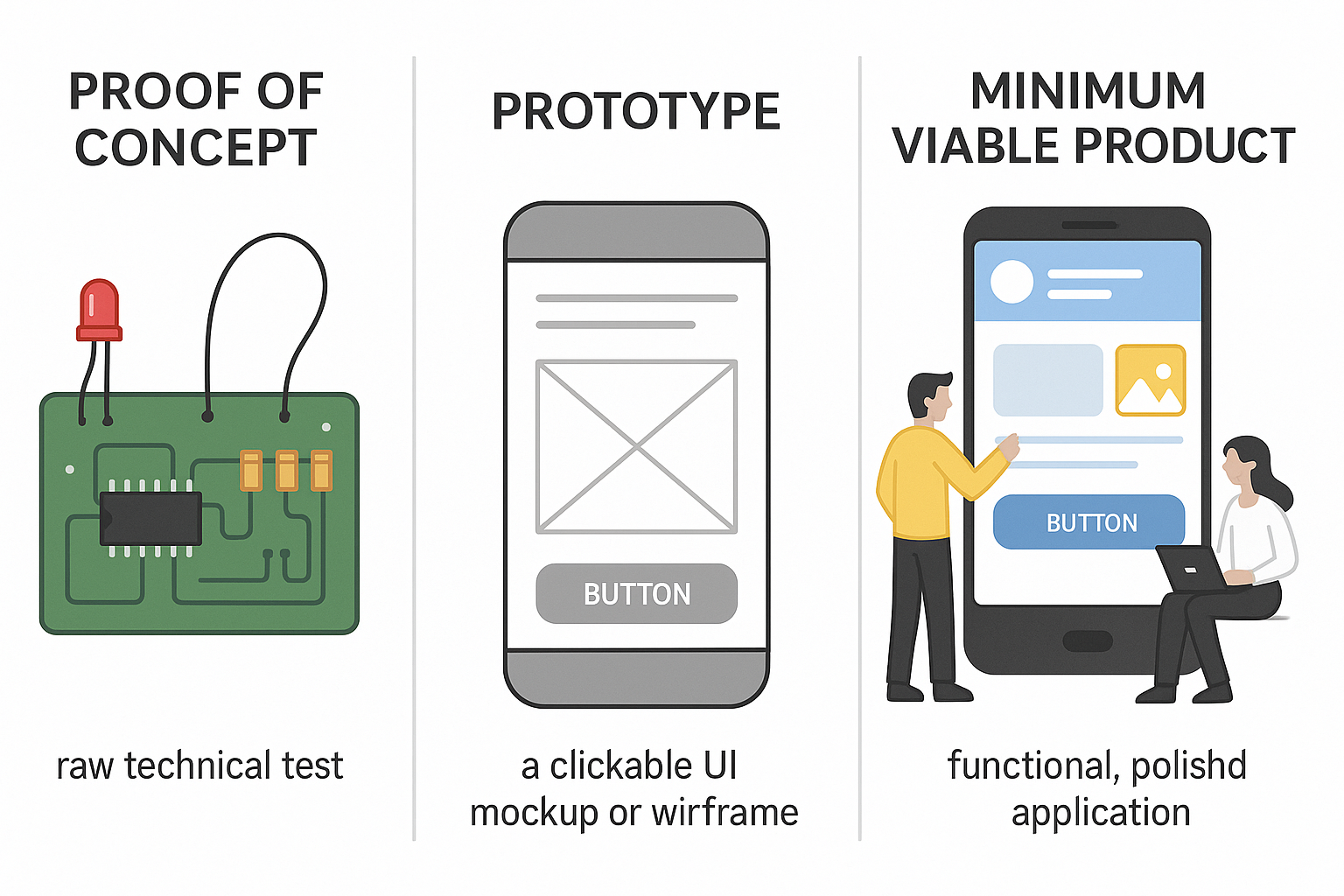
What is a Proof of Concept (PoC)? Validating Feasibility
A Proof of Concept (PoC) is a small, internal exercise designed to answer one critical question: "Is this core idea technically feasible?" Its sole purpose is to validate a key technical assumption before you invest significant time and capital. A PoC isn’t for users; it’s for your own certainty.
Think of it as a targeted reality check. For example, if your app idea relies on a novel real-time video processing algorithm, a PoC would be a raw, scrappy implementation that proves the algorithm can function as expected. It would have no user interface, no login system, and no polished design—it just validates that the technical magic is possible.
The danger with a PoC is scope creep. Many teams make the mistake of letting a successful PoC "evolve" into the product itself. This is a classic path to the endless development cycle, where a quick test mutates into a slow, costly, and directionless project.
An effective PoC must be ruthlessly focused. It isolates the single greatest technical risk and aims for a quick "yes" or "no" answer. Once you have that "yes," you’ve retired a major unknown. The next step is not to build upon the PoC's disposable code, but to take that validated learning and move with deliberate speed toward building an MVP that can actually test your business model with real users.
What is a Prototype? Visualizing and Testing Design
While a PoC validates technical feasibility, a prototype validates the user experience. It’s a visual, often interactive, representation of your product's design and flow. Think of it as a high-fidelity, clickable mockup that feels like a real app but has no working backend code. The primary question it answers is not "Can we build this?" but "Is this design intuitive and usable?"
This step is crucial for de-risking your user interface. By putting a tangible design in front of potential users early, you can gather immediate feedback on navigation, layout, and overall feel. This is a fast, low-cost way to iterate on the user journey before a single line of code is written, saving you from building a functional product that no one can figure out how to use.
The danger, however, is getting stuck in the "perfect prototype" trap. Founders often burn weeks or even months endlessly tweaking pixels and perfecting animations, delaying the moment of truth. A prototype's job is to be "good enough" to validate your core design assumptions. Once it confirms your UI is on the right track, you must move with urgency. The goal isn't to create a flawless simulation; it's to get the clarity needed to build a real product that can test your business model in the market.
What is a Minimum Viable Product (MVP)? Launching with Core Value
An MVP is the most misunderstood—and powerful—concept for founders. It’s not a buggy, half-finished app. It is the simplest, real version of your product that you can launch to deliver core value to your first set of users.
The key word here is Viable. The product must be functional, reliable, and solve a genuine, painful problem for your target audience. It must provide enough value that people are willing to use it (and often, pay for it). This is your first and best defense against building something nobody wants.
The second key word is Minimum. This requires ruthless discipline. Most startups fail here, getting trapped in the "endless development cycle" by adding features that seem important but aren't essential for initial validation. An MVP forces you to answer the question: "What is the absolute smallest set of features we need to launch and start learning?"
The goal isn't perfection; it's momentum. By launching a lean, focused product quickly, you replace months of internal speculation with invaluable market feedback. You get your idea into the world and start iterating based on what real users do, not what you think they’ll do.
Key Differences: Core Purpose & Goals
While these terms are often used interchangeably, their objectives are fundamentally different. Choosing the right one at the right time is the first step in avoiding the costly delays that sink promising ideas.
-
Proof of Concept (PoC): The goal is purely internal and technical. A PoC asks one simple question: “Can we build this?” It’s a small, private experiment designed to verify that a core function is technically feasible before you invest further. It is not a product and is never meant for users.
-
Prototype: The goal is to explore and visualize user experience. A prototype asks, “How will this work?” It’s a tangible mockup—from simple wireframes to clickable designs—used to test usability and gather feedback on the product’s flow and feel. However, a prototype is a simulation; it can't validate market demand, and spending months perfecting it is a common trap.
-
Minimum Viable Product (MVP): The goal is to learn from the market. An MVP asks the ultimate question: “Should we build this?” It is a real, launch-ready product with the absolute minimum set of features needed to solve a core problem for early adopters. Its purpose isn't perfection; it's speed. By launching quickly, you get crucial, real-world data to validate your business model while competitors are still stuck in meetings.
Key Differences: Scope, Functionality & Polish
Understanding the distinction between these three concepts is critical to avoid wasting time and money. The differences lie in their purpose, which dictates their scope, functionality, and level of finish.
A Proof of Concept (PoC) has the narrowest scope. Its sole purpose is to answer a single, critical question: "Is this technically feasible?" It has almost no user-facing functionality and zero polish. Think of it as a small, internal experiment that gets thrown away once the question is answered.
A Prototype expands the scope to the user experience. It's a visual, often clickable mockup that answers, "How would a user interact with this?" Its functionality is simulated—it looks and feels like a real app but has no working backend. The polish is typically high enough to conduct realistic user testing, but it remains a tool for gathering opinions, not a real product.
A Minimum Viable Product (MVP) makes the crucial leap from hypothesis to reality. Its scope is defined by ruthless prioritization—it includes only the core features necessary to solve a primary problem for early adopters. The key difference is its functionality: an MVP is a working, production-ready application that real customers can use. While it intentionally lacks bells and whistles, its core features must be reliable and polished. An MVP isn't about building a perfect product; it's about launching a viable one quickly to get real-world data and escape the endless development cycle that kills promising ideas.
Key Differences: Target Audience & Feedback Loops
Understanding who you're building for at each stage is critical. Confusing these audiences is a classic mistake that leads to wasted time and money.
-
Proof of Concept (PoC): The audience is purely internal—your technical team, co-founders, or investors. The feedback is a simple binary: a "yes" or "no" on technical feasibility. You're not asking if users like it; you're asking, "Can we even build the core function?"
-
Prototype: The audience expands slightly to a small, controlled group of potential users or stakeholders. The goal here is to gather qualitative feedback on usability and flow. You’re answering, "Is the user experience intuitive?" This is valuable, but it’s still happening in a bubble, not the real world.
-
Minimum Viable Product (MVP): This is the turning point. The audience for an MVP is the real market—your first cohort of early adopters. The feedback loop is no longer about opinions; it's about behavior. Are people signing up? Are they using the core feature? Are they willing to pay? An MVP is designed to escape the echo chamber and answer the only question that truly matters for survival: "Should we have built this at all?" This is where speed is a decisive advantage, allowing you to get validated learnings from the market while competitors are still debating features.
Key Differences: Resources (Time & Cost) & Lifespan
Understanding the resource commitment for each stage is crucial for founders. This is where great ideas often get derailed by budget overruns and indefinite timelines.
-
Proof of Concept (PoC): The fastest and cheapest. You’re looking at days or a couple of weeks and minimal cost. Its lifespan is temporary; once it proves a core function is viable, its job is done. It's an internal tool, not a product.
-
Prototype: Requires more time and design resources than a PoC, often taking a few weeks. While more expensive, it's a visual and interactive mockup, not a functional application. Like a PoC, it's disposable—a tool for gathering feedback before committing to code.
-
Minimum Viable Product (MVP): This is where budgets and timelines can spiral out of control. Many founders fall into the trap of an "endless development cycle." However, a disciplined MVP should be a focused sprint, not a marathon. We're talking weeks, not months. This speed is achieved through ruthless prioritization of core features, which provides crucial cost certainty. Unlike the others, an MVP is not disposable. It is the first, live version of your product, designed to be scaled and improved upon with real user data.
When to Choose a Proof of Concept (PoC)
A Proof of Concept is not a product; it’s an answer to a single question: “Is this technically feasible?” Choose a PoC only when your idea hinges on a genuine, high-risk technical unknown that could derail the entire project. Think of a novel algorithm, a complex third-party integration that has never been done before, or a unique hardware interaction.
The deliverable for a PoC is simple: a "yes" or "no" on technical viability. It’s an internal experiment, often just a few lines of code, with no user interface or design considerations.
Here’s the founder’s trap: many waste months and significant capital building a PoC for a problem that is already technically solved. This is a dangerous form of "productive procrastination." It creates the illusion of progress while actively delaying the one thing that matters: validating your idea with real users.
Before you commit to a PoC, be ruthlessly honest. Is your primary risk technical, or is it market acceptance? For the vast majority of app ideas, the technology is the easy part. The real challenge is finding customers. If you don't face a truly unprecedented technical barrier, investing time in a PoC is a strategic error. You should be racing to get a functional product into the market, not getting stuck in a lab.
When to Choose a Prototype
A prototype is your first line of defense against building a product nobody wants. Its purpose isn't to work; it's to feel real. Choose a prototype when your primary goal is to test the user experience (UX) and gather feedback on the core user journey before committing to development.
This is the stage for answering critical questions: Is the navigation intuitive? Does the workflow make sense? Can users accomplish the main task easily? A clickable prototype, built with tools like Figma or Adobe XD, provides tangible answers by letting potential users, stakeholders, and investors interact with your vision.
Think of it as a strategic insurance policy. Spending a week on a prototype to refine your core concept can save you from months of wasted development and a spiraling budget. It forces you to make ruthless prioritization decisions early, clarifying requirements before a single line of code is written. This act of visualizing the essential features prevents the costly scope creep that plagues so many projects. It’s the fastest way to get feedback on your idea so you can move forward to building your product with confidence and speed.
When to Choose a Minimum Viable Product (MVP)
An MVP is your first real-world experiment. You choose this path when you've moved beyond theoretical validation (the job of a PoC or prototype) and are ready to test your core business hypothesis with actual users. This is the critical moment to stop speculating and start learning.
Think of an MVP not as a smaller version of your final product, but as a strategic tool built to answer one question: "Will people use and pay for this solution?" It requires ruthless prioritization, focusing only on the essential features that solve a single, high-value problem for your target audience. Anything else is a distraction that costs you time and money.
Opt for an MVP when your primary goal is to:
- Validate your business model in a live market environment.
- Gather actionable data on user behavior, not just opinions.
- Acquire your first users and start building a community.
- Secure early-stage investment by demonstrating real-world traction.
The fundamental advantage of an MVP is speed. By launching a lean, focused product, you can start gathering feedback and iterating while competitors are still stuck in endless development cycles. It is the most capital-efficient way to find out if you have a viable business before you invest heavily in a full-featured product.
Conclusion
Conclusion: Making the Right Strategic Choice
Stop debating and start validating: Launch your production-ready MVP in 14 days for a fixed $4,990. Book your free project consultation today.

Børge Blikeng
AuthorHelping startups build successful MVPs for over 5 years