The 7-Day MVP: The Brutal Truth vs. Our 14-Day Launch Guarantee
The Siren Song of the 7-Day MVP: Hype vs. Reality
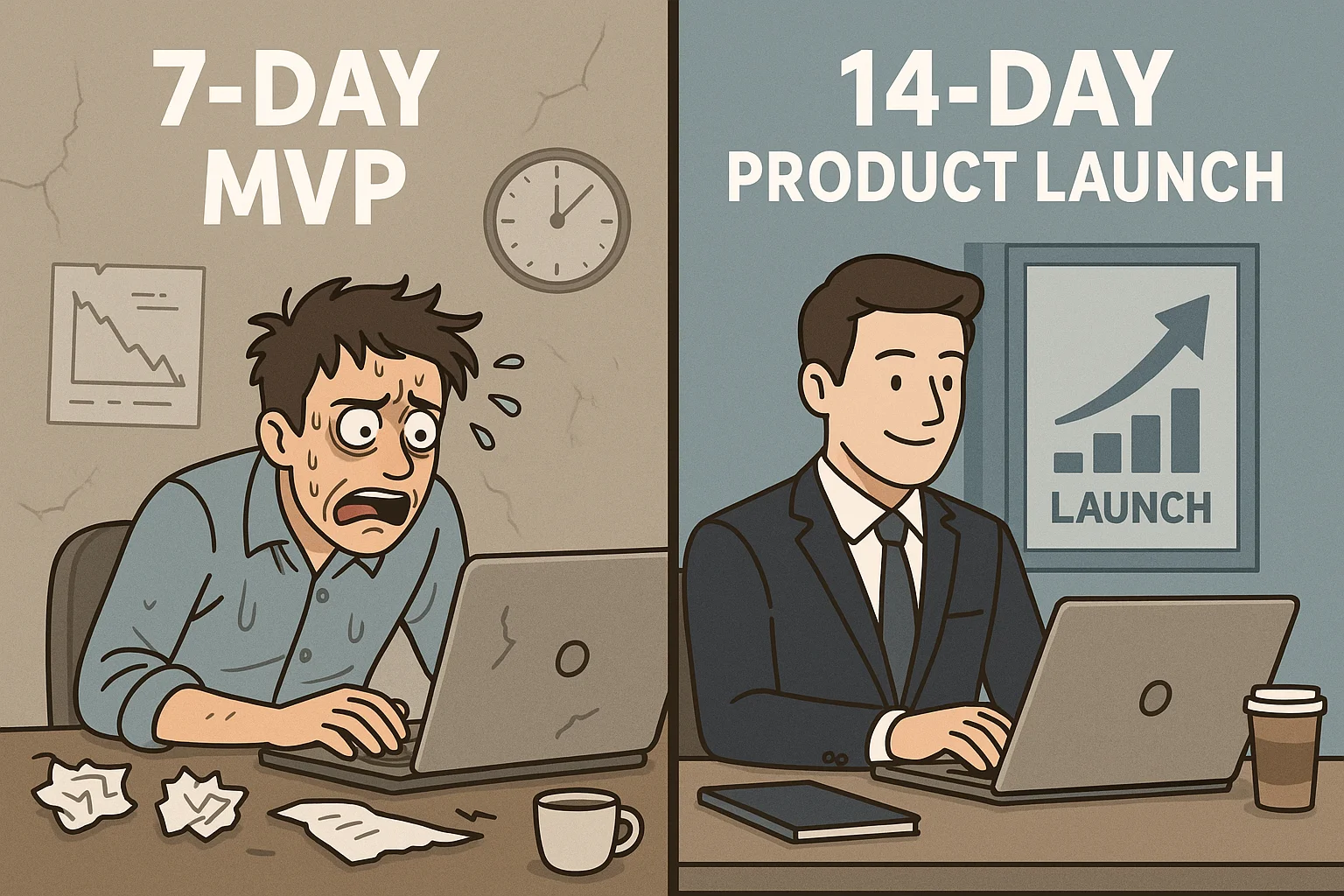
The 7-day MVP is a legend among founders—a frantic, caffeine-fueled sprint promising to turn an idea into a product at warp speed. But the brutal truth is that this heroic effort often ends in burnout, technical debt, and a fragile prototype that’s unfit for real users. This high-risk gamble trades quality and stability for a deadline that’s more myth than reality, leaving you with a product that isn’t truly launched, just exposed. What if you could achieve launch-certainty by trading that one week of chaos for two weeks of structured, professional execution? Our 14-day launch guarantee isn't about moving slower; it's about moving smarter. For a deeper dive into exactly What Does an On-Time MVP Launch Guarantee Actually Cover? (Our 14-Day Promise), we’ll explore the critical difference between a duct-taped proof-of-concept and a production-ready application you can confidently put in front of customers. It’s the difference between a gamble and a guaranteed outcome.
Defining the Elusive 7-Day MVP: What It Is (and Isn't)
Let's cut through the hype. The 7-Day MVP is less a product and more a high-stakes, brute-force experiment. Its singular purpose is to answer one critical question in a week: "Will someone use this to solve a specific problem?" Forget features; this is about validating your single most crucial assumption. It’s the rawest functional form—a simple script, a Typeform pretending to be an app, or a "Wizard of Oz" service where you manually perform tasks behind a basic interface. The goal isn’t revenue or growth; it’s a pure, unadulterated signal from your target market. Now for the brutal truth of what it isn't. A 7-Day MVP is not a business foundation. It is not secure, scalable, or remotely production-ready. By its very nature, it’s built on a mountain of shortcuts and technical debt, prioritizing speed above all else. This frantic approach often results in a fragile prototype that, while proving a point, is ultimately a technical dead end. It’s the classic solo founder’s gamble: a week of sleepless nights that might yield a glimmer of validation but delivers an asset that’s too unstable to build upon, forcing a complete restart. This stark reality underscores why a more robust approach, such as that detailed in The 14-Day MVP: Not a Myth, It's Our Guarantee (Here's How We Do It), is often necessary to move beyond mere validation to a viable, buildable product.
Is a 7-Day MVP Truly Realistic? Unpacking the Hidden Hurdles
The short answer is yes, but it’s a minefield. The allure of a 7-day MVP is speed, but this sprint often overlooks the hidden hurdles that can cripple a launch. The challenge isn't just about rapid coding; it's about navigating the treacherous terrain of scope discipline, technical debt, and deployment realities under extreme pressure. What often gets glossed over are the unseen time sinks: setting up a stable deployment pipeline, configuring DNS, implementing basic security, and wrestling with a no-code tool’s limitations. Each shortcut taken to meet the deadline builds upon a foundation of significant tech debt, making future iterations slow and costly. The true danger, however, isn't failing to ship; it's shipping a product so compromised by haste that it provides a false negative on your core idea. A buggy interface or a broken user flow doesn't invalidate your business concept—it invalidates your test. The razor-thin timeline leaves zero room for unexpected bugs or minor pivots, forcing you to sacrifice the very quality needed for meaningful user feedback. To avoid these pitfalls and ensure a valid experiment even with rapid deployment, founders often seek more robust frameworks, such as those outlined in The 14-Day MVP: A Founder's Guide to Launching for a Fixed $4,990. The question isn't just "can you build it in 7 days," but "will what you build be a valid experiment or a flawed prototype destined to be rebuilt?"
The DIY Approach: Fundamental Steps to Building a Rapid MVP
While attempting a 7-day MVP is a trial by fire, demanding ruthless efficiency, a more structured and perhaps less intense approach for launching your product quickly is outlined in The 14-Day App Build: Our Guaranteed Day-by-Day Process for Launching Your MVP. However, if you're committed to the ultimate high-pressure sprint of a 7-day build, here’s the fundamental roadmap:
Days 1-2: Brutal Prioritization. Isolate the single most critical problem your user faces and define the one core feature that solves it. This isn't a wish list; it’s a survival kit. Every other idea, no matter how brilliant, must be aggressively cut. A bloated scope at this stage guarantees you’ll miss your deadline. Your primary goal is to define the absolute 'Minimum' that delivers value.
Days 3-5: Rapid Build. Choose your tools for speed, not perfect scalability. Leverage no-code platforms like Bubble and Adalo, or a lean stack like a React front-end with a Firebase/Supabase back-end. The objective is functional, not flawless. This is a frantic coding phase where corners will be cut, and the clock becomes your biggest enemy.
Days 6-7: Deploy & Validate. Push your build live, even if it feels raw. Your mission is to get it into the hands of real users immediately. This isn’t about a polished launch; it’s about collecting data. Their feedback is the ultimate prize, providing the crucial validation—or invalidation—that makes this entire stressful week worthwhile.
Leveraging No-Code/Low-Code and Essential Tools for Speed
To have any chance of hitting a 7-day deadline, you must trade traditional code for radical speed. Your primary arsenal becomes the no-code/low-code stack, allowing you to bypass months of development. For web applications, platforms like Bubble or Webflow are essential for building functional front-ends visually. The backend can be rapidly assembled using Airtable as a flexible database and tools like Zapier or Make to act as the automated "glue" connecting your services. Need a mobile presence? Glide can turn a simple spreadsheet into a working app within hours.
However, this is where the brutal truth of the 7-day sprint emerges. The raw speed of these tools is seductive, but it hides a critical challenge: architectural integrity. As a relevant article titled The $5,000 MVP Tech Stack? You're Asking the Wrong Question. suggests, the true challenge isn't the tools themselves, but how they're strategically applied. You aren't just dragging and dropping; you are making crucial systems-design choices on the fly. A poorly planned data structure in Airtable or an inefficient automation in Zapier can create a fragile system that collapses under the first sign of real-world use. The learning curve isn't code, but a complex web of integrations and platform limitations. The race against the clock quickly becomes less about building and more about debugging a hastily assembled machine, proving that the tools are only as effective as the expertise orchestrating them.
Key Principles for Success: Focus, Scope, and Validation in Hyper-Speed
To survive a 7-day build, you must be brutally disciplined. The timeline is unforgiving and leaves no room for anything but the absolute essential. This starts with focus. Forget your grand vision; identify the single, most painful problem your target user faces and build the most direct solution to that one specific pain point. This very principle underpins the strategy for Quick MVP Development for Startup Validation: The 2025 Blueprint and ensures you're on the right path for efficient startup validation. Not three problems, not a problem and a nice-to-have. One. If a feature doesn’t directly serve this purpose, it’s a distraction you can’t afford.
This ruthless focus dictates your scope. Define the one critical path a user must take to solve their problem. Can you boil your product down to a single core function? Think one input, one process, one output. This isn’t about building a full-featured product; it’s about architecting a functional hypothesis. The goal is to create the simplest possible mechanism to validate your core assumption. Anything else, from polished UI to user account settings, introduces risk and delays that will derail your timeline.
Ultimately, success isn't measured by the code you ship, but by the clarity of the answer you get. Your stripped-down MVP has one job: to prove that people will actually use your core solution to solve their problem. The goal is validation, not perfection. A successful 7-day launch provides a clear signal—a "yes" or "no" from the market—that tells you whether your core idea is worth pursuing. It’s a high-stakes experiment, and the outcome is pure data.
Case Studies: Examples of Ultra-Fast Launches (and Why Some Fail)
The lore of the 7-day MVP is filled with legends. Consider Dropbox. Drew Houston didn’t ship a single line of production code; he launched a 3-minute video demonstrating file sync. Buffer began as a simple two-page site to gauge interest in scheduled tweets. These weren’t products; they were elegant experiments designed to answer one critical question: “Will anyone care?” They succeeded by focusing entirely on validating the core assumption with minimal possible effort. For a deeper understanding of such achievements and to study more triumphs, exploring resources like Launching Success: 9 Successful SaaS MVP Examples 2024 You Need to Study can be incredibly valuable.
The brutal truth is that for every Dropbox video, there are countless failed attempts. Failure rarely comes from a lack of effort; it stems from mistaking a 7-day sprint for a 7-day product launch. This rush leads to buggy, feature-thin applications built on technical quicksand. This fragile foundation isn't just impossible to scale; it can actively mislead you. A poor user experience due to rushed execution often generates a false negative, killing a potentially brilliant idea because the prototype was untrustworthy or simply unusable.
The critical difference lies in the objective. Successful ultra-fast launches validate a core hypothesis with extreme focus. Failed ones try to compress a full development cycle into a single week, creating a liability instead of a launchpad for future growth.
The Unseen Toll: Why 7-Day DIY MVPs Often Cost More Than Time
The allure of a week-long sprint is powerful, but the true invoice for a DIY MVP arrives long after launch. The most immediate charge is crippling technical debt. Hasty code, bypassed testing, and fragile integrations create a product that’s a nightmare to scale or pivot. You’ve built a foundation of sand, and every future feature will cost double the time and effort to implement. In fact, many common startup pitfalls stem from these early choices, a point elaborated upon in resources like Your Tech Stack Choice is Killing Your Startup. Here’s How to Launch in 14 Days Instead..
The steeper price, however, is opportunity cost. Every hour spent debugging a flaky API is an hour you’re not talking to customers, refining your go-to-market strategy, or building a waitlist. Your focus shifts from validating the business to simply keeping the build from collapsing, stalling your actual progress. Worse, a buggy MVP can poison the well with your most crucial audience: early adopters. A poor first impression doesn't just fail to validate your idea; it can generate a false negative, convincing you to abandon a great concept because of flawed execution. The data you collect is compromised from day one. Ultimately, this frantic pace trades short-term speed for long-term momentum. The goal isn't just to ship something fast, but to launch a reliable, professional foundation that gives your business a genuine chance to succeed.
Our Solution: The Certainty of a 14-Day Production-Ready Launch
The allure of a 7-day MVP is speed, but the brutal truth is that it often forces a frantic sprint ending in a buggy, non-scalable prototype. It trades certainty for a rushed deadline. What if you could eliminate that chaos and gain absolute confidence in your launch?
We’ve engineered a battle-tested process that transforms your core idea into a production-ready application, launched in a guaranteed 14-day timeline, a precise strategy we detail in our guide on MVP Development: The Guaranteed 14-Day Path to Launch [For $4,990]. This isn't simply about building faster; it's about executing with expert precision. We bypass the weeks of decision paralysis you'd lose to tech stack analysis, infrastructure setup, and late-night debugging. Our streamlined system handles everything: a clean, scalable codebase, secure cloud deployment, and essential integrations for payments, user authentication, and analytics.
Instead of a fragile prototype riddled with technical debt, you receive a polished, secure, and professionally architected product ready for real users from the moment it goes live. You get to market with the velocity you demand, but with a solid foundation built for growth and iteration. This is the realistic, intelligent path to validating your business—fusing the speed of a startup with the quality and reliability your first customers deserve, without the corner-cutting.
Beyond Speed: How Our Process Delivers Robustness and Real Business Value
The allure of a 7-day launch is pure speed, but what is the true cost of that velocity? A frantic sprint often results in a product held together by digital duct tape. It might function for a demo, but it breaks under the first wave of real users, producing unreliable feedback. The code becomes an instant dead end, forcing a complete rewrite the moment you find product-market fit. This isn't just technical debt; it's a validation fallacy.
Our guaranteed 14-day launch isn't about moving slower; it's about building smarter from day one. That extra week is a strategic investment in what a 7-day rush must ignore: foundational architecture, clean code, and a core user experience that is both functional and intuitive. We build a stable platform that can actually handle user feedback and future iterations without collapsing.
The result is a genuine asset, not a disposable prototype. You receive a robust, production-ready product that delivers reliable data because it provides a seamless user experience. It’s a launchpad for growth, ready for your first paying customers and built to scale for what comes next. This transforms a high-risk gamble into a confident, valuable market entry.
Choosing Your Launchpad: Risk, Reward, and Your Business Future
The path you choose to validate your idea is more than a project plan; it's the first major decision about your company’s future. It boils down to a fundamental choice between two types of speed: the frantic sprint versus the deliberate launch.
The 7-day, self-built MVP is a high-risk, high-reward gambit. It’s a scrappy, duct-taped proof-of-concept designed for one thing: raw, immediate feedback. The reward is the sheer velocity of learning. The risk? You might build something so fragile it collapses under the first real user, riddled with technical debt that sabotages your ability to pivot or scale. It validates a hypothesis but rarely produces a viable asset.
Alternatively, a structured, production-ready launch prioritizes strategic speed. This approach, exemplified by resources like Rapid App Development: The Founder's Guide to Launching an MVP in 14 Days, trades the chaotic sprint for a focused, two-week build cycle that delivers a polished, secure, and scalable foundation. It’s not just about validating an idea; it’s about creating a stable platform ready for real customers and future development from day one.
Ultimately, your choice depends on your objective. Are you simply testing the waters to see if an idea floats, or are you building the vessel that will actually carry you to market? The path you take now determines whether your next challenge is fighting fires or acquiring your first hundred users.
Don't Just Launch Fast, Launch Right: Partner for Guaranteed Success
While the allure of a 7-day MVP is strong, the reality is often a rushed product built on a fragile foundation, leading to technical debt and missed market opportunities. The brutal truth is that true validation requires more than just speed—it demands strategic execution. For a realistic and powerful alternative, consider our methodology outlined in Rapid MVP Development: The Guaranteed 14-Day Launch Plan. This structured timeframe allows for crucial discovery, core feature development, and essential testing, ensuring your product is not just launched quickly, but launched correctly. It’s the difference between a flimsy prototype and a viable asset ready for growth. If you’re serious about building an MVP that lasts beyond its first week, let’s discuss how our process can bring your vision to market with confidence and a clear path forward.
Stop risking your idea on a frantic, low-quality 7-day MVP and secure a production-ready launch guaranteed in 14 days with MVPExpert. Book your free project consultation today.

Børge Blikeng
AuthorHelping startups build successful MVPs for over 5 years