No-Code MVP: The Founder's Guide to Building (And Knowing When to Stop)
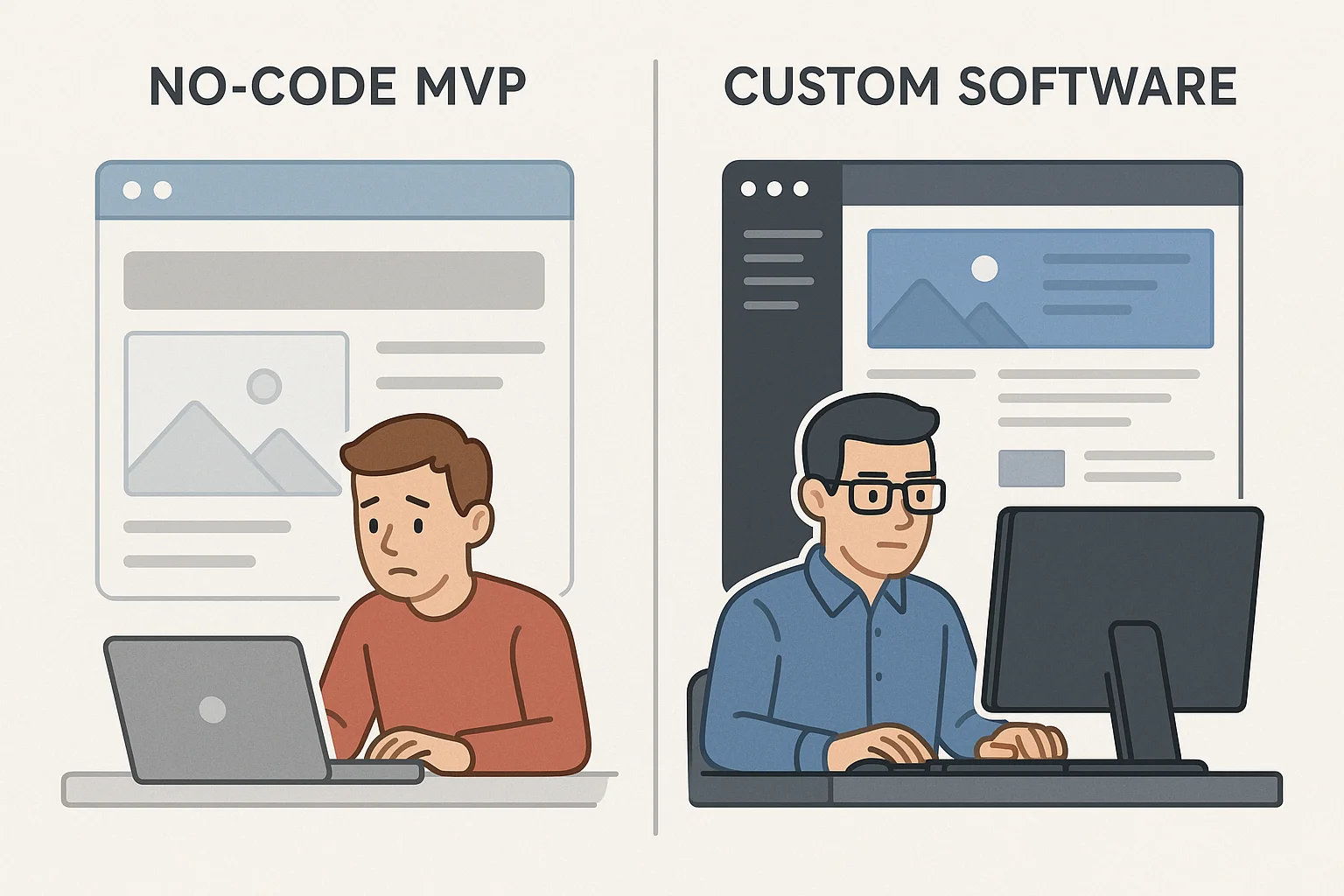
The Founder's Dilemma - Idea to Market, Fast and Lean
As a non-technical founder with a brilliant business idea, you might face the daunting challenge of bringing it to life. No-code platforms can seem like the perfect solution, offering a fast and affordable way to create a Minimum Viable Product (MVP) and test your concept with real users. In fact, you can learn exactly How to Build an MVP with No-Code Tools: Launch Your Startup Faster & Cheaper for simple prototypes. However, while these tools are fantastic for initial validation, the very platforms that empower your start can quickly become a bottleneck after that, hitting a hard wall on scalability, custom features, and performance. This guide will show you not only how to build a no-code MVP but, more crucially, how to recognize its limits. We’ll explore the critical point where you must graduate from a fragile prototype to a robust, scalable foundation—and reveal how our guaranteed 14-day development service is the superior path to launching a serious, production-ready product.
Understanding the No-Code MVP: Speed, Savings, and Simplicity Defined
A No-Code MVP is a functional first version of your product built without writing a single line of code. Think of it as using sophisticated digital LEGOs—visual, drag-and-drop tools—to construct a working application. For non-technical founders, this method demystifies product development and is defined by three key advantages: speed, savings, and simplicity. Speed is its most compelling benefit. Instead of a months-long traditional development cycle, you can assemble and launch a testable product in a matter of days or weeks. This velocity is critical for getting your idea in front of early adopters and gathering real-world feedback while your concept is still fresh. Next are the dramatic savings. By eliminating the need to hire a costly engineering team for your initial market test, you significantly lower the financial barrier to entry. This preserves precious capital, allowing you to invest in growth after you’ve validated that you’re building something people actually want. Finally, its simplicity empowers you, the founder, to be the creator. You can directly translate your vision into a tangible product without a technical co-founder, enabling rapid iterations based on direct user insights. While a no-code MVP is an unparalleled tool for testing a hypothesis and proving market demand, its true purpose is to be a stepping stone. It's the fastest way to get an answer, not the foundation for a scalable, high-performance business. In fact, many successful founders understand that focusing too early on a complex, expensive tech stack can be a misstep, and often, as this article suggests, you might be asking The $5,000 MVP Tech Stack? You're Asking the Wrong Question. when approaching your initial product development.
Why Non-Technical Founders Are Turning to No-Code for Initial Validation
For founders without a technical background, the journey from a brilliant idea to a tangible product has historically been blocked by a major hurdle: code. Sourcing a technical co-founder is time-consuming, and hiring developers is expensive—two resources early-stage startups can't afford to waste. No-code platforms have emerged as the game-changing solution to this dilemma, empowering entrepreneurs to build and launch a functional version of their product independently. This approach, crucial for rapid market entry, is comprehensively detailed in guides such as MVP Development for Non-Tech Founders: Your 2025 Guide to Launching Fast.
The primary driver behind this trend is speed. In the world of startups, learning fast is everything. No-code tools allow you to bypass the lengthy development cycles and get a working MVP in front of users in days or weeks, not months. This accelerates the feedback loop, allowing you to test your core assumptions and validate market demand with a live product. By significantly lowering the cost and technical barriers to entry, founders can de-risk their venture, gathering crucial data on what users actually want before committing significant capital to a full-scale build. It’s about proving the concept quickly and cheaply.
Ultimately, turning to no-code for initial validation is a strategic move to answer the most critical question: "Should I build this?" It provides the fastest path to real-world user interaction and tangible proof of concept, giving founders the confidence and data needed to take the next, more serious step in their startup journey.
A Step-by-Step Guide to Crafting Your Own No-Code MVP
Building your no-code MVP is a sprint, not a marathon. The goal is to quickly validate your core assumption with minimal resources. For a detailed guide on rapid development, you might find The 14-Day App Build: Our Guaranteed Day-by-Day Process for Launching Your MVP particularly helpful. Following these key steps will help you get to an answer, fast. First, brutally define the single problem you are solving. What is the one critical action a user must be able to complete? Write it down and ignore everything else. This isn't your dream product; it’s a focused experiment. Second, map the simplest possible user journey for that one action. Think three to four essential screens, maximum. If it involves complex logic or multiple user types, you're already overcomplicating it for a no-code build. Third, choose your primary tool. Pick one platform like Bubble, Glide, or Softr and stick with it. Trying to chain multiple services together creates "no-code spaghetti" that is slow to build and impossible to scale. Fourth, build for function, not beauty. Your objective is a working prototype, not a design award. Does the button work? Can users sign up? Focus relentlessly on testing the core mechanic with a small group of target users. Finally, and most importantly, define your "stop" metric beforehand. Is it 10 paying customers? 100 sign-ups? Once you hit that validation point, stop building. Your no-code experiment has succeeded, proving it's time to build a scalable, production-ready application.
Essential No-Code Tools: Powering Your Rapid MVP Development
Navigating the no-code ecosystem can feel overwhelming, but the right stack is your launchpad for rapid validation. The goal isn't to find a perfect, all-in-one solution, but to select tools that quickly bring your core idea to life. For building interactive web applications, Bubble remains a powerhouse, offering deep functionality, but it comes with a steep learning curve. For simpler, data-driven apps, Glide or Softr can create a functional interface from an Airtable or Google Sheet in hours.
To capture initial interest and build a waitlist, a compelling landing page is crucial. Webflow provides unmatched design freedom for visually rich sites, while Carrd is the champion of simplicity for getting a beautiful single-page site live in under an hour.
The real magic happens when you connect these services. Airtable often serves as a flexible, user-friendly database for managing everything from user lists to product inventories. You can then use an automation platform like Zapier or Make to act as the "glue," linking your user sign-ups and form submissions to create automated workflows.
While this combination is powerful for testing your assumptions and gathering initial user feedback, remember the primary goal: validation. Piecing together multiple tools can introduce complexity and performance bottlenecks. Think of them as the fastest way to prove your concept before building the robust, scalable product your future customers will depend on.
Inspiring Examples: Successful Ventures Born from No-Code MVPs
The leap from a great idea to a funded company can feel vast, but many successful ventures started by bridging that gap with a no-code MVP. These examples prove that you don’t need a technical co-founder to gain initial traction; you just need to validate your core hypothesis. For more insights into how to achieve this, exploring resources like Launching Success: 9 Successful SaaS MVP Examples 2024 You Need to Study can be invaluable.
Consider Zapier, the automation giant now valued in the billions. Its first version wasn't a complex platform but a simple prototype cobbled together to demonstrate the concept at a startup event. They validated user demand on a forum before writing a single line of production code. Similarly, Lambda School (now Bloom Institute of Technology) launched its tech education program using a combination of Typeform for applications, Slack for community, and manual payment processing. They proved their entire business model without building a custom learning platform.
Another great example is Comet, a freelance marketplace that built its initial two-sided platform entirely on Bubble. This allowed them to facilitate their first transactions and prove the market existed for their service.
What these founders understood is that the goal of an MVP isn't perfection; it's learning. They used no-code tools to quickly test their assumptions, attract their first users, and gather crucial data. This validation gave them the confidence and leverage to later invest in the robust, scalable code needed for long-term growth.
The No-Code Wall: Understanding Its Inherent Limitations and Downsides
While the initial rush of building something with no-code is exhilarating, it’s vital for ambitious founders to recognize when they're about to hit "The No-Code Wall." This is the critical point where a platform's initial convenience turns into a barrier to growth, leaving your MVP trapped and unable to evolve.
The most significant limitation is scalability. No-code platforms often struggle under the weight of a growing user base, leading to slow performance and a frustrating user experience that can kill your momentum. Customization is another major hurdle; your unique value proposition is confined to the platform's pre-set features and templates. If a critical function isn't available, you're simply out of luck.
Beyond functionality, you face fundamental business risks. With vendor lock-in, your app and its valuable user data are tethered to a third-party service, making future migration a complex and costly ordeal. You also don't own the underlying codebase, a significant red flag for potential investors and a risk to your long-term intellectual property. For founders building a serious, production-ready business, these limitations aren't just inconveniences—they are strategic dead ends. The goal isn’t just to launch, but to build a foundation that can support real growth from day one.
Scalability, Customization, and Security: Where No-Code Eventually Falls Short
Your no-code MVP has successfully validated your idea—congratulations. But as you transition from testing a concept to building a business, the very platform that gave you speed now becomes a bottleneck. This is where you encounter the three critical walls: scalability, customization, and security.
As your user base grows from hundreds to thousands, no-code platforms often struggle. The app slows down, performance becomes unpredictable, and you can’t optimize the backend to handle heavy traffic. This poor user experience can halt your growth in its tracks and drive early adopters away.
Next, you'll hit the customization ceiling. Your unique value proposition might require a specific user workflow or a proprietary feature that simply isn't possible with pre-built modules. You're forced to conform to the platform's limitations, unable to build the exact product you envision and that your customers demand, stifling your competitive edge.
Finally, security and data ownership become major concerns. You don't control the underlying infrastructure, making it difficult to implement robust, custom security measures or ensure compliance with regulations like GDPR or HIPAA for sensitive data. For a serious venture, relying on a third-party platform's generic security is a significant risk. These aren't just technical issues; they are fundamental business hurdles that signal it’s time to build on a foundation designed for growth.
Beyond Experimentation: Why a Production-Ready MVP Matters for Serious Founders
A no-code MVP is a brilliant tool for one thing: confirming a hypothesis. You’ve used it to prove that people want what you’re building. But once you sign up your first real, paying customers, the game changes entirely. An experimental tool is no longer sufficient; you need a stable foundation for a real business. This is where most no-code solutions hit a hard wall.
Suddenly, performance lags, security becomes a real concern, and you can’t build the unique, custom features your users are demanding. The platform that got you started now actively holds you back. This is the critical moment when a "serious founder" must evolve beyond simple experimentation, recognizing the brutal truth about what it truly takes to move from concept to a production-ready product, a challenge often explored in discussions like The 7-Day MVP: The Brutal Truth vs. Our 14-Day Launch Guarantee.
A production-ready MVP isn’t just a more robust version of your no-code build; it’s a strategic asset. It’s a secure, scalable, and reliable platform engineered to handle real-world pressure. It’s something you can confidently charge for, build upon, and present to investors as the bedrock of your future growth. While a no-code tool validates a concept, a production-ready MVP validates your business. It sends a clear signal that you’re not just testing an idea—you’re building a company prepared for its first 1,000 customers and beyond.
Guaranteed Launch in 14 Days: The Superior Path to a Serious MVP
No-code tools are invaluable for testing the waters and confirming you have a problem worth solving. But once you have that validation, a critical question arises: is your no-code prototype ready to become a real business? For many founders, this is where the limitations appear. Scalability issues, performance bottlenecks, and the inability to build custom, differentiating features can bring your momentum to a screeching halt. You’ve proven the what, but now you need a professional how. This is the moment to transition from a prototype to a production-ready application. Imagine launching a robust, scalable MVP, built with clean, maintainable code. Our commitment to speed means a launch in just two weeks, reflecting exactly What Does an On-Time MVP Launch Guarantee Actually Cover? (Our 14-Day Promise). This accelerated path bypasses the common pitfalls of no-code limitations and the lengthy timelines of traditional development. Instead of wrestling with platform constraints, you get a solid foundation that you own completely, ready for your first real users and future growth. It provides the ultimate combination of speed and substance, allowing you to enter the market with a professional-grade product without the typical delays and uncertainties. This isn't about replacing early validation; it's about graduating to a serious launch with confidence and guaranteed speed.
Making the Right Choice: No-Code vs. Professional Development for Long-Term Success
No-code platforms are an excellent tool for one specific job: testing a hypothesis quickly. They allow non-technical founders to build a functional prototype and get crucial feedback, confirming if a real market exists for their idea. However, confusing this initial validation with a long-term business foundation is a common and costly mistake. The very simplicity that makes no-code attractive for experiments becomes its greatest liability for growth. The limitations of a no-code MVP often surface just as you start gaining traction. Performance degrades as your user base grows, creating a poor experience. You’ll find you can’t build a key, differentiating feature because it’s outside the platform’s rigid toolkit. Most critically, you don’t own your codebase, which poses a significant risk for future investment and creates vendor lock-in. You’re essentially building your business on rented land. This technical debt inevitably leads to a complete, expensive rebuild down the line. For founders serious about building a scalable, investment-ready company, professional development is the clear path. This doesn’t mean a slow, drawn-out process; in fact, it can be remarkably fast. For insights on achieving rapid deployment with the right approach, consider Your Tech Stack Choice is Killing Your Startup. Here’s How to Launch in 14 Days Instead.. A focused, professionally-built MVP provides a rock-solid foundation, full ownership of your intellectual property, and limitless potential for customization. It’s the difference between a temporary experiment and a real product launch, giving you the speed and certainty to grow without hitting a technical wall.
Building Smart, Scaling Right – Your MVP Journey Ahead
Building a no-code MVP is more than a technical shortcut; it's a powerful strategic discipline. It empowers you to transform an idea into a tangible product quickly and affordably, but its true value lies in validation. The most critical lesson is restraint: defining your core hypothesis and building only what is essential to test it. Resist the temptation of feature creep; your goal isn't a perfect product, but actionable feedback from real users. This data is the true metric of success.
Your next step isn't to master every tool, but to clarify the single most important question your business needs answered. Choose your platform, build with purpose, and launch. The learning you gain from that first user interaction will be the most valuable asset you create.
Stop hitting no-code walls and launch your serious, production-ready MVP in just 14 days with MVPExpert's guaranteed development service. Book your free project consultation today.

Børge Blikeng
AuthorHelping startups build successful MVPs for over 5 years