The 14-Day App Build: Our Guaranteed Day-by-Day Process for Launching Your MVP
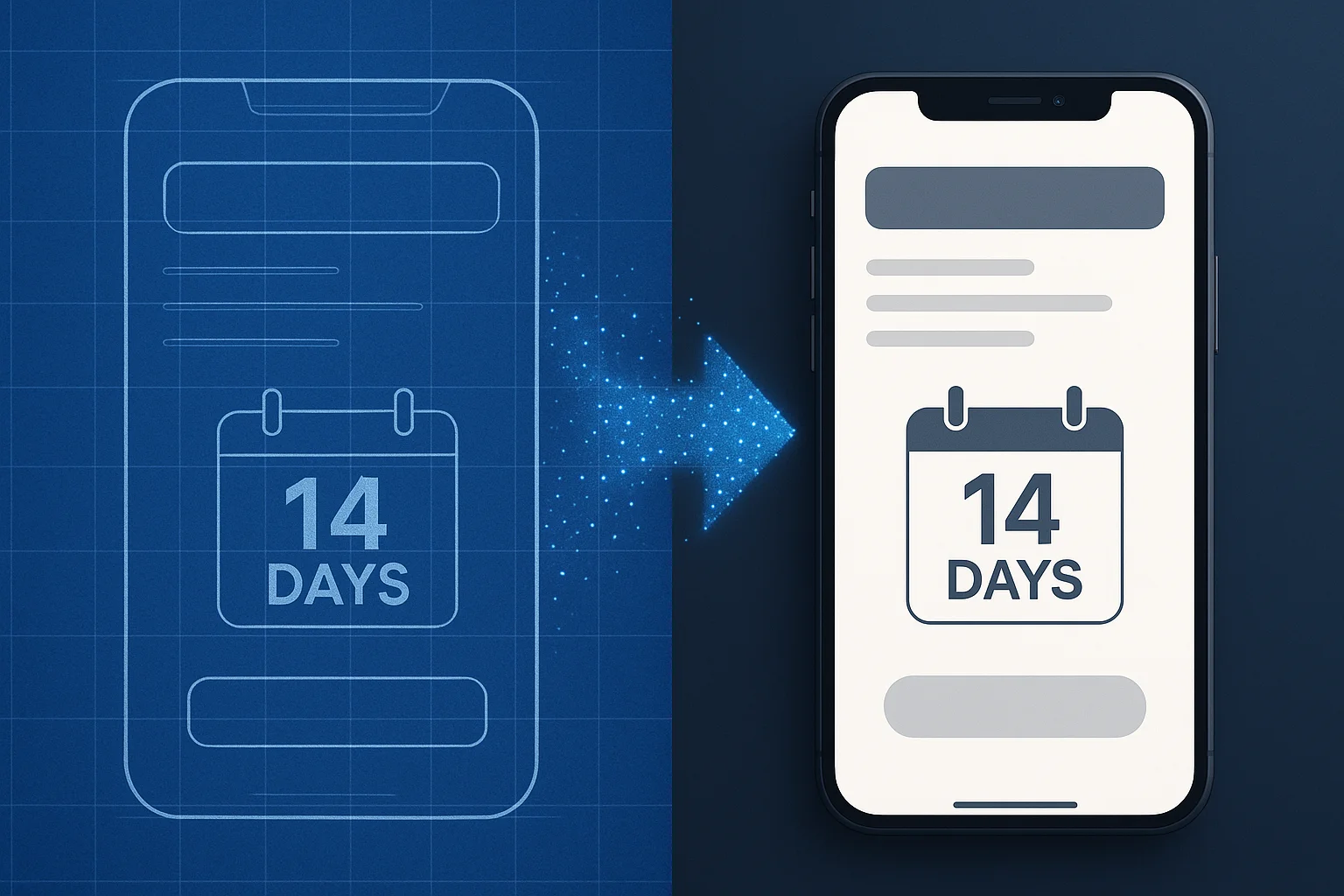
Introduction: The 14-Day App Build – Reality or Myth?
1. Debunking the Myth: Why a 14-Day MVP is Not Only Possible, It's Strategic
Forget the myth that app development requires months of work and a massive budget before you can even launch. The most common question we hear is, "Is it realistic to build an app in 14 days?" The answer is an unequivocal yes. As we explain in The 14-Day MVP: Not a Myth, It's Our Guarantee (Here's How We Do It), it's not merely possible; it's the most strategic first step you can take.
This isn't about building a flawless, feature-rich final product. It's about launching a focused Minimum Viable Product (MVP) designed to do one thing exceptionally well: validate your core idea with real users. The two-week constraint isn't a limitation; it's a powerful tool for focus. It forces you to slash the "nice-to-haves" and concentrate exclusively on the single, most critical feature that solves your user's primary problem.
This approach saves you from the biggest startup pitfall: spending months building something nobody wants. Instead of perfecting an assumption in a vacuum, you launch quickly, gather invaluable market feedback, and learn what users actually value. Speed is your competitive advantage. A 14-day MVP isn't a shortcut; it's a calculated strategy to de-risk your idea and build a foundation for success based on data, not guesswork. It's entirely achievable with a disciplined, day-by-day plan.
2. Day 1-2: The Unbreakable Foundation – Idea Validation & Core Feature Mapping
Every great app starts not with a line of code, but with unshakeable clarity. These first 48 hours are where we forge that foundation. Forget months of tedious market research; our process is about decisive action and ruthless focus.
On Day 1, your singular mission is to validate the core problem. This isn't about writing a complex business plan; it's about getting a fast, real-world signal. Your task: identify and speak with at least five potential users. Find them in relevant Reddit communities, Facebook groups, or your immediate network. Ask them about the specific pain point your app addresses. Do they genuinely feel it? What are their current, clunky workarounds? You’re listening for genuine frustration, which is the ultimate green light to proceed.
Day 2 is dedicated to defining the absolute core of your product—the one thing it must do to be valuable. This is where most aspiring builders get bogged down, trying to include every feature. Instead, we map the single, non-negotiable user journey. This crucial step aligns with the principles detailed in The $4,990 MVP: How We Prioritize Features & Launch Your App in 14 Days, emphasizing the need to focus on what truly matters to get your app live quickly. Brainstorm every feature you can imagine, then apply the "one-job" rule: which single feature solves the user’s primary pain point? Your output for this stage is a crystal-clear list of no more than three essential features. This isn't your dream app; it's the critical first step to getting there.
3. Choosing Your Arsenal: Essential No-Code/Low-Code Tools for Rapid Development
To hit a 14-day launch target, you cannot afford "analysis paralysis" when choosing your tools. You need a proven, high-velocity arsenal designed for speed. This approach aligns perfectly with strategies like How to Build an MVP with No-Code Tools: Launch Your Startup Faster & Cheaper, emphasizing rapid development without writing a single line of code. Forget endless research; this is the core stack that enables your vision to come to life quickly.
For your primary application builder, we recommend starting with an all-in-one platform. Bubble is our go-to for building sophisticated web apps like marketplaces, SaaS platforms, or social networks. Its visual editor handles your front-end design, back-end logic, and database management in one place. If you’re building a native mobile app for iOS and Android, Adalo or FlutterFlow provide a similar drag-and-drop experience, translating your vision directly into a functional app store-ready product.
Next, you need to connect your app to the outside world. This is where integration platforms are non-negotiable. Zapier or Make act as the digital glue, allowing you to link your app to thousands of other services. Need to process payments with Stripe, send emails via Mailchimp, or update a Google Sheet? These tools handle it in minutes, not days.
This isn’t a list of every tool available; it’s a battle-tested toolkit for guaranteed speed. Pick your primary builder based on your web or mobile needs, and leverage an integration platform to handle the rest. This lean setup is the engine behind a successful two-week build.
4. Day 3-5: UI/UX Design & Database Blueprint – Crafting the User Experience
With your core feature validated, it’s time to move from concept to concrete structure. These three days are critical for translating your idea into a visual and logical plan, ensuring the upcoming development phase is fast and focused.
We dedicate this block to two parallel tasks: UI/UX design and creating a database blueprint. For the user interface (UI) and user experience (UX), the goal is clarity, not complexity. Using a free tool like Figma, create simple wireframes—basic screen layouts—for the entire user journey you defined on Day 2. How does a user sign up? How do they interact with your core feature? Map out every essential screen, button, and input field. This isn't about choosing colors or fonts yet; it's about creating a functional, visual guide that eliminates guesswork.
Simultaneously, sketch out your database blueprint. As you design the UI, ask: "What information does this screen need to show, and what data do I need to save?" For a recipe app, this would be Users (name, email), Recipes (title, ingredients), and Reviews (rating, text). Draw simple boxes for each data table and lines to show how they connect. By the end of Day 5, you will have a complete architectural plan—the essential roadmap that makes a rapid, two-week build not just possible, but predictable.
5. Day 6-8: Core Functionality Sprint – Building the MVP's Heartbeat
Welcome to the engine room. These three days are a pure development sprint, dedicated to building the single most important function of your app. Forget the bells and whistles; this phase is about making your app do the one thing it promises. Your singular focus must be on the core user journey you mapped out on Day 3. Anything else is a distraction that jeopardizes the 14-day timeline. Our approach to this is heavily inspired by principles of Ruthless Feature Prioritization: How We Build & Launch a Guaranteed MVP in 14 Days.
Our blueprint for this sprint ensures rapid, tangible progress. On Day 6, build the gateway: user authentication. Using your chosen no-code tool or framework, implement a simple sign-up, login, and the basic data structure for a user profile. This is the foundation. On Day 7, tackle the main event—the core action. If you’re building a task manager, this is the day users can successfully add and view a task. Make this one "job-to-be-done" work flawlessly.
Day 8 is for connection and crude testing. You’ll link the user accounts from Day 6 to the core action from Day 7, ensuring the entire loop is functional. Does logging in lead to the main screen? Can a user perform the core action? By the end of this sprint, you won’t have a polished product, but you will have its heartbeat: a working, testable prototype that proves your concept is viable. This is the non-negotiable outcome for this phase.
6. Day 9-11: Feature Refinement & Integration – Adding Depth to Your MVP
With the foundational blocks of your app in place, these three days are dedicated to transforming a collection of functions into a cohesive, intelligent system. The goal is to add depth, moving from features that simply work to features that work together. This is the critical phase where your prototype starts to feel like a real, polished product.
Your primary focus is integration. Your mission is to ensure data flows logically between screens. When a user creates a profile, does that information correctly populate their dashboard? When they complete a key action, does it update their status elsewhere in the app? You will spend this time connecting the dots, making sure every part of your application communicates effectively. This creates a seamless experience that builds user confidence.
Simultaneously, you will begin refining. Revisit your core user journey and ruthlessly eliminate friction. This isn’t the time for new features; it’s for fixing bugs, simplifying confusing steps, and improving the flow of what already exists. Is a button unresponsive? Is a menu hard to navigate? Focus on the 20% of refinements that will yield 80% of the user experience improvement. By Day 11’s end, you'll have a stable, integrated MVP ready for final testing.
7. Day 12-13: Rigorous Testing & Bug Extermination – Polishing for Launch
With the core functionality locked in, these two days are dedicated to the relentless pursuit of perfection. This is where your functional app becomes a polished product ready for its first users. We shift from building to breaking, systematically hunting down every bug and smoothing every rough edge.
On Day 12, your mission is User Acceptance Testing (UAT). Don’t just casually click around; be methodical. Create a simple checklist from your core user stories defined on Day 3 and test every single feature path. Does every button work as expected? Does the app handle incorrect inputs gracefully? Test on different devices and screen sizes to uncover UI inconsistencies. Log every issue, no matter how small, in a bug tracker—even a simple spreadsheet will do.
Day 13 is Bug Extermination Day. Prioritize your list from Day 12: crush any "showstopper" bugs that break core functionality first, then address major UI flaws. While you fix, grab 3-5 trusted friends for a quick "fresh eyes" test. Give them zero instructions and watch them use the app for 15 minutes. Their confusion is invaluable data, revealing usability gaps you're too close to see. This rigorous two-day process ensures your launch isn't derailed by embarrassing, preventable errors.
8. Day 14: Deployment Day – From Development to Live MVP
This is it—the culmination of 13 days of disciplined effort. Deployment day is not about adding new features; it’s about moving your finished product from your local machine to a live environment where users can access it. This transition from development to a live MVP is the moment your idea becomes a tangible reality.
Your first step is a final, comprehensive system check. Run through your testing plan one last time, ensuring every core function works as intended. Next, prepare your environment for launch. For web applications, platforms like Vercel, Netlify, or Heroku simplify this process immensely, allowing you to connect your code repository and deploy with a few clicks. For mobile apps, this means preparing your build for submission to TestFlight (iOS) or the Google Play Console's internal testing track.
Once you push the button and your app is live, your job isn’t over. Immediately perform a smoke test on the live version. Can you create an account? Does the main feature work? This confirms the deployment was successful.
Many believe an app launch requires months, but this blueprint proves otherwise. For a detailed guide on achieving this rapid deployment, consult How to Launch Your App MVP in Under a Month: The 2025 Blueprint. You now have a functioning MVP in the hands of users, ready to generate the feedback needed for real growth. Congratulations, you’ve just launched your app in two weeks.
Congratulations, your MVP is live! While it’s a huge milestone, remember: the launch isn’t the finish line; it’s the starting gun. Your primary mission now shifts from building to learning, with the goal of validating your core assumptions with real user data. Forget complex analytics dashboards initially; focus on direct, qualitative feedback. Personally email your first ten users. Set up brief 15-minute video calls. Ask open-ended questions like, “What problem were you trying to solve when you found us?” and “Was there anything you expected the app to do that it didn’t?” This is the essence of the powerful Build-Measure-Learn loop. You’ve completed the “Build” phase. Now, you “Measure” user reactions and “Learn” what to prioritize next. This data-driven approach is what separates successful apps from forgotten projects. Create a simple backlog for all feedback, then prioritize relentlessly. A simple impact/effort matrix is your best friend: focus on high-impact, low-effort fixes and features first. Which suggestions directly enhance your app’s core value? Tackle those. For a detailed guide on this crucial validation stage, consider following The 14-Day Post-Launch Plan: How to Validate Your MVP with Real Users. Now, maintain that velocity by iterating intelligently and building what your users prove they actually want.
10. Your Guaranteed Blueprint: Kickstarting Your 14-Day App Build Today
The theory is over. You now possess the exact, day-by-day blueprint we use to transform promising ideas into functional apps in just two weeks flat. While others debate feasibility, this guide provides certainty. The primary obstacle for most aspiring entrepreneurs isn't a lack of ideas; it’s the lack of a clear, actionable starting point. This plan eliminates that friction entirely. The path from concept to a tangible product is no longer a mystery—it’s a checklist waiting to be executed.
So, how do you kickstart your build today? Simple. Stop researching and start doing. Your first mission is to complete the Day 1 task outlined in this guide: brutally define your single core feature. What is the one, indispensable problem your app must solve for a user? Once you have it, map out the simplest possible user journey to that solution on a whiteboard or piece of paper. That’s your entire goal for today.
By completing this critical first step, you trigger the momentum needed to carry you through the next 13 days. This guaranteed blueprint is your shortcut past doubt and procrastination. In two weeks, you won’t just have an idea; you’ll have a working app in your hands, ready for real-world feedback. The clock starts now.
Conclusion: The Power of Rapid Iteration – Launch Your Vision in Two Weeks Flat
Stop struggling with vague timelines and unlock your guaranteed 14-day MVP launch blueprint now. Book your free project consultation today.

Børge Blikeng
AuthorHelping startups build successful MVPs for over 5 years