MVP Feature Prioritization: The Simple Framework to Stop Debating and Launch Faster
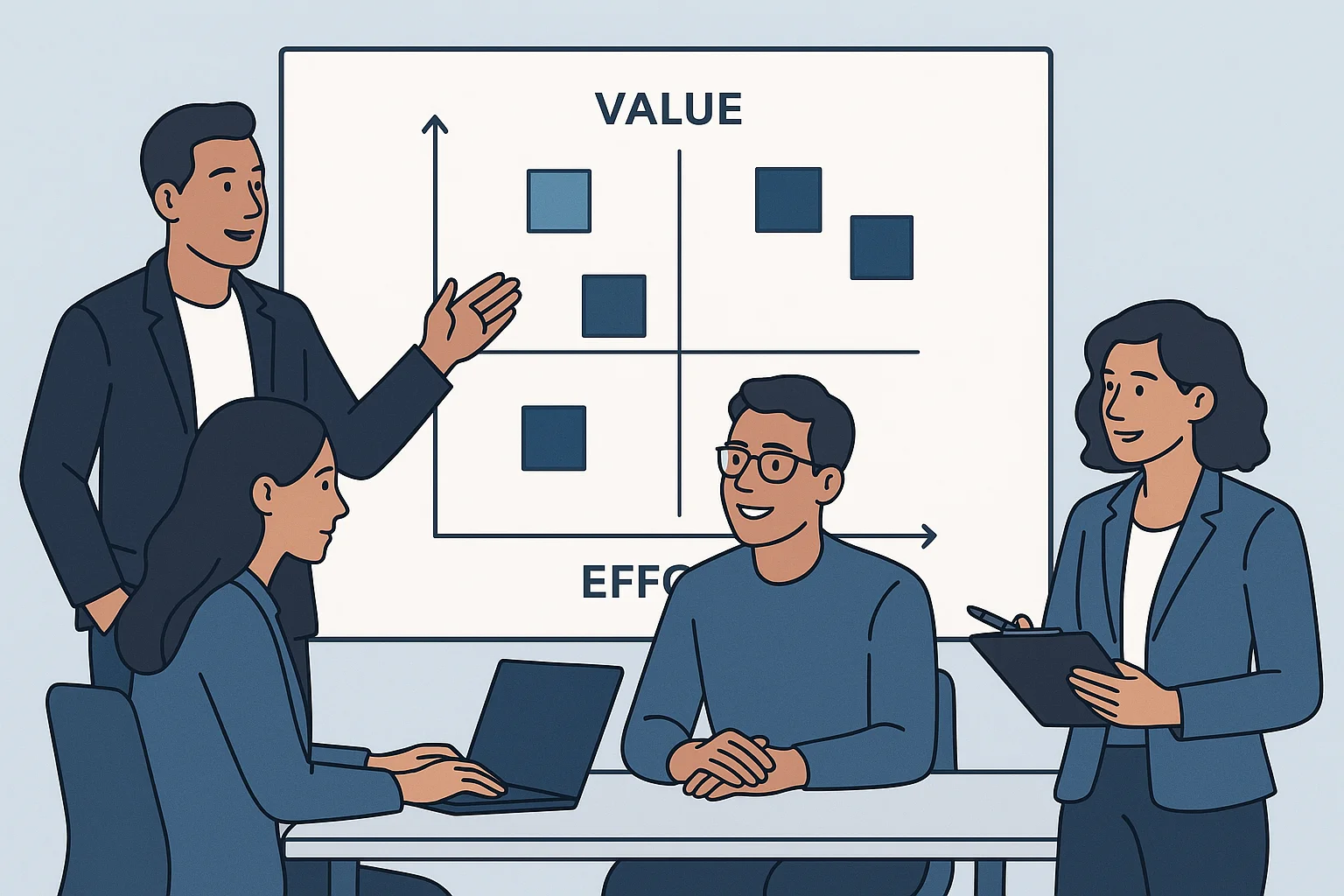
From Debate to Done – The MVP Prioritization Challenge
The war room is tense. The whiteboard, a graveyard of conflicting ideas, tells a familiar story for many startup founders: analysis paralysis. You know you need to launch a lean MVP, but every feature feels essential. Hours turn into weeks spent debating priorities with co-founders, getting lost in complex frameworks like RICE or MoSCoW that feel like overkill for an early-stage product. What if you could cut through the noise and create a clear, actionable roadmap in a single afternoon? This guide is designed to do just that, offering a streamlined approach similar to what you might find in systems like the MVP Development Process Steps: The Guaranteed 14-Day Launch System. We’re shelving the complex spreadsheets and focusing on one brutally simple tool: the Value vs. Effort matrix. It’s the fastest way to translate your sprawling brainstorm into a focused, prioritized feature list. This framework is your key to ending the debates, making decisive choices, and getting your product into the hands of users faster.
What is MVP Feature Prioritization and Why It's Non-Negotiable
MVP feature prioritization is the disciplined process of deciding which features to build now versus later for your initial product launch. It’s not about creating an endless wishlist; it’s about making strategic, often ruthless, cuts to focus solely on what delivers the most critical value to your first users with the least amount of effort. For founders and product managers, this isn't a "nice-to-have" management exercise—it's a core survival mechanism. So, why is it non-negotiable? Because you are operating with finite resources. Every hour your development team spends on a low-impact feature is an hour stolen from one that could validate your entire business idea. Without a clear prioritization framework, teams inevitably fall into classic startup traps: endless debates driven by opinion, chasing competitor features, and bloating the product until it fails to solve any single problem well. This is how you burn through cash and momentum. Effective prioritization is your fastest path from idea to real-world feedback. It forces your team to align on the core hypothesis—the single most important problem you are solving. It replaces subjective arguments with a structured system, enabling you to build only what is essential to prove customers want your solution. This discipline protects your runway and gives your MVP the best chance of success, exemplifying the value of focused, rapid development strategies such as those highlighted in [MVP Development For Startups: Launch in 14 Days for a Fixed $4,990].
Why Most Prioritization Frameworks Overwhelm (And Why We Need Simplicity)
If you've delved into the world of feature prioritization, you've undoubtedly encountered a confusing alphabet soup of frameworks: RICE, MoSCoW, Kano, and ICE. While resources like RICE vs MoSCoW: The Ultimate 2025 Guide to MVP Feature Prioritization Frameworks explore the nuances of some of these, these systems, though valuable for mature products with extensive data, often prove disastrous for a pre-launch MVP. They demand you assign precise scores to abstract variables like "Reach" or "Confidence" when you’re still operating on educated guesses. This quest for false precision grinds progress to a halt. Instead of building, teams get trapped in endless debates and “analysis paralysis,” arguing over whether a feature’s impact is an 8 or a 9. The complex spreadsheets create a dangerous illusion of certainty while you burn through your most critical assets: runway and momentum. You spend weeks debating what to build instead of days actually building it. For an MVP, the goal isn't mathematical perfection; it's maximum learning with minimum effort. You don't need a convoluted algorithm to tell you what to do. You need a brutally simple tool that sparks the right conversation and provides directional clarity. It should focus exclusively on the two foundational questions every founder must answer: How much value does this create for my first users, and how much effort will it take to build? Everything else is just noise.
The "Value vs. Effort" Matrix: Your Simple Path to Clarity
Forget the complex spreadsheets and endless debates that kill momentum. The Value vs. Effort matrix is a brutally simple, visual tool designed to get your team aligned and your feature list prioritized in a single session. It forces you to answer just two critical questions for every feature idea. First, plot Value on the vertical axis: How much impact will this have on your user? Does it solve a core, painful problem or is it just a nice-to-have? This is about delivering a game-changing solution for your first customers. Next, plot Effort on the horizontal axis: How much time, technical complexity, and resources will it take to build? This simple grid immediately sorts your features into four clear quadrants:
- Quick Wins (High Value, Low Effort): These are your Minimum Viable Product (MVP) features. Do them now, following a streamlined approach similar to the principles found in Startup MVP: A Founder's Guide to Building and Launching in 14 Days.
- Major Projects (High Value, High Effort): These are strategic initiatives for future releases. Plan for them, but don’t build them yet.
- Fill-ins (Low Value, Low Effort): Tempting distractions. Ignore them for now.
- Time Sinks (Low Value, High Effort): Avoid these at all costs.
This framework replaces subjective arguments with a shared visual map. It provides instant clarity, eliminates analysis paralysis, and gives you a concrete, actionable plan to start building what truly matters.
Step 1: Laying the Groundwork – Defining Core Problem & User Needs
Before you list a single feature, stop. The biggest mistake founders make is brainstorming a solution before deeply understanding the problem. A long list of features is a sign of an unfocused strategy, leading to months of building something nobody actually needs. Remember, your MVP is not a miniature version of your final product; it's a laser-focused experiment designed to solve one core, painful problem for a very specific user. For a comprehensive understanding of this critical process, you might find The Complete MVP Development Guide for 2024 incredibly useful. Your first task is to define this problem with absolute clarity. Get out of your own head and talk to at least five potential customers. Listen to their frustrations. Don't ask for a feature wishlist—dig into the "why" behind their struggles. Your goal is to distill this research into a simple Problem Statement: “Our target user [describe user] struggles with [describe a specific pain point] because [describe the obstacle].” This single sentence is your anchor. It becomes the ultimate filter for every feature idea you have. An idea is only valuable if it directly helps this user solve this problem. With this groundwork laid, you're no longer debating opinions; you're making evidence-based decisions. This focus transforms the next step—prioritization—from a chaotic debate into a fast, objective exercise.
Step 2: Ideation & Assessment – Brainstorming and Initial Feature Listing
With your core problem defined, it's time for a rapid, unfiltered brain dump. This isn't the stage for debate or feasibility checks; it’s about capturing every potential feature without judgment. Gather your team—whether in a room with a whiteboard and sticky notes or virtually on a Miro board—and set a timer for 30 minutes. The objective is quantity over quality. Ask yourselves: "To solve our customer's primary problem, what actions must they be able to take?" Frame every idea as a simple feature or user story. Think "user can reset their password," "user can invite a team member," or "admin can view a dashboard." If an idea pops into someone's head, it goes on the board. No idea is too small or too audacious at this point. Avoid the classic trap of getting bogged down in "how." Discussions about database schemas or API choices are distractions that kill momentum. Your only goal is to create a comprehensive longlist of everything the product could do. This list will likely feel overwhelming and chaotic—that's a sign you're doing it right. This raw, unorganized inventory is the essential raw material we'll use in the next step to surgically identify your true MVP. For more in-depth guidance on this critical phase, consider consulting resources like How to Define Scope for an MVP Project: The Ultimate Guide.
Step 3: Quantifying Impact – Scoring Features by "Value"
"Value" isn't just about potential revenue. For an MVP, its primary measure is impact on learning. How effectively does this feature validate your core business assumption and solve the user’s most critical pain point? Forget complex financial models. To quantify value, use a simple, relative scoring system. Gather your key stakeholders—like the founder, a developer, and a customer-facing team member—and assign each feature a score from 1 (low impact) to 5 (critical impact). This is a gut-check exercise, not a scientific analysis. The goal is speed and alignment, not perfect precision. To guide your scoring, ask these crucial questions for every feature:
- Problem-Solving: How essential is this to solving the user's number one problem?
- Hypothesis Testing: Does this directly test a make-or-break assumption about our business?
- User Acquisition: Will this single feature be compelling enough to attract our first 10 users?
Discuss each feature briefly as a group and force a score. If the team is stuck between a 3 and a 4, pick one and move on. This rapid, collaborative process eliminates endless debates and focuses everyone on what truly matters: shipping a product that proves your concept. To effectively validate your MVP and ensure it meets user needs, mastering strategies like those outlined in The 2025 Playbook: Essential User Testing Strategies for Your New MVP is crucial. The output is simply a ranked list, ready for the next step.
Step 4: Estimating Resources – Scoring Features by "Effort"
With your features scored by value, it’s time to calculate their cost. In the world of MVP development, we call this “Effort.” This isn’t just developer hours; it’s the total resource investment required to bring a feature to life. For a comprehensive understanding of the complete price tag, encompassing design, development complexity, testing, and even potential operational overhead, you might want to consult 2025 MVP Costs: Demystifying Your Basic Minimum Viable Product Budget.
Your job here is not to create a detailed project plan—that’s a classic mistake that leads to analysis paralysis. Instead, you need a quick, relative estimate. This is a crucial moment to bring in your technical lead or development team. Don’t guess the effort if you’re non-technical.
Walk through your feature list with your technical experts and have them assign a simple score from 1 to 5.
- 1 = Trivial: Can be completed quickly with minimal resources.
- 3 = Moderate: A standard-sized task requiring some focused work.
- 5 = Very High: A complex and resource-intensive feature with significant risk or dependencies.
The goal is rapid, relative sizing. You only need to know if Feature A is roughly twice as complex as Feature B, not whether it will take 27 hours versus 14. Once every feature has an effort score, you have the final data point needed to make ruthless, effective decisions.
Step 5: The Decision Matrix – Plotting and Prioritizing Your MVP Features
This is where your abstract scores become a concrete action plan. Forget complex spreadsheets; all you need is a whiteboard or a simple digital canvas. Draw a four-quadrant grid. The vertical axis represents Value (Low to High), and the horizontal axis represents Effort (Low to High). Now, take your feature list and place each item onto the matrix based on the scores you assigned in the previous step.
Once plotted, your priorities become visually undeniable:
- High Value, Low Effort (Top-Left): Quick Wins. These are your non-negotiable MVP features. They deliver maximum impact for minimal work. Build these first, no debate. This quadrant forms the core of your initial product launch, much like what's described in The $4,990 MVP: How We Prioritize Features & Launch Your App in 14 Days.
- High Value, High Effort (Top-Right): Major Projects. These are powerful, strategic features that will likely define future versions of your product. Acknowledge their importance, but park them for a post-launch release to avoid delaying your MVP.
- Low Value, Low Effort (Bottom-Left): Fill-ins. Tempting because they’re easy, these minor features add little core value. Ignore them for now.
- Low Value, High Effort (Bottom-Right): Time Sinks. Ruthlessly eliminate these. They are the definition of scope creep and will kill your timeline and budget.
By plotting each feature, your MVP roadmap materializes instantly. The top-left quadrant isn’t just a list; it’s your clear, validated path to launch.
Avoiding the Traps: Common Pitfalls and Sustaining Momentum
Even with a simple framework like the Value vs. Effort matrix, it’s easy to get stuck. The most common pitfall is analysis paralysis in disguise, where teams waste days debating if a feature is a ‘9’ or ‘10’ on the value scale. The solution? Time-box it. Give yourselves two hours to score and plot every feature, trusting your gut—the goal is directional accuracy, not scientific precision. Another trap is "gold-plating," the temptation to add “just one more small thing” to a feature to make it perfect. These small additions accumulate, bloating your scope and pushing back your launch date. Remember, you are building a Minimum Viable Product; be ruthless in cutting anything that isn’t essential to solving the core user problem. To effectively navigate these and other challenges, ensuring your initial efforts translate into long-term success, explore how to Future-Proof Your Product: Avoiding Common Pitfalls in MVP Development Strategy. Finally, don't lose sight of the 'why'. It's easy to fall in love with features, but your focus must remain on the customer's problem. Before committing to any work, always ask: "Is this the most direct way to validate our main assumption?" Sustaining momentum after launch means treating your prioritized list as a living document. Your first users are your new source of truth; their feedback and behavior are the most accurate inputs for the "Value" axis. Let real-world data guide your next sprint, turning your initial plan into a dynamic, customer-centric roadmap.
Launch Faster, Learn Sooner
Navigating the path to a successful MVP launch is often stalled by one major roadblock: endless feature debates. The key to breaking this cycle lies in adopting a simple, structured prioritization framework. By shifting the focus from subjective opinions to a clear evaluation of core user value versus implementation effort, teams can make objective decisions. This ensures your MVP remains truly "minimum" yet "viable," solving a crucial problem for your target audience without unnecessary complexity. This disciplined approach not only silences the noise of debate but also conserves resources and dramatically accelerates your time to market. The real test begins now. Implement this framework in your next planning session, challenge your team to ruthlessly prioritize, and launch your product to start gathering the invaluable user feedback that truly matters.
Stop endless debates and launch your MVP faster by implementing our brutally simple feature prioritization framework today. Book your free project consultation today.

Børge Blikeng
AuthorHelping startups build successful MVPs for over 5 years