The Freelancer Gamble: Why It's the Riskiest Way for Non-Technical Founders to Build an MVP
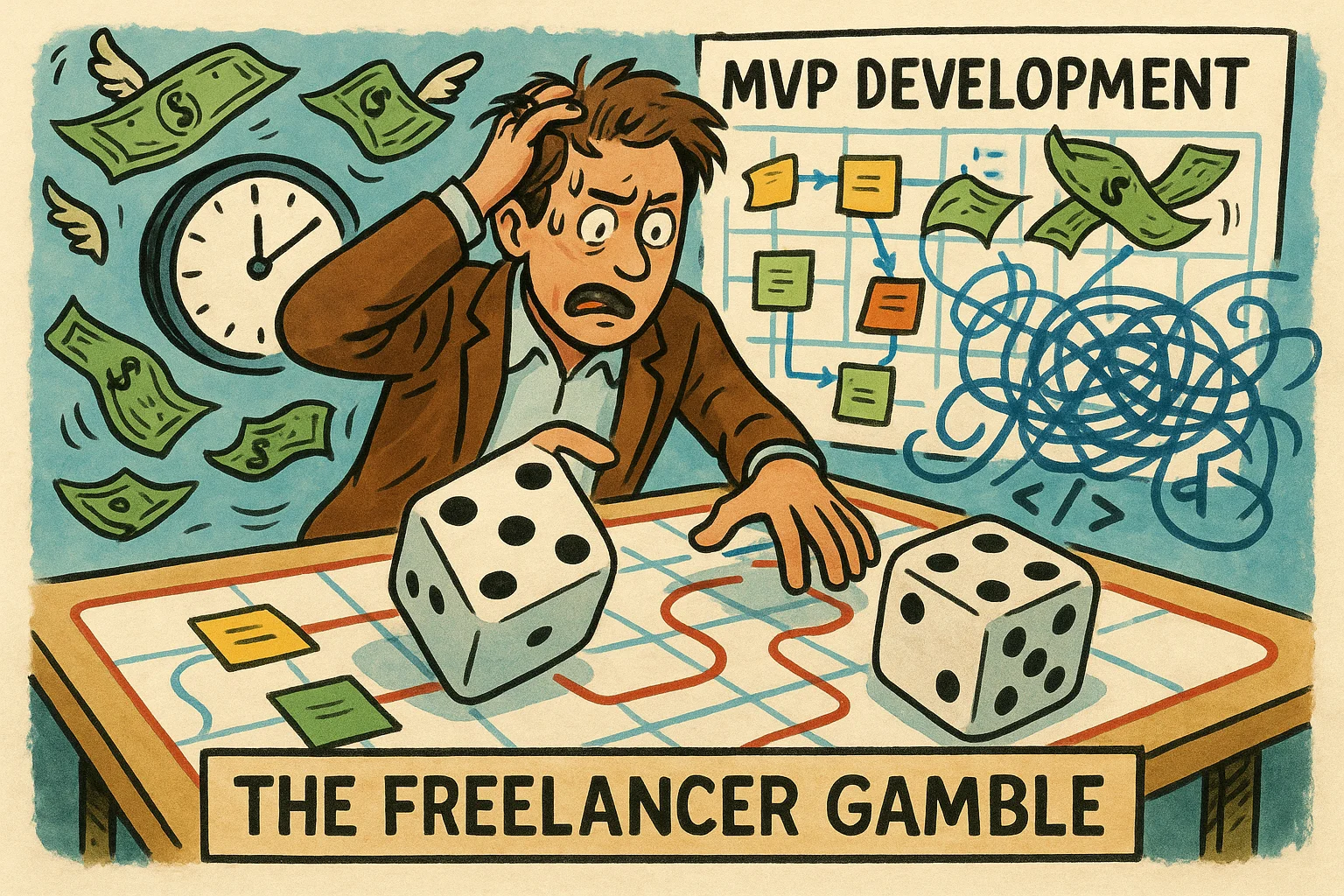
The Allure and Peril of Freelancers for Non-Technical MVP Development
You have a brilliant business idea, a solid plan, but one crucial missing piece: the technical expertise to build it. For many non-technical founders, hiring a freelance developer seems like the most direct path to launching a Minimum Viable Product (MVP). But this well-trodden path is a high-stakes gamble. You risk facing a project plagued by spiraling costs, unexpected delays, and inconsistent quality, turning your entrepreneurial dream into a costly nightmare. What if you could remove the uncertainty from the equation entirely? This article moves beyond simply highlighting the dangers of the freelance market. It introduces a definitive alternative: Fixed Price MVP Development Packages: Your Predictable Path to Product Launch, a guaranteed system designed to eliminate the gamble, ensuring your vision is built on time, on budget, and precisely to your specifications, paving a secure road to your market launch.
The Illusion of Savings: Unmasking the Hidden Costs and Scope Creep of Freelance MVPs
The initial quote from a freelance developer often feels like a bargain, a straightforward path to bringing your vision to life. However, this figure is rarely the final bill. It’s the starting line for a financial marathon with no clear finish. The core issue is scope creep, a gradual expansion of the project that quietly inflates your budget. As a non-technical founder, your initial brief is a hypothesis, not a perfect blueprint. Every clarification, minor adjustment, or “small” feature request—the natural evolution of building a product—becomes a billable event. This is the central gamble: you’re not just paying for the code you specified, but also for the discovery process. Hidden costs quickly accumulate in the form of bug fixes on features you thought were complete, unexpected integration challenges, and lengthy problem-solving sessions. Each unforeseen task adds billable hours, pushing your launch date further away and draining your crucial seed capital. The real danger isn’t just the overspending; it’s the crippling uncertainty. Without a guaranteed, fixed price, you’re essentially handing over a blank check, gambling that the final number is one your startup can survive. This unpredictable model turns your budget into a moving target, undermining your ability to plan and invest in other critical launch activities. To truly understand The True Cost of an MVP: How to Eliminate Hidden Fees with a Fixed-Price Model and overcome these financial challenges, exploring models that offer budgetary certainty is essential.
Quality Control Catastrophe: Why Non-Technical Founders Struggle to Ensure Code Excellence
As a non-technical founder, you can judge the user interface, but you have no visibility into the code's foundation. Your MVP might look sleek and function correctly on the surface, but underneath it could be a tangled mess of ‘spaghetti code.’ This isn't just about neatness; it's about your future. Poorly written code is a ticking time bomb, creating 'technical debt' that cripples your ability to scale. Adding new features becomes a slow, expensive nightmare. Performance suffers, bugs multiply, and your product becomes unstable as soon as it faces real user traffic.
The real disaster strikes when you inevitably hire a new developer. They take one look at the codebase and deliver the devastating news: it’s unmaintainable and needs a complete rewrite. The time and money you invested are effectively lost, sending you back to square one. Without an integrated system of code reviews and quality assurance—something lone freelancers rarely provide—you are simply gambling on their individual skill and integrity. It’s a bet on an invisible asset, and for a founder with everything on the line, the odds are stacked against you. This lack of oversight is one of the biggest hidden risks of the freelance model.
The Communication Chasm: Navigating Jargon and Expectations Without a Technical Background
You describe a “simple user profile,” envisioning a name and photo. Your freelance developer, however, hears a list of technical tasks: database schema design, API endpoints, image upload processing, and authentication protocols. This is the communication chasm, and it's where MVP budgets and timelines are lost. The danger isn’t just misunderstanding; it’s the unasked questions. Did you specify password recovery flows, social login options, or data privacy compliance? A freelancer, often paid by the hour, builds exactly what’s requested, leaving you to discover these critical omissions later—each one a new, costly change order. This forces you to become an amateur project manager, responsible for translating every business need into a flawless technical specification. Every assumption becomes a financial risk. This constant, high-stakes translation drains your focus from what you do best: growing your business. Effectively managing a developer isn’t about learning to code overnight; it's about eliminating the guesswork that plagues the freelance model. For non-technical founders, understanding the intricacies of Outsourced MVP Development for Non-Technical Founders: Launch Your Idea Without is key to navigating these challenges. The only way to bridge the chasm is with a system that translates your vision into a locked-in plan, guaranteeing a fixed scope and cost before a single line of code is written. This provides a predictable roadmap, not a journey of expensive misunderstandings.
Project Management Paralysis: The Burden of Solo Oversight on Non-Technical Founders
As the visionary, your job is to steer the ship. But when you hire a freelancer, you’re suddenly forced into the engine room, expected to be the project manager, product owner, and quality assurance tester—all without a map. This is where project management paralysis sets in. You’re tasked with overseeing a process you don’t fully understand, turning your role from CEO into a full-time, high-stress coordinator. How can you effectively manage a developer’s progress without a technical background? The hard truth is, you can’t—not without significant risk. You can’t accurately validate their timelines, question their architectural decisions, or spot shoddy code that will cause problems later. Is a feature taking five days because it’s complex, or because it’s being built inefficiently? This paralyzing uncertainty means you spend more time chasing updates and trying to translate your vision into technical specs than you do talking to customers. This isn't a personal failing; it's a fundamental flaw in the model. Your focus is splintered, and your energy is drained by operational details instead of being invested in strategy and growth. For non-technical founders seeking to navigate these challenges and ensure a swift, successful launch, comprehensive guidance is crucial. Consider valuable resources such as MVP Development for Non-Tech Founders: Your 2025 Guide to Launching Fast. A successful MVP launch ultimately requires a system where technical project management is an included guarantee, not your second job. It frees you to focus on what truly matters: building the business.
The Post-MVP Predicament: Long-Term Support and Scalability Challenges with Freelance Solutions
Congratulations, your MVP is live! You’ve successfully navigated the development process and have a working product. But what happens next? For many founders who chose the freelance route, this is where the real challenge begins. The initial launch isn't the finish line; it’s the start of a long-term journey requiring ongoing support, bug fixes, and feature updates. Understanding this path is crucial, and resources like Beyond the MVP: A Founder's Roadmap to Scaling and Iteration provide valuable insights. The most immediate problem is freelancer availability. The developer who built your MVP is likely juggling multiple clients and may not be available for urgent fixes or critical security patches. Your product’s stability becomes dependent on one person's schedule, creating a dangerous single point of failure. Beyond immediate support, there’s the issue of scalability. A solo freelancer, focused on speed, may have inadvertently built up significant "technical debt"—code that works for now but is messy, poorly documented, and not structured for growth. When you’re ready to add complex features or handle a surge in users, you’ll discover the foundation is too fragile. This often forces a painful and expensive decision: patch a broken system indefinitely or start over with a complete rebuild. The initial "win" of a quick launch can quickly become a long-term technical and financial burden, derailing your path to growth.
De-Risking Your MVP: The Strategic Alternatives to the Freelancer Gamble
Navigating your MVP launch doesn't have to feel like a high-stakes bet on a single developer. For non-technical founders, moving beyond the freelancer gamble means exploring strategic alternatives that prioritize certainty. While finding a technical co-founder is one path, it's often a long, difficult process requiring significant equity surrender before concept validation. Similarly, traditional agencies, despite being an option, often present high costs and slow, bureaucratic processes that conflict with the lean, agile nature of an MVP. The most effective alternative for startups is a productized development system. This approach fundamentally de-risks the entire process by offering a guaranteed outcome for a fixed price and a set timeline, a key benefit explored in depth through services like Fixed Cost MVP Development Services for Startups: 2025's Smartest Launch. Imagine knowing your exact cost and launch date before a single line of code is written. This model replaces the uncertainty of hourly billing and project creep with a clear, predictable partnership. You aren't just hiring a coder; you are investing in a complete, end-to-end system designed to transform your idea into a market-ready product efficiently. It's the definitive way to remove the guesswork, control your budget, and get to market with the speed and confidence your new venture demands, letting you focus on validation and growth, not managing a risky project.
Introducing the Predictable Path: How Fixed-Price Systems Mitigate MVP Risks
After navigating the unpredictability of the freelancer market, the idea of a guaranteed outcome can feel like a revelation. This is the core promise of a fixed-price development system—an approach designed to replace risk with certainty. Instead of paying an hourly rate for an undefined period, you commit to a single, upfront price for a meticulously scoped-out Minimum Viable Product. The entire financial equation is solved before a single line of code is written. This model directly neutralizes the biggest threats non-technical founders face. The risk of a runaway budget disappears; your total investment is known and capped from day one, eliminating the anxiety of surprise invoices and endless billing cycles. Scope creep, the silent killer of so many projects, is managed through a disciplined process where the features are locked in, ensuring your team builds only what is essential for launch. For a deeper understanding of how to prevent the common 'horror stories' often associated with MVP budgets and fixed-price contracts, see MVP Budget vs. Fixed-Price Contract: How to Avoid Both Horror Stories. Most importantly, this system provides a firm delivery date. Your launch is no longer a vague target subject to delays but a fixed point on the calendar you can build your entire business strategy around. By trading the freelancer gamble for a predictable path, you stop managing a project and start building a business with the confidence that your MVP will be delivered on time and on budget, guaranteed.
The Non-Technical Founder's Playbook: Managing Your MVP Project with a Structured Approach
Managing a technical project without technical expertise can feel like you're flying blind. The key isn't to learn to code, but to implement a rigid management system that demands clarity and accountability. This playbook replaces guesswork with a structured process, giving you control even when you don't understand the underlying code. First, eliminate ambiguity by defining everything upfront. Create detailed user stories (“As a user, I want to…”) and simple wireframes for every single screen. Define clear "acceptance criteria" for each feature—what does "done" actually look like? This document is your contract and your guide, preventing the scope creep and budget overruns that plague freelance projects. For a proven method to establish this foundational clarity and accelerate your product's journey, explore resources like Define MVP Scope for a Fixed Price: The Guaranteed 14-Day Launch Plan. Next, establish a non-negotiable communication rhythm. Mandate brief daily stand-ups and a weekly demo where you see and test the actual, working software. This forces progress to be tangible, shifting the focus from technical jargon to outcomes you can personally verify. Finally, maintain absolute transparency with a project management tool like Trello or Asana. Every task should be visible, tracked, and prioritized. While this playbook provides a framework, successfully enforcing it on an independent freelancer can become a full-time job in itself. The most reliable path to launch isn't just about managing a project; it's about adopting a proven system built for delivering results with speed and certainty.
Beyond Launch: Ensuring Future Growth and Support Within a Guaranteed Framework
Launching your MVP isn’t the finish line; it’s the starting gun. What happens in the weeks and months that follow is what truly determines your success. This is where the freelancer model often reveals its most critical flaw. After the final payment, their commitment typically ends. You’re left with a codebase you don’t understand, facing a new gamble for every bug fix, security patch, or feature iteration. Will they be available? What will their new hourly rate be? This uncertainty can paralyze your ability to react to user feedback and grow your business. A guaranteed framework, however, builds your long-term success into the initial plan. Instead of a one-off transaction, it establishes an ongoing partnership. This means having a clear, predictable path for maintenance, support, and future development cycles, directly addressing the question of What Does an On-Time MVP Launch Guarantee Actually Cover? (Our 14-Day Promise). The team that built your initial product retains that critical knowledge, allowing for rapid and cost-effective iterations. You can confidently promise improvements to users and investors because you have a reliable technical foundation ready to scale with your vision. It replaces the anxiety of post-launch abandonment with the certainty of a dedicated team, ensuring your MVP is not just a finished project, but the first step on a clear roadmap to a mature product.
Investing in Confidence: Why a Structured, Fixed-Price MVP is Your Smartest Bet
The freelance model often feels like a slot machine: you keep feeding it money, hoping for a jackpot but never knowing when—or if—it will pay out. For a non-technical founder, this uncertainty is more than just stressful; it's a direct threat to your venture. The smart alternative is to shift from gambling on hourly rates to investing in a guaranteed outcome. A structured, fixed-price MVP model eliminates the financial guesswork and puts you back in control.
With a fixed-price agreement, the total cost is defined upfront, based on a meticulously planned scope. This isn't just about budget certainty; it’s about forcing the discipline of strategic planning before a single line of code is written. It transforms the conversation from "How many hours will this take?" to "What is the exact functionality we will deliver for this price?"
This approach fundamentally aligns incentives. The development team is motivated to work efficiently and deliver on schedule because their profitability depends on it, not on billing more hours. You're no longer paying for time; you're paying for a tangible result. By removing the fear of spiraling costs and endless delays, you can focus your energy where it truly belongs: validating your business idea, talking to customers, and preparing for a successful launch. It’s not just a different payment structure—it’s a strategic decision to buy confidence and predictability.
Empowering Non-Technical Founders to Build with Certainty, Not Chance
For non-technical founders, entrusting an MVP to a freelancer is a significant gamble. The core risks—an inability to vet code quality, misaligned long-term incentives, and poor communication—can lead to an unscalable product riddled with costly technical debt. The danger of a developer becoming a single point of failure cannot be overstated, leaving you with a codebase no one else can manage. While the upfront cost seems tempting, focusing solely on a cheap "tech stack" often means you're asking the wrong question, as detailed in The $5,000 MVP Tech Stack? You're Asking the Wrong Question.. The potential for budget overruns and future rebuilds makes it a perilous path. Instead of rolling the dice, prioritize more stable foundations. Diligently seek a technical co-founder who shares your vision, validate your concept with powerful no-code tools, or partner with a reputable development agency. Investing in the right technical foundation from day one isn't an expense; it's your startup's most critical insurance policy.
Stop gambling on unpredictable freelancer costs and launch your MVP with our guaranteed, fixed-price system. Book your free project consultation today.

Børge Blikeng
AuthorHelping startups build successful MVPs for over 5 years