The True Cost of an MVP: How to Eliminate Hidden Fees with a Fixed-Price Model
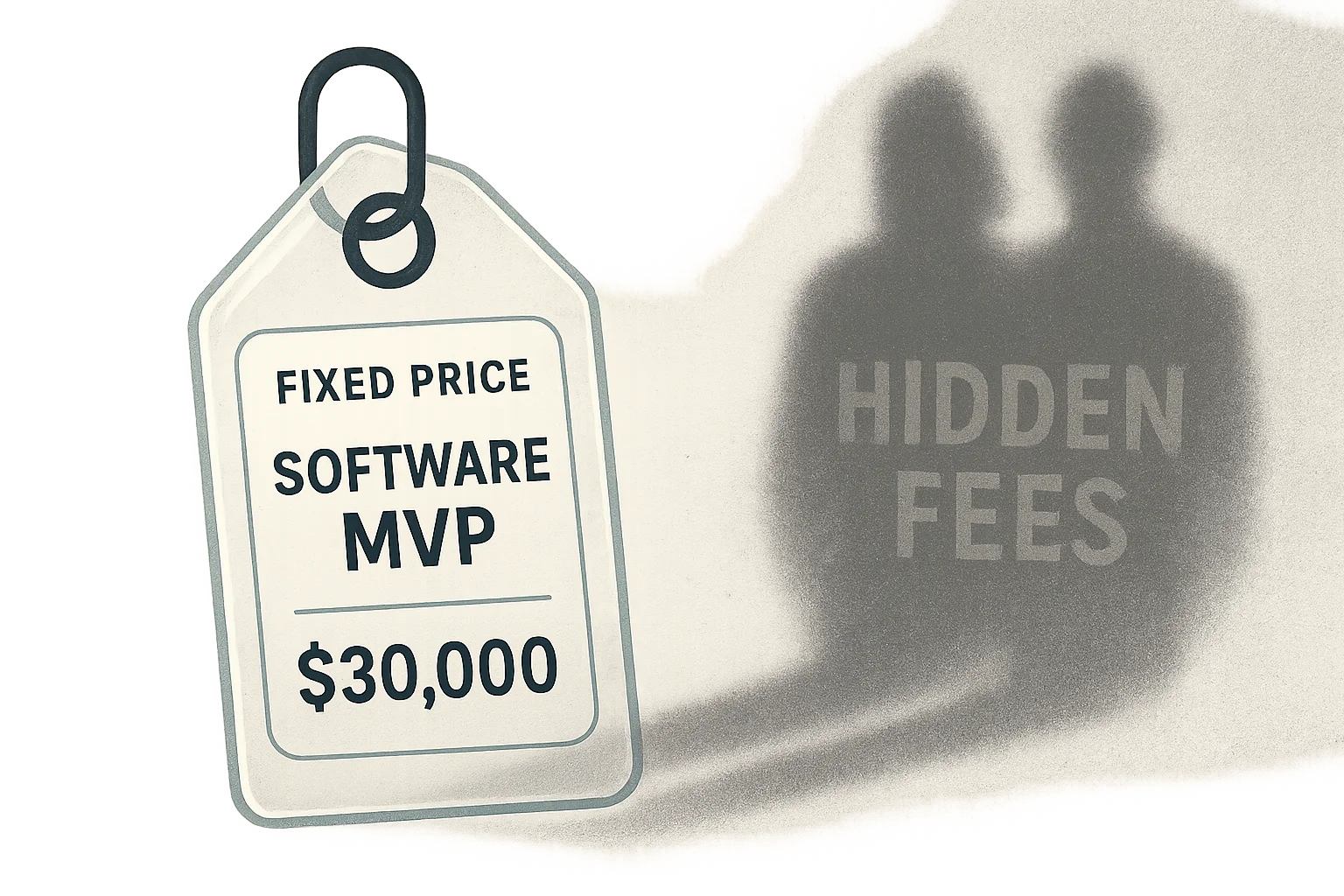
The Unseen Drains on Your MVP Budget
The dream of launching your MVP can quickly turn into a financial nightmare. Scope creep, surprise invoices, and endless "add-ons" are the hidden costs that sink promising startups before they ever set sail. You've likely been warned against fixed-price contracts, often portrayed as rigid and risky by development agencies that profit from the unpredictability of hourly billing. To truly understand the dynamics and avoid common pitfalls, consider insights on MVP Budget vs. Fixed-Price Contract: How to Avoid Both Horror Stories. We’re here to challenge that narrative head-on: a meticulously planned, fixed-scope model isn't just a viable option; it is the only path to achieving absolute budget certainty. This approach forces critical upfront planning, eliminates the ambiguity that fuels cost overruns, and places the accountability for on-time delivery squarely on your development partner. Forget the myth of "flexibility" that secretly drains your runway. Let’s explore how a guaranteed price eliminates hidden fees and empowers you to launch your vision with confidence.
Understanding the MVP Development Landscape: Beyond the Initial Quote
Receiving that first development quote feels like a major milestone, a tangible step towards bringing your vision to life. However, this initial number often serves as an entry point into a complex landscape fraught with financial traps. The most common pitfall is the alluring flexibility of hourly billing, which, while sounding adaptable, renders your budget completely unpredictable. Every minor bug fix, clarification email, and "quick sync-up call" adds to a ticking clock, creating an incentive structure that rewards extended timelines over rapid, efficient delivery. You are effectively paying for the development process itself, not the guaranteed delivery of a finished product. Another dangerous path is the vaguely defined “agile” retainer. Without a crystal-clear, locked-down scope from the outset, these sprints can become an endless cycle of costly revisions and "pivots." What begins as a direct path to a Minimum Viable Product slowly morphs into a project with no finish line and a rapidly draining bank account. This is the breeding ground for scope creep, where seemingly small feature requests snowball into significant, unbudgeted expenses. The reality is that these open-ended models are designed to absorb “unforeseen” costs—costs that are ultimately passed on to you. For a truly predictable path to product launch, ensuring the price you agree to is the final price you pay, explore options like Fixed Price MVP Development Packages: Your Predictable Path to Product Launch, which can eliminate these financial variables from day one.
Unmasking the Hidden Enemies: Common Invisible Costs in MVP Development
For a founder, the initial development quote is often a mirage. The true financial danger isn’t in the number you see, but in the invisible costs that materialize in hourly-billing models. These hidden enemies are what turn a promising budget into a cautionary tale.
The most infamous is scope creep. In a time-and-materials contract, every "quick addition" or "minor change" directly inflates your final bill, turning small requests into major expenses. Then there's the relentless drain of project management overhead. You're not just paying for code; you're paying for every meeting, email, and status update. Another silent budget-killer is development drag, where debugging, refactoring, or simple inefficiencies are billed by the hour, rewarding slower work. Finally, watch for surprise invoices for third-party integrations and post-launch "support" that you assumed were included.
These aren't unfortunate accidents; they are built-in features of a flexible pricing structure. This model thrives on ambiguity, creating a battleground where your vision and your budget are constantly at risk. The only way to guarantee victory is by refusing to fight on those terms, demanding a locked-in scope and a single, final price from the start. This approach aligns perfectly with the predictability and peace of mind offered by options like Fixed Cost MVP Development Services for Startups: 2025''s Smartest Launch, ensuring your project launches smartly and within budget.
The Allure of Flexibility: Exploring the Time & Materials Model's True Price
On the surface, the Time & Materials (T&M) model seems seductive. It promises unparalleled flexibility—the freedom to pivot, add features, and evolve your product as you go. For a founder navigating an uncertain market, this adaptability can feel like a crucial advantage. But what is the true price of this perceived freedom?
In reality, this flexibility often masks a dangerous lack of financial discipline. With T&M, the final bill is a moving target, making budget forecasting impossible. Every hour logged, every "quick call," and every minor tweak adds to a growing invoice with no defined ceiling. This structure creates a fundamental misalignment: the development partner is incentivized by billable hours, not by the rapid, efficient delivery of your MVP. Suddenly, your project’s timeline stretches, and your precious runway evaporates. The "flexibility" to add features becomes a gateway to uncontrolled scope creep, turning your role from a product visionary into a timesheet auditor. You're left micromanaging progress instead of focusing on market strategy. For a startup, this model transforms your budget from a strategic tool into an unpredictable gamble. It swaps the certainty of a fixed launch cost for the constant anxiety of a running meter—a risk few new ventures can afford to take.
Challenging the Narrative: Why Fixed-Price Isn't 'Risky' for Your MVP
Let's challenge a common industry myth: the idea that a fixed-price contract is too rigid and therefore "risky" for a dynamic MVP. This narrative suggests that flexibility is paramount, but it often disguises the true danger—an open-ended budget and a timeline that stretches indefinitely. The real gamble isn't committing to a scope; it's starting development without a clear finish line, where hourly billing can easily fuel scope creep and hidden fees. This approach leaves you vulnerable to endless development cycles that drain your capital before you can even launch.
A fixed-price agreement fundamentally flips this equation from risk to certainty. It forces crucial, upfront strategic decisions about what truly matters for your initial product. This isn't a constraint; it's a powerful discipline. By defining the exact features, deliverables, and cost from day one, it aligns your vision with a concrete execution plan. The very purpose of an MVP is to test a core hypothesis with speed and efficiency. A fixed-price model is the ultimate enabler of this goal, enforcing a laser-focus on essential functionality. Instead of a financial leap of faith, you make a calculated investment with a guaranteed outcome: a specific product, for a specific price, by a specific date. That isn’t risk; it's control.
The Fixed-Price Advantage: Budget Certainty and Scope Clarity from Day One
For a startup founder, financial uncertainty is the ultimate threat. The common "flexible" billing models, often sold as an advantage, frequently become a direct path to budget overruns and scope creep. They place the financial risk of delays and inefficiencies squarely on your shoulders. A fixed-price contract fundamentally reverses this dynamic, providing the two things an early-stage venture needs most: certainty and discipline.
From the very beginning, you know the exact cost to bring your MVP to life. This isn't a vague estimate; it's a guaranteed number you can build your financial plans around. This budget certainty is only possible through absolute scope clarity. The fixed-price model mandates a rigorous planning phase where every feature, user story, and deliverable is meticulously defined and agreed upon. This process forces you to prioritize what truly matters for your initial launch, cutting through the noise of "nice-to-have" features that derail timelines.
This isn't about being rigid; it's about being strategic. By locking in the scope and price, you and your development partner are perfectly aligned on a single, clear objective. The responsibility to deliver efficiently and on schedule rests with the experts you hired. This framework eliminates hidden costs and ensures your focus remains on one thing: a successful, on-budget launch.
Decoding the Ideal Match: Why a Fixed-Price Model Excels for MVP Success
When launching an MVP, the choice between a fixed-price and a flexible, time-and-materials model is pivotal. While flexible models promise adaptability, they often become a gateway to budget overruns and indefinite timelines. For a founder whose runway is finite, this unpredictability is a critical risk. Every unexpected development hour chips away at your capital, delaying market validation and draining resources that could be used for user acquisition.
This is precisely why a fixed-price model is the ideal partner for your MVP journey. It’s not about rigidity; it’s about discipline. This model enforces the very principles of an MVP: ruthless prioritization and a laser-focused scope. By defining the exact features, deliverables, and total cost upfront, you eliminate the single greatest source of startup anxiety—financial uncertainty.
A fixed-price contract transforms your budget from a vague estimate into a guaranteed investment. It forces crucial, upfront conversations about what is truly essential for your first launch, ensuring every dollar is spent on validating your core business idea. This alignment between scope, timeline, and cost provides the absolute certainty needed to build with confidence and launch on schedule. It’s the ultimate de-risking strategy, allowing you to preserve capital for the growth that follows a successful release.
Mastering the Blueprint: Crafting an Ironclad Fixed-Price MVP Scope
Scope creep is the silent killer of startup budgets. The only way to combat it and eliminate unexpected expenses is with a meticulously defined project blueprint. Think of it like building a house: you wouldn’t let a contractor start without an architect’s detailed plans. An ironclad scope for your MVP serves the same purpose—it’s your non-negotiable agreement on precisely what will be built, leaving no room for costly assumptions.
This blueprint moves beyond vague feature lists into granular detail. It’s built on two key pillars:
- Crystal-Clear User Stories: Define every function from an end-user's perspective (e.g., "As a user, I can reset my password via email to regain account access").
- Comprehensive User Flows: Visually map the exact step-by-step journey a user takes to complete a task, from the first click to the last.
The most critical exercise is ruthless prioritization. Every feature must be challenged: is this absolutely essential for validating the core business hypothesis, or is it a "nice-to-have"? If it's not critical for your first launch, it belongs on the V2 roadmap. This disciplined, upfront planning is the very foundation that makes a guaranteed fixed-price model work, giving you absolute control over your budget and a launch date you can count on.
Fortifying Your Fixed-Price MVP: Strategies to Eliminate Scope Creep and Surprises
A fixed-price MVP is your greatest defense against budget overruns, but its strength depends on a fortified scope. True cost certainty comes from meticulous upfront planning, transforming your project plan into an unbreakable contract that guarantees your launch. The key isn't to prevent new ideas, but to manage them with disciplined strategy, and for an ultimate guide on this essential process, refer to resources like How to Define Scope for an MVP Project: The Ultimate Guide. First, co-create a hyper-detailed specification document before a single line of code is written. This isn't a simple feature list; it's a granular blueprint defining every user flow, button, and outcome. This document becomes the single source of truth, eliminating ambiguity and "he said, she said" disputes. Second, be ruthless with prioritization. Use a framework like MoSCoW (Must-have, Should-have, Could-have, Won't-have) to define your absolute core functionality. Anything not labeled a “Must-have” is a candidate for a future version, protecting your initial launch from value-diluting feature bloat. Finally, establish a formal change control process. Brilliant new ideas will inevitably arise during development. Instead of derailing the project, log them in a dedicated "Phase 2" backlog. This acknowledges their value without compromising the timeline and budget you’ve locked in. By defining precisely what’s in—and what’s out—from day one, you transform your fixed-price agreement from a constraint into your ultimate guarantee for an on-time, on-budget launch.
Navigating the Minefield: Common Pitfalls and How Fixed-Price Mitigates Them
The path to launching an MVP is a minefield of costly pitfalls. The most notorious is "scope creep," where seemingly small feature additions gradually inflate your budget and derail your timeline. Vague initial requirements create another trap, leading to misunderstandings, endless revisions, and wasted development hours—all billed directly to you. These issues culminate in the ultimate startup nightmare: budget overruns that drain your runway before you even reach the market. For a founder, this level of uncertainty isn't just stressful; it's a critical threat to your entire venture.
A fixed-price, fixed-scope model is your strategic advantage against these failures. It inherently combats scope creep by defining the exact deliverables upfront. This forces a disciplined planning phase, eliminating the ambiguity that leads to expensive rework and delays. The result is a clear, shared understanding of the final product from day one. Most importantly, it provides absolute financial certainty. The price you agree on is the price you pay, period. The risk of inefficiency shifts from you to your development partner, whose profitability depends on delivering your precise MVP on time and on budget. This model doesn't just manage risk; it eliminates it, providing a guaranteed path to launch.
Your Path to Certainty: Launching Your MVP with Confidence and Control
The greatest threat to your startup isn’t a competitor; it’s the financial uncertainty of a project without boundaries. Vague estimates and flexible hourly rates are invitations for spiraling costs and endless delays, turning your launch into a moving target. To launch with confidence, you must eliminate the unknown.
The path to certainty begins with a non-negotiable, hyper-detailed Scope of Work (SOW). This is more than a feature list; it is your project’s constitution. By defining every screen, user flow, and technical specification upfront, you build a fortress against scope creep. This rigorous planning process is the single most critical step to locking in a truly fixed price. When the blueprint is agreed upon, there is no room for ambiguity or surprise invoices.
This model fundamentally changes how you handle new ideas. Instead of derailing your timeline and draining your budget, new feature requests are simply and strategically added to the roadmap for version 2.0. You maintain complete control, armed with a guaranteed budget, a fixed timeline, and a precise understanding of the product you will receive. This isn’t just a pricing model; it's a strategic framework for turning a high-stakes gamble into a predictable business launch.
Guaranteeing Your MVP's Success, Not Just Its Development
Ultimately, the true cost of an MVP isn't the initial estimate, but the financial risk of an unpredictable process. While flexible billing models appear attractive, they often mask hidden fees and invite costly scope creep. A fixed-price model directly counters this by demanding rigorous upfront planning and a clearly defined scope, transforming ambiguity into certainty. This disciplined approach ensures you and your development partner are fully aligned, delivering your product on time and, crucially, on budget. By choosing this path, you eliminate financial surprises and gain the confidence to invest in your vision. Ready to build with complete cost transparency? Seek a development partner who guarantees a fixed price and turn your idea into a market-ready product without the hidden fees.
Don't let hidden fees inflate your MVP budget; choose our fixed-price model for guaranteed predictability and launch success. Book your free project consultation today.

Børge Blikeng
AuthorHelping startups build successful MVPs for over 5 years