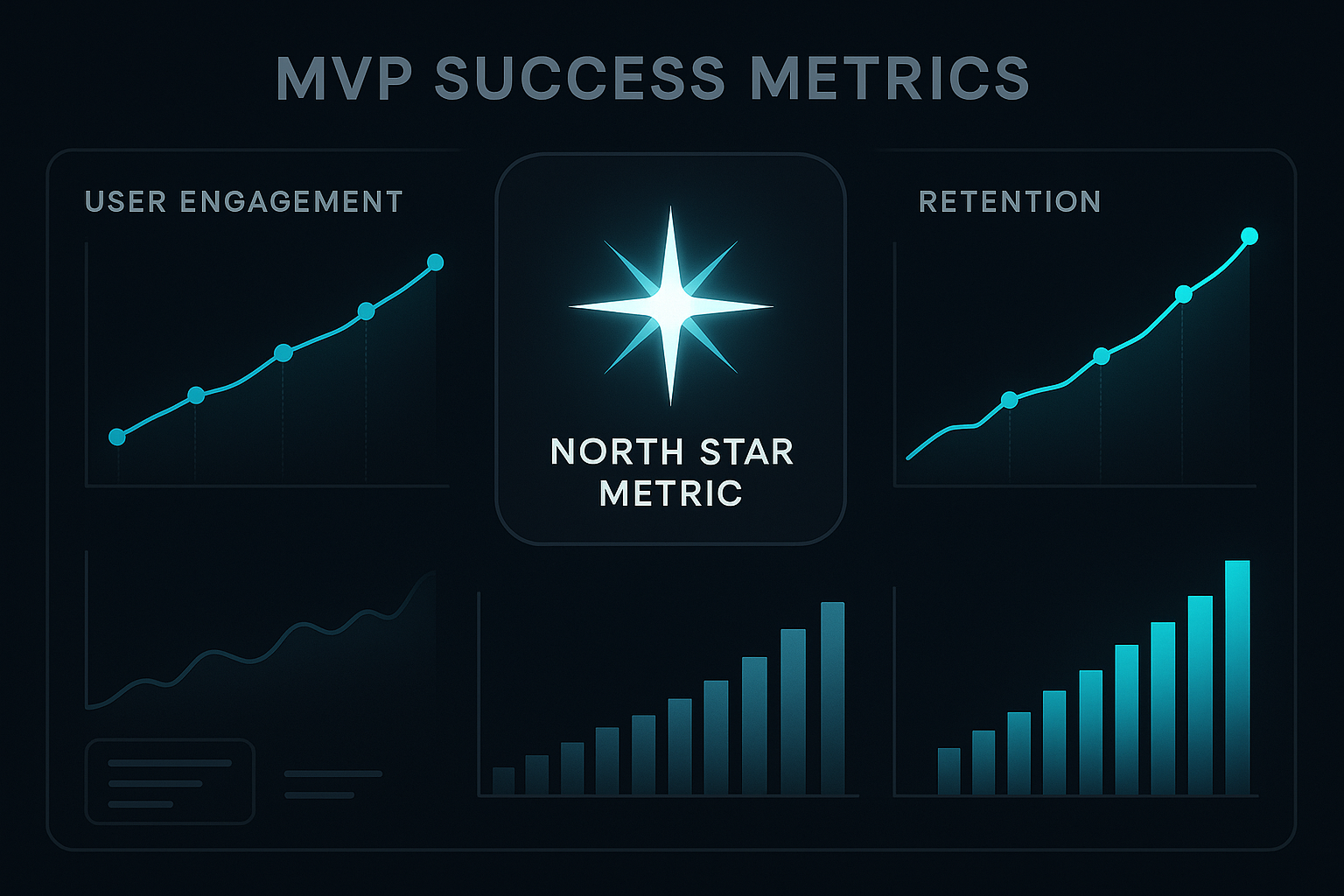
TL;DR: The MVP metrics that matter
- Activation: Do users reach the “aha moment”?
- Retention: Do they come back (D1/D7/D30)?
- Core feature adoption: Are they using the one thing you built?
- Revenue intent: Are they willing to pay (even in small ways)?
Everything else is secondary until these are healthy.
Defining MVP Success: Beyond Just Launching
Hitting “launch” feels like crossing the finish line, but for a savvy founder, it’s the starting gun. The true measure of an MVP’s success isn’t the launch event itself, but what happens immediately after. It’s about replacing months of speculation with hard data from real users.
Your MVP was never meant to be a polished, feature-complete application. Its sole purpose is to be a focused experiment designed to answer one critical question: does your core solution resonate with a real audience? Success, therefore, isn't a bug-free experience; it's achieving a clear verdict on your primary business hypothesis.
This is why speed is so critical. The longer an idea remains in development, the longer you’re operating on risky assumptions. The real race is to get your core concept in front of users to start learning. Did you validate demand? Are users engaging with the one key feature you built? Did you gather enough feedback to confidently decide whether to persevere, pivot, or stop?
Answering these questions decisively, with minimal wasted time and capital, is the ultimate MVP win. It’s the strategic clarity that separates ventures that thrive from those that get stuck in an endless development cycle.
The North Star Metric: Finding Your Guiding Star
In the chaos of launching a startup, it's easy to get lost tracking a dozen different metrics. The North Star Metric (NSM) cuts through that noise. It is the single metric that best captures the core value your product delivers to its users. For Airbnb, it's "nights booked." For a B2B SaaS, it might be "projects created." This isn't a vanity metric like sign-ups; it's a measure of real, sustained engagement.
Defining your NSM is an act of ruthless prioritization. It becomes the ultimate filter for your MVP's feature set. Before adding anything to the development backlog, you must ask: "Will this feature directly and significantly move our North Star Metric?" If the answer is no, it’s a distraction that can derail your timeline and budget.
This intense focus is what separates a rapid, successful launch from a project stuck in an endless development cycle. Instead of debating endless feature possibilities, your team has a clear, unifying goal. This clarity allows for incredible speed, enabling you to build only what is essential to validate your core hypothesis. By identifying your guiding star before you build, you ensure you're not just launching fast, but launching in the right direction.
2. User Engagement Metrics: Understanding Interaction and Stickiness
Once you've launched, your focus must immediately shift from acquisition to activation. A thousand sign-ups mean nothing if users open the app once and never return. This is the moment of truth: are you solving a real problem? True validation comes from measuring behavior, not just vanity metrics.
Forget complex dashboards. Zero in on the signals that prove your core hypothesis:
- Stickiness (DAU/MAU Ratio): This ratio of Daily Active Users to Monthly Active Users is your habit-meter. A strong score (20%+) shows that your product is becoming part of a user's routine, not just a one-time curiosity.
- Core Feature Adoption Rate: This is arguably the most vital MVP metric. What percentage of users are interacting with the single most important feature—the one your entire business model hinges on? A low adoption rate is an immediate, critical signal that your core assumption may be flawed.
- Session Duration & Frequency: Are users engaging for meaningful periods, or bouncing in seconds? How often do they return? Short, frequent visits can be just as valuable as long, infrequent ones, depending on your app's purpose.
Tracking these metrics isn't an academic exercise. It’s about getting real-world answers, fast. You simply cannot afford to spend six months building only to discover your core loop isn't engaging. This data, gathered in days or weeks, is what separates successful founders from those trapped in an endless cycle of building the wrong thing.
Acquisition Metrics: How Are Users Finding You?
Your MVP exists to answer one fundamental question: can you attract real users? Acquisition metrics provide the first, unfiltered answer. Long before you worry about lifetime value, you need to know if your path to your first customers is a highway or a dead end. The goal isn't to track every vanity metric, but to ruthlessly identify which channels are actually working.
Start with the essentials:
- Channel Breakdown: Where is your traffic coming from? (e.g., Organic Search, Paid Ads, Social Media, Referrals). This is your baseline reality check.
- Customer Acquisition Cost (CAC): How much are you spending to get one new user? If you don't know this number, you’re flying blind and burning cash.
- Visitor-to-Signup Conversion Rate: What percentage of people who land on your site actually sign up? This tells you if your messaging is resonating with the audience you're attracting.
Many founders wait months, trapped in development, before getting this data. That's a critical error. You need these answers within weeks of launch, not quarters. The sooner you know which channels are effective, the faster you can double down on what works and cut what doesn't, saving precious time and capital while your competitors are still debating feature lists.
Retention Metrics: Are They Coming Back?
Acquiring your first users feels like a victory, but the real test is whether they stick around. Retention is the ultimate indicator that your app solves a genuine, recurring problem. This is where you measure user stickiness, tracking metrics like Day 1, Day 7, and Day 30 retention rates. A simple cohort analysis, which groups users by their sign-up week, will reveal if your product has staying power.
The most common and costly mistake is waiting too long to get this data. Founders who get trapped in a six-month development cycle are flying blind. They burn through precious time and capital before they can even ask the most critical question: are people returning? A rapid launch isn't about cutting corners; it's about starting this feedback loop in weeks, not quarters.
If retention is low, don't panic and start building more features. This is a classic trap that leads to budget bloat and endless delays. Instead, see it for what it is: priceless, actionable feedback. Low retention tells you to double down on understanding the core user problem, not to add distractions. Getting this data quickly allows you to iterate on what truly matters, giving you a powerful advantage while others are still stuck in planning meetings.
Monetization & Value Metrics: Proving Business Viability
An app that users engage with but won't pay for is a popular hobby, not a viable business. Your MVP’s ultimate test is its ability to generate revenue. Waiting months to test your monetization strategy is a fatal error; you need this data while you still have the resources to act on it.
Focus on these core metrics from day one:
- Customer Acquisition Cost (CAC): How much do you spend on marketing and sales to get one paying customer? Knowing this number early prevents you from sinking a fortune into a product before confirming you can acquire users profitably.
- Customer Lifetime Value (CLV): How much revenue, on average, will a single customer generate before they stop using your service?
- Conversion Rate (to Paid): What percentage of your free or trial users upgrade to a paid plan? This is the most immediate signal of perceived value.
The goal isn’t to build a complex billing system with tiered plans and annual discounts for your MVP. That’s a classic trap that leads to delays. Instead, you need the simplest possible mechanism to test a user’s willingness to pay. This ruthless focus gives you the most critical business validation you can get: proof that you're solving a problem valuable enough for someone to open their wallet.
Operational & Performance Metrics: Ensuring Stability and Scalability
While user engagement metrics tell you if people want your product, operational metrics tell you if your product can even survive its first users. A buggy, slow, or constantly crashing app yields tainted data. You’ll never know if users left because they hated your idea or because they couldn’t get the app to work. Focusing on a few core metrics from day one is non-negotiable.
Track these fundamentals:
- Uptime: The percentage of time your app is online and available. For an MVP, anything less than 99% is a red flag that will frustrate early adopters.
- Load Time: How quickly your app's key screens load. If it takes more than a few seconds, you're losing users before they’ve even seen your core value.
- Error Rate: The frequency of bugs or crashes. A high error rate destroys user trust and makes it impossible to validate your concept.
The goal here isn't to over-engineer a system for millions of users before you have your first ten. That’s a classic trap that leads to endless development cycles. Instead, the objective is to launch with a stable, professional-grade foundation. A well-built MVP should be production-ready, ensuring that the feedback you gather is clean, reliable, and directly reflects the viability of your business idea—not the instability of your tech.
Setting Up Your Tracking: Tools and Best Practices
Your analytics setup shouldn’t become another source of delay or a project in itself. The goal is to get actionable data fast, not to build a perfect data science suite. To do this, start lean and focus only on what truly matters for validation.
For quantitative, event-based tracking—the critical actions users take—tools like Mixpanel or Amplitude are industry standards with generous free tiers. To understand where users come from and how they navigate, Google Analytics 4 is essential. Crucially, complement this with qualitative insights. A free tool like Microsoft Clarity provides session recordings and heatmaps, showing you why users are dropping off or getting confused.
The best practice isn't about the tool, but the discipline behind it:
- Integrate from Day One: Analytics cannot be an afterthought. It must be baked into your initial build. Waiting until after launch means flying blind when you need sight the most.
- Track Actions, Not Views: Define the one or two key actions that validate your core business hypothesis—a completed profile, a created project, a shared item. Focus your entire setup on measuring that.
- Keep it Simple: Resist the urge to track every single click. A cluttered dashboard is just as useless as no dashboard. Focus on the core metrics that will inform your first crucial product decisions.
This focused approach ensures you get the feedback you need to iterate while competitors are still planning their analytics strategy.
Interpreting Data and Iterating: The Cycle of Continuous Improvement
Collecting metrics is just the start; the real value lies in turning insight into action. Too many founders fall into the "analysis paralysis" trap. They gather data, spend weeks debating its meaning, and then map out a massive "Version 2.0." This pulls them right back into the very thing they escaped: an unpredictable and costly development cycle that kills momentum.
True agility isn't about creating a perfect long-term roadmap. It's about ruthless, short-term execution. The process should be simple: identify the most critical bottleneck or opportunity in your data, define the smallest possible change to address it, and ship the update. Did users drop off at onboarding? Tweak the copy or remove a field. Don't rebuild the entire experience.
This rapid loop of learning and iterating is your ultimate competitive advantage. While others are stuck in planning meetings, speculating on what users might want months from now, you are actively learning and improving in the real world. This approach replaces the uncertainty of a massive overhaul with the clarity of small, controlled experiments, ensuring you’re always building what matters without derailing your budget or your launch timeline. It’s a cycle that builds not just a better product, but a resilient business.
Common Pitfalls to Avoid in MVP Metric Tracking
Navigating MVP metrics is as critical as building the product itself, yet it's where many promising ideas get lost. The cardinal sin is prioritizing vanity metrics—like total downloads or sign-ups—over actionable ones. While a high number of sign-ups feels good, it tells you nothing about whether users find value. Instead, focus ruthlessly on metrics that prove your core hypothesis: user engagement, retention rates, and feature adoption.
Another common trap is waiting too long to gather data. When development drags on for months, you’re not just burning cash and time; you’re operating on pure speculation. The goal isn't to launch a perfect, fully-instrumented product. It's to get a lean version into the hands of real users as fast as possible. Your first meaningful data points should arrive in weeks, not quarters. This speed provides an invaluable, early look at reality while your competitors are still debating features.
Finally, avoid the temptation to track everything. Over-instrumentation is a symptom of an unfocused product strategy. If you can’t decide on the 3-5 key metrics that define success for your MVP, you may have included too many features. True validation comes from proving one core value proposition, not from analyzing dozens of peripheral interactions. Your metrics shouldn't be comprehensive; they should be decisive.
Conclusion
Conclusion: The Roadmap to Sustained MVP Growth
Tired of guessing what works? Launch your production-ready MVP in 14 days and start measuring what truly matters. Book your free project consultation today.

Børge Blikeng
AuthorHelping startups build successful MVPs for over 5 years