Post-Launch Playbook: How to Measure User Engagement for Your EdTech MVP
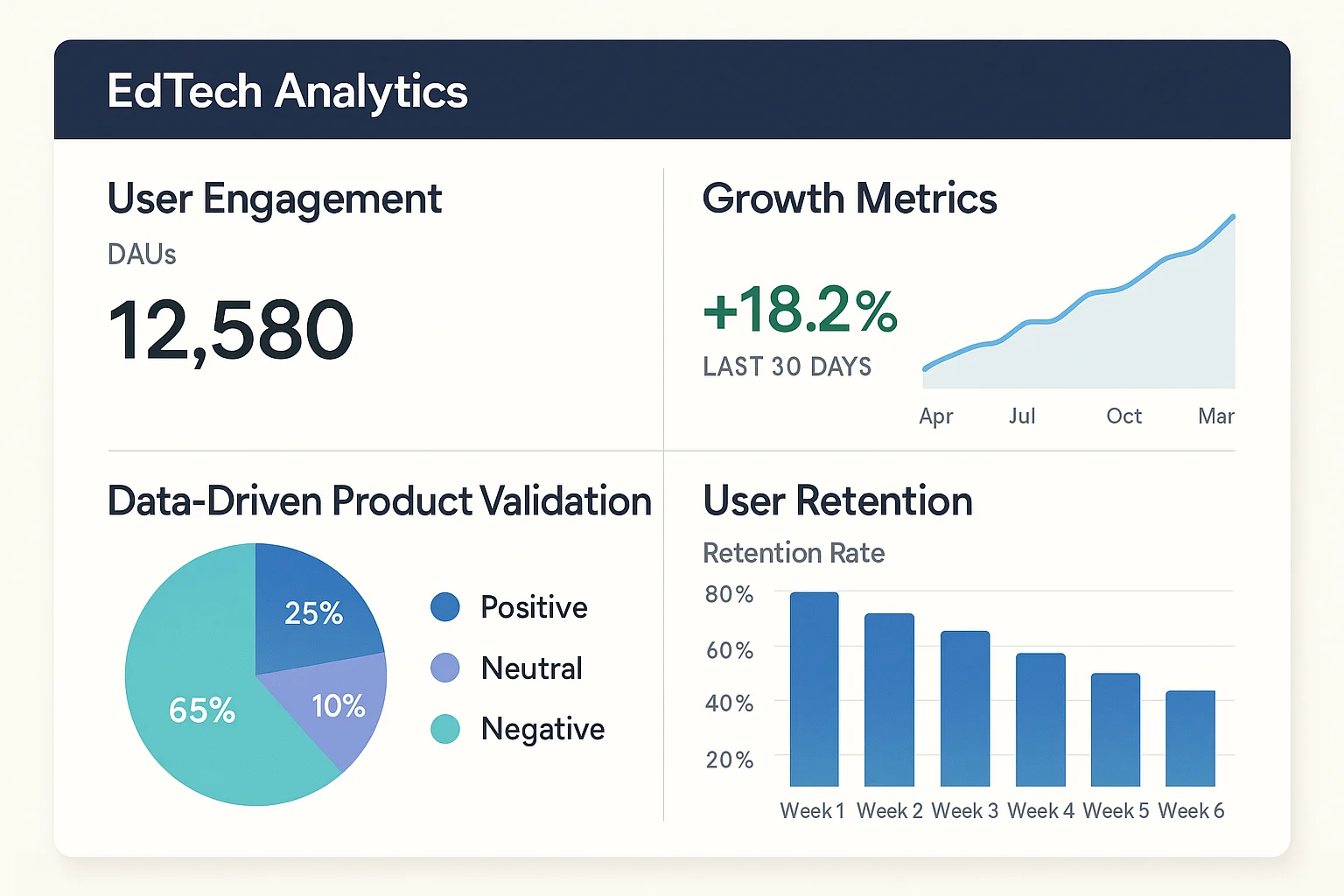
Beyond Launch - The Critical Next Step for Your EdTech MVP
Congratulations, your EdTech MVP is live! After the whirlwind of development and launch, you're now facing a new, critical challenge: navigating the flood of user data. It's tempting to focus on vanity metrics like total sign-ups or page views, but these numbers don't answer the most important question: is your product actually creating value for learners and educators? This is your essential post-launch playbook, and for a deep dive into immediate next steps, we highly recommend consulting The 14-Day Post-Launch Plan: How to Validate Your MVP with Real Users. This guide cuts through the noise to provide a no-nonsense framework designed for non-technical founders, offering actionable steps to measure what truly matters—the specific user interactions that signal genuine engagement, validate your core features, and predict long-term retention. Think of this as the next crucial chapter after launching your MVP, giving you the clarity needed to turn raw data into confident, product-defining decisions and build a tool that makes a real impact.
Beyond the Hype: Why EdTech Engagement is Different
In most tech startups, engagement is a numbers game: more clicks, longer sessions, higher daily active users (DAU). For an EdTech founder, clinging to these metrics is a trap. They measure activity, not learning. A student spending hours on a single module isn’t necessarily engaged; they might be stuck, frustrated, and on the verge of churning.
True EdTech engagement is fundamentally different because it’s tied to a specific outcome: educational progress. Your goal isn’t just to occupy a user’s time, but to facilitate mastery, understanding, or a new skill. A short, successful session where a student aces a quiz is infinitely more valuable than a long, meandering one with poor results. Similarly, a teacher logging in just twice a week to assign work and review student dashboards might be one of your most valuable, highly-retained users. Their engagement pattern is efficient and purpose-driven, not casual.
This means we must redefine our core concept of engagement. It’s not about screen time; it's about learning velocity and meaningful interaction. Are users successfully completing courses? Are their assessment scores improving over time? Are teachers able to efficiently manage their classroom tasks? Answering these questions requires looking past the standard SaaS dashboard. The following sections provide the specific, non-vanity metrics needed to measure what truly matters for validating your product and ensuring long-term success.
Defining Your North Star: Key Engagement Metrics for EdTech MVPs
After launch, it’s tempting to track every click. Resist the urge. Instead, define your North Star—the one metric that proves users are getting real educational value from your platform. This isn't about daily sign-ups (a vanity metric); it's about measuring the core learning experience you promised. For an EdTech MVP, your focus must be on metrics that signal genuine learning and progress, not just activity. To truly understand Measuring What Matters: The Key Metrics to Track for MVP Success, start with this essential checklist to find your product’s true pulse:
- Learning Module Completion Rate: This is your primary indicator of content value. It answers the simple question: "Is our content engaging enough to hold a learner's attention?" A low rate is a major red flag for your curriculum design or user experience.
- Frequency of Core Learning Action: Identify the single most important action in your app (e.g., completing a quiz, practicing a flashcard, collaborating on a project). How often do returning users perform this action? This measures habit formation and the "stickiness" of your core learning loop.
- Time to First "Aha!" Moment: How quickly does a new user complete their first lesson or pass their first assessment? A shorter time-to-value is critical for proving your product's worth and retaining users beyond their initial session.
- Assessment Performance: Are users' scores improving over time? This metric directly validates your product's educational effectiveness. Track average quiz scores or the percentage of users who pass a key milestone.
Choose one or two of these to serve as your guiding light. They provide the actionable truth you need to iterate, prove value, and build a platform that genuinely facilitates learning.
Setting Up Your Analytics Foundation: Essential Tools for Early-Stage EdTech
With your MVP live, it’s time to build your data command center. Don’t get lost in the sea of complex analytics software. Your goal isn't to track everything; it's to measure what matters for student and educator engagement. A lean, powerful stack is all you need to translate user clicks into product clarity. Start with these essentials:
- Event-Based Analytics (e.g., Mixpanel, Amplitude): This is your core. Instead of just tracking page views, you’ll track specific actions or "events"—like ‘Lesson Started,’ ‘Quiz Submitted,’ or ‘Resource Downloaded.’ This tells you what users are actually doing inside your platform, revealing your most valuable features. Most have generous free tiers perfect for an MVP.
- Session Replay & Heatmaps (e.g., Hotjar, Microsoft Clarity): While event analytics show you what happened, these tools show you why. Watch anonymized recordings of real user sessions to see where they get stuck, what they ignore, and how they navigate your interface. It’s the fastest way to spot friction and usability issues without needing to be a data scientist.
- In-App Feedback (e.g., Sprig, Hotjar Surveys): Sometimes, the best way to understand a user is to just ask them. Use simple, targeted in-app surveys to gather qualitative feedback at the exact moment a user completes (or abandons) a key action.
This three-part foundation provides both the quantitative data (the 'what') and the qualitative insight (the 'why') you need to make informed decisions. This setup moves you beyond guesswork, empowering you to build a product that truly resonates with your users.
Implementing Event Tracking: What to Monitor and How (Without Code)
Once your MVP is live, you need to see exactly how users interact with its core features. This is where event tracking comes in. An 'event' is simply a specific action a user takes, like clicking a button or completing a lesson. The good news? You don't need to write a single line of code to monitor these critical interactions. Modern analytics platforms are designed for non-technical founders, allowing you to define and track events with a simple point-and-click interface.
Focus your tracking on actions that validate your core learning hypotheses. Avoid vanity metrics like page views and instead monitor events that signal genuine progress and value.
| Key EdTech Event to Track | Why It Matters for Your MVP |
|---|---|
| Course/Module Started | Measures initial interest and top-of-funnel engagement. |
| Lesson/Video Completed | The single most important indicator of core value delivery. |
| Quiz/Assessment Attempted | Shows users are engaging with interactive learning components. |
| Resource Downloaded | Validates the value of your supplementary materials. |
| Discussion/Comment Posted | A strong signal of community building and deeper engagement. |
To implement this, use a tool with a 'visual event tagger' or 'autocapture' feature, such as Mixpanel, Amplitude, or Heap. After a quick installation snippet (often a simple copy-paste), these tools let you navigate your app and simply click on the buttons, links, and features you want to track. You can then name the event (e.g., "Clicked 'Start Lesson' Button") and start collecting data immediately. This turns abstract user behavior into concrete data points for validating your product’s core learning loop.
Gathering the 'Why': Effectively Collecting Qualitative User Feedback
Quantitative data from your analytics tools tells you what users are doing, but qualitative feedback reveals the crucial why behind their actions. It’s the difference between knowing a student dropped off during a lesson and understanding they found the instructions confusing. To gather these essential stories without slowing down, focus on a lean, targeted approach.
Here is a simple framework for collecting feedback that drives real product improvements:
- Segment and Conquer: Don't try to talk to everyone. Identify two key groups: your power users who have completed multiple lessons, and users who signed up but churned within the first week. Their contrasting perspectives are a goldmine for understanding what works and what doesn't.
- Conduct '5-Why' User Interviews: Schedule brief, 15-minute video calls with 3-5 users from each segment. Your goal isn't to follow a rigid script but to understand their core motivations. Start with a broad question like, "Walk me through the last time you used our platform," and follow up with "Why?" to dig deeper into their reasoning.
- Use Contextual Microsurveys: Implement simple, one-question surveys that appear based on user actions. For example, after a teacher creates a new assignment, trigger a pop-up asking, "How easy was that to set up? (1-5)". Tools like Hotjar or Sprig make this simple to implement and provide immediate, contextual insights.
- Watch Session Recordings: The most honest feedback is unspoken. Use a tool like FullStory to watch recordings of real user sessions. Seeing exactly where a student hesitates or a teacher gets frustrated provides undeniable evidence of friction points that need fixing.
Analyzing Your Data: From Raw Numbers to Actionable Insights
You've launched, and now the data is rolling in. It's easy to get lost in dashboards full of charts and numbers. The key isn't just to look at data, but to translate it into your next move. Raw numbers, like daily active users, are just a starting point. Real insights come from understanding the story behind them.
To turn data into decisions, follow this simple, three-step framework:
- Segment Your Users: Don't analyze everyone as one big group. Separate your users into meaningful cohorts. For an EdTech platform, this could be "Teachers vs. Students" or "First-Week Users vs. Power Users." Are teachers engaging with the assignment creation tool? Are new students completing the onboarding tutorial? Segmentation reveals who is getting value and who is struggling.
- Connect the "What" with the "Why": Your analytics tell you what is happening (e.g., "70% of users drop off during Lesson 3"). Now, you must find out why. Is the content too difficult? Is there a technical bug? Combine your quantitative data with qualitative feedback from user interviews, surveys, or support tickets to get the full picture.
- Form a Testable Hypothesis: Turn your insight into an action plan. Frame it clearly: "We believe that by adding a short video explainer to Lesson 3, we will increase the lesson completion rate because users are currently finding the text-based instructions confusing." This creates a clear, measurable experiment for your next product iteration.
Benchmarking Your EdTech MVP: What Good Engagement Looks Like
So, what does 'good' engagement actually look like? In EdTech, there’s no single magic number. A daily-use K-12 phonics app will have vastly different benchmarks than a corporate compliance platform used quarterly. Instead of chasing vague industry averages, focus on benchmarks that signal true product value for your specific users.
The most important benchmark is your own progress. Is your Week 1 retention improving over time? That’s your north star. However, it’s still helpful to have a directional sense of where you stand. Use this framework as a general guide to gauge your MVP's health, but remember that context is everything.
General EdTech MVP Engagement Benchmarks
| Metric | Needs Improvement | Good (Signals Validation) | Excellent |
|---|---|---|---|
| DAU/MAU Ratio (Stickiness) | <10% | 15-25% | >30% |
| Core Action Completion | <20% | 40-60% | >70% |
| Avg. Learner Session Duration | <3 mins | 5-10 mins | >12 mins |
| Week 1 User Retention | <15% | 20-30% | >40% |
A quick note on "Core Action Completion": This isn't just logging in. This is the key value exchange you offer. Did the student finish a lesson? Did the teacher successfully create an assignment? A high completion rate here is one of the strongest indicators of product-market fit. If your numbers are in the "Needs Improvement" column, don't panic. This is precisely what an MVP is for—to give you the data you need to learn, iterate, and build a product that truly sticks.
Translating Metrics into Action: Prioritizing Product Improvements
Data without a plan is just noise. Your analytics dashboard can feel overwhelming, but a simple framework turns that data into a decisive product roadmap. Instead of guessing, you can use real user behaviour to prioritize improvements with speed and certainty.
Here’s a no-nonsense, three-step process to translate your metrics into action:
- Segment and Isolate Value: Don’t rely on averages. Isolate your "power learners"—the students who complete courses or log in daily. What features do they use most? Compare their journey to users who churn after one session. This contrast immediately highlights your stickiest features (what to enhance) and your biggest friction points (what to fix).
- Map Metrics to the User Journey: Connect data to specific workflow stages. A high drop-off rate on "Module 2 Quiz" isn't just a number; it’s a direct signal that the quiz may be too hard, buggy, or poorly explained. Mapping metrics to the user experience tells you exactly where to investigate.
- Prioritize with an Impact vs. Effort Matrix: Once you have a list of potential improvements, plot them on a simple 2x2 grid to decide what to tackle first.
- Quick Wins (High Impact, Low Effort): Clarifying confusing instructions or fixing a broken link. Do these immediately.
- Major Initiatives (High Impact, High Effort): Building a requested progress-sharing feature. Plan these for your next development cycle.
- Thankless Tasks (Low Impact, High Effort): Overhauling a feature only 1% of users touch. Put these on the backburner indefinitely.
This structured approach ensures you’re always working on what truly matters, systematically improving the features that drive engagement and retention.
Iterate and Optimize: Continuous Improvement Loops for Retention
Your MVP launch isn’t the finish line; it’s the starting gun for growth. To navigate the complexities of what comes next, consider exploring resources like Beyond the MVP: A Founder's Roadmap to Scaling and Iteration. The key to improving retention is turning your engagement data and user feedback into a repeatable process for product improvement. Don't get stuck in analysis paralysis; instead, implement a simple and powerful continuous improvement loop.
Follow this three-step cycle to create a data-driven roadmap for what to build next:
- Measure: Consistently monitor your core engagement metrics (e.g., feature adoption rates, session duration) and collect qualitative feedback from user interviews or surveys. This step tells you what is happening and why.
- Learn (Hypothesize): Connect the dots between the numbers and the narratives. If you see a high drop-off rate on a specific learning module (what) and users say the instructions are confusing (why), your hypothesis becomes: "Clarifying the module instructions with a short video will increase completion rates by 15%."
- Build (Implement): Execute the smallest possible change to test your hypothesis. This isn't a complete redesign; it's a targeted tweak. Ship the update and immediately return to Step 1 to measure its impact on your metrics.
By running this "Measure-Learn-Build" loop consistently—whether weekly or bi-weekly—you replace guesswork with evidence. This relentless, iterative cycle is the most direct path to refining your EdTech product and building something users truly value.
Avoiding Common Pitfalls: What Non-Technical Founders Get Wrong
Navigating post-launch analytics can feel overwhelming, especially without a technical background. The temptation is to chase numbers that look good on a slide deck but offer zero insight into whether your product is actually working. These challenges often stem from common pitfalls in the initial development phase. To ensure your EdTech platform stays on track for validation and to avoid broader issues, consider insights from resources like 10 Common MVP Development Mistakes (And How to Avoid Them) as you sidestep these specific measurement traps:
- Obsessing Over Vanity Metrics: Total user sign-ups and daily visits are exciting but misleading. They don’t tell you if students are learning or if teachers find your tool indispensable. Instead, focus on activation and retention rates. What percentage of users complete a core action, like finishing their first lesson module or creating a quiz? That’s a far better signal of value.
- Ignoring the Qualitative "Why": Quantitative data shows what users are doing, but it rarely explains why. Relying solely on dashboards means you’re missing the critical context behind a user’s frustration or delight. The fastest path to certainty is to talk to your early adopters. Schedule brief video calls to understand their experience and uncover the story behind the numbers.
- Building Based on Assumptions: Seeing a drop-off in your user journey funnel doesn’t automatically mean you need a new feature. This is the quickest way to build a bloated product that solves no one's problem well. Use metrics to form a hypothesis, then validate it with user interviews before committing development resources.
Fueling Retention and Growth – Your Next Steps with MVPExpert
Successfully launching your EdTech MVP is not the finish line; it’s the starting gun for the crucial phase of learning and iteration. The true measure of success lies beyond initial sign-ups, focusing instead on meaningful user engagement. To do this effectively, move past vanity metrics and analyze the complete user journey: from activation and core feature adoption to long-term retention. This quantitative data, when paired with direct qualitative feedback from educators and learners, provides an invaluable narrative about your product’s real-world impact. These insights reveal whether your MVP is truly solving a problem and delivering educational value. Use this playbook to transform raw data into a clear product roadmap, ensuring each development cycle is guided by genuine user needs, ultimately evolving your MVP into an indispensable educational tool. For a comprehensive guide on this crucial next step, consider the insights provided in Post-Launch Power-Up: How to Scale Your MVP to a Full-Fledged Product in 2025.
Ready to confidently measure user engagement after your EdTech MVP launch? MVPExpert builds scalable MVPs designed for clear, data-driven validation from day one. Book your free project consultation today.

Børge Blikeng
AuthorHelping startups build successful MVPs for over 5 years