MVP Budget vs. Fixed-Price Contract: How to Avoid Both Horror Stories
The MVP vs. Fixed-Price Dilemma – Navigating Project Funding Without the Fear
As a founder or product manager on the brink of a new product launch, you’re facing a classic but flawed choice. It’s the kind of decision that keeps you up at night: gamble on an open-ended MVP budget to chase product-market fit, or lock into a rigid fixed-price contract for financial certainty? One path risks endless scope creep that drains your runway before you find validation. The other risks delivering a product on time and on budget, but one that completely misses the mark with users, trapping you in a cycle of expensive change orders. What if this is a false dichotomy? The truth is, you don't have to choose between fiscal responsibility and agile development. We’re here to introduce a third way, offering solutions like those found in Fixed Price MVP Development Packages: Your Predictable Path to Product Launch: a hybrid model engineered to deliver the critical market validation of an MVP with the absolute certainty of a guaranteed fixed price and timeline.
The Allure of the Fixed-Price Contract: Promised Certainty and Hidden Costs
For a founder or product manager, the fixed-price contract seems like the ultimate safety net. It promises a single, predictable number to bring your vision to life—a powerful allure when every dollar is scrutinized, especially when aiming for Fixed Cost MVP Development Services for Startups: 2025's Smartest Launch. It feels like the most responsible way to de-risk a project. But does a fixed price truly guarantee your budget and a successful outcome? In practice, this perceived certainty often comes with significant hidden costs. To buffer against unforeseen complexities, the initial quote is almost always inflated. You pay a premium for a "guarantee" that is far more rigid than you imagine. The most significant downside is the complete lack of flexibility. Software development is a process of discovery. When you uncover a critical user insight or a necessary technical pivot, the "fixed" price shatters. You become locked in a cycle of costly and time-consuming change orders that kill momentum and drain your budget. This rigidity often forces the development team to prioritize the original contract over building the right product. Quality can be compromised to meet the letter of the agreement, saddling you with technical debt. The model can create an adversarial relationship, stifling the collaborative partnership needed to innovate. You get a fixed scope, but you sacrifice the very agility required for a successful MVP.
Fixed-Price Horror Stories: When Rigidity Leads to Scope Creep and Quality Sacrifices
On paper, a fixed-price contract sounds like the perfect antidote to budget anxiety. It promises a predictable cost and a firm deadline—a founder’s dream. But in the dynamic world of software development, this rigidity often becomes a project's biggest liability, creating a different kind of nightmare.
Here’s the classic scenario: two weeks into development, you gain a crucial insight about user behavior. With a fixed-price agreement, this isn't an opportunity—it's a conflict. The project scope, locked in stone months ago, becomes a battleground. Every necessary adjustment, no matter how small or vital for success, turns into a costly and time-consuming 'change order,' systematically dismantling your original budget and timeline. The "fixed" price quickly becomes a myth.
Worse, when the pressure is on to meet the rigid budget, quality is the first casualty. To protect their margins, development partners may be forced to cut corners, rush through testing, or build up significant technical debt. You receive a product that checks all the contractual boxes but is brittle, unscalable, and ultimately fails to impress users. The fixed price guarantees a deliverable, but it offers no guarantee of market success, forcing you into a no-win choice between your budget and your vision.
The MVP Approach: Agile Innovation and Its Potential Budget Pitfalls
The Minimum Viable Product (MVP) approach is praised as the gold standard for agile innovation. Its core promise is compelling: launch quickly with just enough features to attract early adopters, gather invaluable user feedback, and iterate your way to product-market fit. This build-measure-learn loop is designed to de-risk your venture, ensuring you create something the market actually needs before investing heavily. Yet, this celebrated flexibility is precisely where the financial danger lies. The biggest risk of a traditional MVP isn't failure—it's uncontrolled success in gathering feedback. Without a defined endpoint, the iterative process can morph into a perpetual development cycle. Each new feature request and "minor tweak" extends the timeline and inflates the budget, turning your lean experiment into a financial drain. This is the horror story many founders fear: a project that constantly evolves but never officially launches, burning through cash with no clear ROI. This leaves you trapped, facing what feels like a mandatory trade-off. Do you embrace the agile validation that could lead to a breakthrough, or do you lock down scope to protect your budget? The belief that you must choose between learning and certainty is a false dilemma that puts countless projects at risk. Effectively navigating these challenges to Future-Proof Your Product: Avoiding Common Pitfalls in MVP Development Strategy is crucial for sustained success.
MVP Budget Horror Stories: When Flexibility Transforms into Uncontrolled Spending
The siren song of the flexible MVP budget is alluring. You start with a lean plan, embracing the agile promise to "discover as you go." A minor tweak here, a "must-have" feature there—each seems insignificant. But this is how the horror story begins. These small, seemingly logical additions accumulate, creating a powerful undercurrent of scope creep. Suddenly, your weekly development sprints feel less like progress and more like treading water in an ever-expanding ocean of features. This uncontrolled expansion often derails what should be efficient MVP iteration, making it crucial to have a clear strategy. For a comprehensive guide on navigating these challenges and ensuring focused development, consider exploring a resource like Mastering Agile Development Sprints: Your 2025 Blueprint for Rapid MVP Iteration. What was once a clear path to market validation becomes a winding road with no destination in sight. Your burn rate skyrockets, devouring your runway faster than you can track the changes. Each "flexible" decision adds another week, another invoice, pushing your launch date further into the unknown. You’re left with a bloated, half-finished product and a budget in tatters, realizing that the agility you paid for has become an endless development cycle. The core problem isn't the desire to adapt; it's the lack of a financial anchor. It forces a false choice: either risk this budgetary chaos or lock yourself into a rigid plan that stifles innovation. But must you really choose between uncontrolled spending and inflexible development?
The False Choice: Why "MVP vs. Fixed-Price" Is the Wrong Question to Ask
Many founders feel trapped, believing they must choose between two risky paths: the unpredictable, evolving budget of an MVP or the rigid confines of a fixed-price contract. This framing forces a difficult trade-off between market validation and financial security. But what if this entire debate is based on a false premise? The truth is, it’s a no-win scenario. The core purpose of an MVP is to learn and adapt based on real user feedback—an agile process that is fundamentally at odds with a fixed-price model’s demand for a complete, unchangeable scope from day one. When you’re forced to pick one, you’re betting on either your budget or your product vision. Opt for a purely agile MVP, and you risk endless scope creep and a project that bleeds cash with no clear finish line. Choose the perceived safety of a fixed bid, and you might get a product that’s delivered on-budget but is misaligned with user needs, making it obsolete upon arrival. The most successful projects don’t choose a side; they change the rules. The right question isn’t “MVP or fixed-price?” It’s “How do I get the market validation of an MVP with the financial certainty of a fixed-price contract?” You shouldn’t have to sacrifice one for the other. The solution lies in a modern, hybrid approach that guarantees both speed and certainty, eliminating the horror stories altogether. For a deeper dive into how this can be achieved, explore concepts like The 14-Day MVP: Not a Myth, It's Our Guarantee (Here's How We Do It).
Introducing the Hybrid Model: Combining MVP Validation with Fixed-Price Certainty
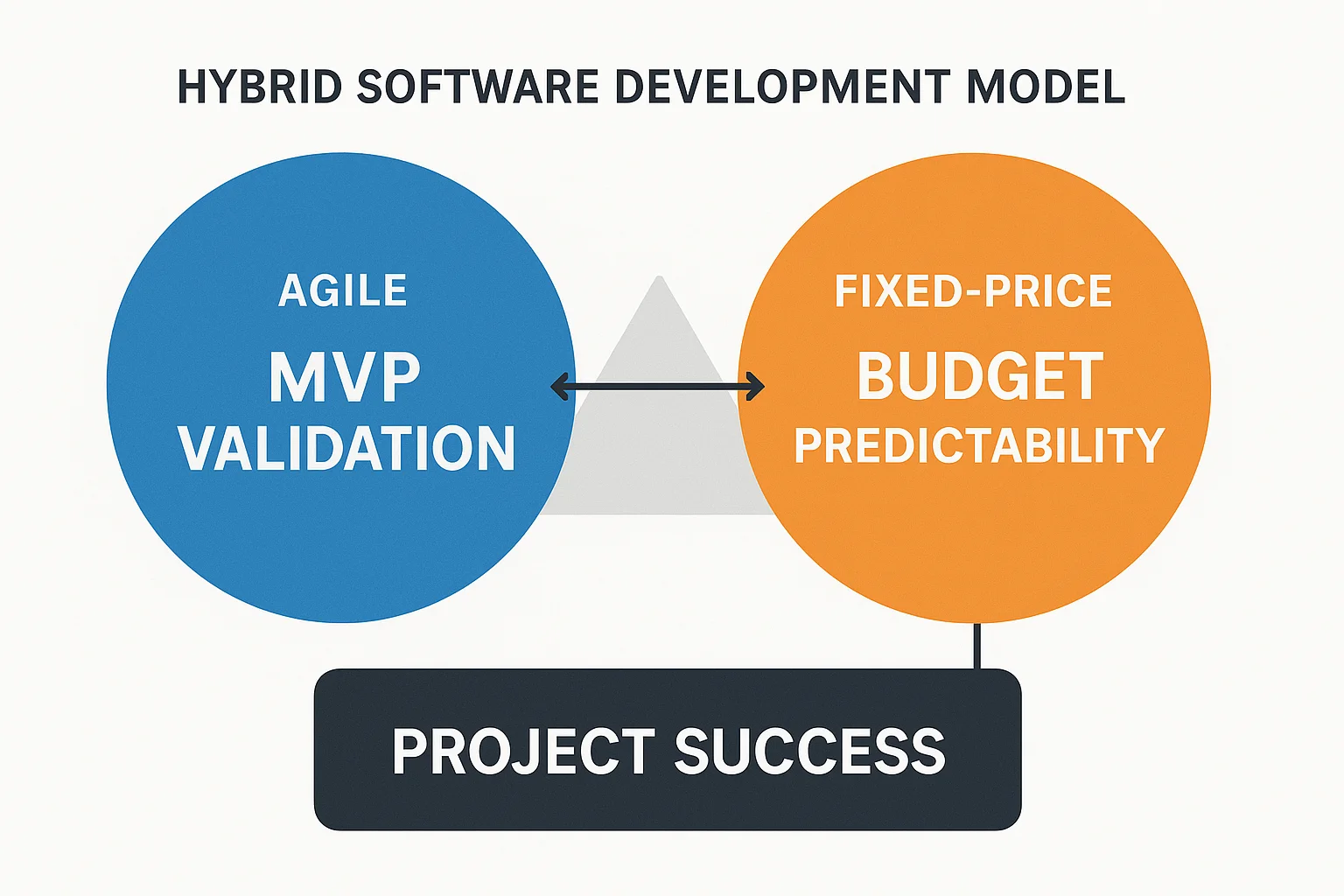
What if you didn't have to choose between the financial uncertainty of an agile MVP and the creative rigidity of a fixed-price contract? The traditional MVP model offers vital market validation but brings the risk of spiraling costs and endless development cycles. Conversely, a fixed-price agreement provides a firm budget but can lock you into building a product based on unproven assumptions, leading to a perfectly built product that nobody wants. This is a false choice that forces founders to gamble on either their budget or their product-market fit.
The solution is a hybrid model that synthesizes the best of both worlds. It focuses on developing a rigorously scoped, high-impact MVP within a guaranteed fixed-price and timeline. The process begins with a deep discovery phase to pinpoint the single most critical feature set needed to test your core business hypothesis. This tightly defined scope is then built and delivered for one, predictable price.
This approach provides the ultimate advantage: you can launch your core product, gather crucial real-world feedback, and validate your business assumptions without the sleepless nights caused by an unpredictable budget. You get the essential, market-validated learning of an MVP with the absolute financial and timeline certainty required to de-risk your investment and build a solid foundation for future growth.
How Our Hybrid Model Delivers Absolute Budget and Timeline Guarantees for Your MVP
Tired of the false choice between a spiraling MVP budget and a rigid, innovation-killing fixed-price contract? Our hybrid model eliminates this dilemma by blending disciplined planning with agile execution, offering the validation of an MVP with the financial certainty you need. It all starts with a rigorous, collaborative discovery and design phase. We work with you to meticulously define and de-risk the absolute core feature set—the true 'Minimum' in your MVP. This isn't a loose backlog; it's a precise architectural and functional blueprint. This intensive upfront work is the key to our guarantee. Once this core scope is locked, we commit to building it for a fixed price and by an immovable deadline. This is your absolute guarantee, as we delve into What Does an On-Time MVP Launch Guarantee Actually Cover? (Our 14-Day Promise). The budget will not change. The launch date will not slip. You get the critical version 1.0 of your product in-market, on time, and on budget, ready to gather crucial user feedback. This approach provides the ultimate founder's peace of mind. You’re not signing a blank check for unpredictable development, nor are you sacrificing your ability to learn and adapt post-launch. You’re securing a guaranteed business asset that allows you to test your core assumptions without betting the company on a project with an unknown final cost.
Mitigating Risk: Preventing Overruns and Project Failures with the Hybrid Approach
The traditional development dilemma forces a difficult choice: the financial unpredictability of a classic MVP versus the rigid, often inadequate scope of a fixed-price contract. Both paths are riddled with risk, from spiraling costs to building the wrong product. But what if this is a false choice?
The hybrid approach systematically de-risks your project by separating strategic planning from development execution. It starts with a highly focused, upfront discovery phase where we collaboratively define, design, and prototype the core functionality of your product. This initial stage provides the validation and clarity needed to establish an exact, feature-complete scope.
Only once this precise scope is locked in do we commit to a guaranteed fixed price and delivery timeline for the build. This isn't an estimate; it's a promise. The result is the perfect balance. You get the strategic flexibility to define the right product at the beginning, followed by the absolute certainty of a fixed budget and schedule for its execution. This method eliminates the financial guesswork and scope creep that derail most projects, ensuring you launch on time and on budget without sacrificing the initial vision. It’s about achieving innovation with disciplined financial control.
Is the Hybrid Model Your Solution? Assessing Fit for Your Specific Project
Choosing a development model often feels like a high-stakes compromise. The traditional MVP approach offers agility to learn and pivot, but its open-ended nature can lead to crippling budget anxiety and scope creep. For those looking to demystify financial planning, understanding 2025 MVP Costs: Demystifying Your Basic Minimum Viable Product Budget is essential. On the other hand, a fixed-price contract promises financial predictability, yet its rigidity can stifle essential innovation, forcing you to build a product based on assumptions that may be proven wrong upon launch. This presents a difficult choice: do you risk your budget for flexibility, or risk your product's success for certainty? For founders, this isn't just a choice; it's a gamble. This is precisely why the 'MVP vs. Fixed-Price' debate is a false choice. The optimal path isn't a compromise but a synthesis. A hybrid model provides the definitive solution by blending the best attributes of both worlds. It starts with a rigorous scoping phase to define a core, non-negotiable feature set—your true Minimum Viable Product. This core is then developed under a guaranteed fixed price and a fixed timeline, completely eliminating financial uncertainty. You get the absolute budget and deadline certainty of a fixed-price contract, but applied to the lean, validation-focused scope of an MVP. The hybrid model is your ideal solution if you need to de-risk your launch without sacrificing fiscal discipline. It’s perfect for founders who have a clear vision for the core problem they're solving but require real-world user feedback to refine the user experience and prioritize future features. If you need to hit a critical market window, secure your next funding round with a tangible product, or simply cannot tolerate budget overruns, this approach is designed for you. It replaces the gamble of traditional development with a strategic, predictable path to market.
Building Your Software Product with Confidence, Certainty, and Strategic Flexibility
The choice between a rigid fixed-price contract and a boundless MVP budget is a false dilemma, as both paths are paved with potential project failures. One stifles innovation and ignores evolving user needs, while the other invites scope creep and financial uncertainty. The optimal path forward transcends this binary choice, embracing a collaborative model built on structured flexibility. This approach prioritizes a thorough discovery phase, iterative development in sprints, and transparent communication. By focusing on shared business outcomes rather than a static feature list, you align incentives and de-risk the entire process. For your next project, shift the conversation from cost to collaboration. Seek a development partner who champions a process built on trust and a mutual commitment to delivering tangible value, ensuring your investment yields a successful product, not a cautionary tale.
Stop fearing unpredictable costs and endless timelines; discover how our hybrid model guarantees your MVP's success with a fixed price and clear deadline. Book your free project consultation today.

Børge Blikeng
AuthorHelping startups build successful MVPs for over 5 years