De-Risk Your Startup: How to Secure Investor Funding with a 14-Day MVP
The Founder's Funding Conundrum and the MVP Solution
For early-stage founders, the pitch meeting is the ultimate hurdle. You have a brilliant idea, a compelling market analysis, and a vision that could change the world. But in a sea of slide decks all promising the next big thing, how do you truly stand out? The hard truth is that investors are paid to mitigate risk, and a concept alone—no matter how visionary—is the riskiest bet of all. They need tangible proof of execution and early validation before they commit capital. This is where the conversation fundamentally shifts from "what if" to "what is." To understand the most direct path to achieving this, delve into Rapid MVP Development: The Guaranteed 14-Day Launch Plan, which outlines our guaranteed 14-day, fixed-price MVP process. We'll show you how to move beyond promises, transforming your abstract concept into a functional, investment-ready asset that investors can see and touch, ultimately turning your pitch into an irresistible case for funding.
Decoding Investor Risks: Why Early-Stage Startups Face Scrutiny
To an investor, a pitch deck isn't a business—it's a collection of hypotheses. Their job is to scrutinize these assumptions, because every unproven claim represents a significant risk to their capital. Before writing a check, they need to see that you've moved beyond theory. Early-stage ventures face scrutiny on three critical fronts. First is Market Risk: Is your target audience real, are their pain points severe enough, and will they actually pay for your solution? An unvalidated idea is a pure gamble on market demand. Second is Product Risk: Your vision for a complex, feature-rich platform might be ambitious, but can your team technically build it? Investors need to see proof of concept, not just a roadmap filled with promises. Finally, Execution Risk looms largest: Can you, as a founder, deliver on your promises, adapt to feedback, and steer the ship through inevitable storms? A compelling narrative is essential, but it doesn't answer these fundamental questions. Investors are inundated with brilliant ideas; they fund tangible evidence. They need to see that you’ve already taken the most critical step: transforming an abstract concept into a functioning reality. For guidance on how to make your venture stand out and secure early investment, consider resources like The 2025 Edge: How to Secure Pre-Seed Funding with a Standout MVP Prototype. This single act demonstrates capability, validates core assumptions, and shifts the conversation from 'what if' to 'what's next,' making your venture dramatically more credible.
The MVP Advantage: How a Minimum Viable Product Mitigates Investor Concerns
Investors aren’t just backing a great idea; they’re betting against risk. For early-stage ventures, these risks are glaring: market risk (does anyone actually want this?), execution risk (can the team build it?), and financial risk (will you burn through capital endlessly?). A compelling pitch deck can address these concerns in theory, but a Minimum Viable Product dismantles them with tangible proof. An MVP immediately shifts the conversation from abstract projections to concrete reality. It replaces market assumptions with hard data—early user sign-ups, engagement metrics, and qualitative feedback. This provides irrefutable evidence that a real problem is being solved, directly mitigating the primary concern of market validation. Furthermore, a delivered product silences doubts about your team’s ability to execute. It’s the ultimate demonstration of competence, proving you can move from concept to a functional, in-market asset. By rapidly launching a focused product, such as through efficient strategies like MVP Development For Startups: Launch in 14 Days for a Fixed $4,990, you showcase a commitment to capital efficiency and an ability to achieve critical milestones without a protracted, expensive development cycle. Ultimately, an MVP transforms your pitch from a speculative request into a data-backed investment opportunity. You’re no longer just selling a vision; you’re presenting a business with demonstrated traction and a de-risked path to growth.
Beyond the Pitch Deck: Using Your MVP for Tangible Market Validation
A compelling pitch deck opens doors, but a functional MVP closes deals. Investors are inundated with theoretical solutions; what they truly crave is evidence. Your MVP is the fastest route to generating that proof, transforming your venture from a concept into a data-backed opportunity. To effectively achieve this, understanding How to Validate Your MVP Idea Before Development is crucial, as it helps definitively answer the single most critical question for any investor: "Does anyone actually want this?" The key is to move swiftly from code to customer. With a focused MVP built on a predictable timeline, you can get your product into the hands of your target users within weeks, not months. Your immediate goal isn't scale; it's validation. Begin tracking the metrics that matter: user sign-up rates, initial engagement data, and direct qualitative feedback. Are people using the core feature? Are they returning? Can you secure early testimonials, letters of intent, or even initial revenue? This is the tangible traction that makes investors pay attention. Presenting this real-world data fundamentally changes your fundraising narrative. You're no longer selling a vision based on market research slides; you are demonstrating proven demand and your ability to execute. You're showing them a living business with early momentum, proving a market exists for your solution. This proactive validation significantly de-risks their investment, replacing speculation with undeniable evidence and making your startup an irresistible opportunity.
The Lean Machine: Essential Features for an Investment-Ready MVP
An investment-ready MVP isn’t a collection of half-built features; it's a strategic tool designed to prove one thing: your business model is viable. When selecting features, ruthless prioritization is your greatest asset, and understanding a clear strategy for MVP Feature Prioritization: The Simple Framework to Stop Debating and Launch Faster can help you focus on the essentials that directly address investor risks. First, isolate your "one thing." Identify the single, core feature that solves your target user's most painful problem. This is your value proposition made tangible. It should be so effective that early adopters can’t imagine going back. Investors need to see this core loop in action, proving you understand the market's primary need. Second, demonstrate a clear path to revenue. You don't need a fully integrated payment gateway, but your MVP must hint at the business model. This could be a "premium" feature that is visible but locked, or a clear call-to-action that outlines future subscription tiers. It shows investors you’ve moved beyond a cool idea and are thinking about commercialization. Finally, include a simple feedback mechanism and basic analytics. A "send feedback" button or a simple survey tool shows you are building a data-driven company. Tracking key metrics like user sign-ups and daily engagement provides the tangible traction data that turns a compelling pitch into an undeniable investment opportunity.
From Idea to Traction: Demonstrating User Engagement and Proof of Concept with Your MVP
Investors fund evidence, not just ideas. Your pitch deck presents a compelling hypothesis, but an MVP is your first experiment to prove it. It’s the critical bridge between a concept on a slide and a business with tangible proof of market demand. By putting a functional, core version of your product into the hands of real users, you immediately begin generating the traction data that investors need to see. This isn't about achieving massive scale overnight. It's about demonstrating a clear signal of product-market fit. Focus on tracking crucial early-stage metrics: user sign-ups, activation rates, session duration, and initial user feedback. Are people willing to sign up? Are they using the core feature as intended? Even a small cohort of highly engaged early adopters provides powerful validation. This initial data transforms your investment narrative from "we believe users will..." to "our first users are already...". Crucially, this process doesn't need to take months. A hyper-focused development sprint can deliver a lean, effective MVP in as little as 14 days, allowing you to quickly gather these vital proof points. For a detailed strategy on maximizing these initial weeks, consider The 14-Day Post-Launch Plan: How to Validate Your MVP with Real Users. You trade speculation for evidence, replacing assumptions with real-world user data. This demonstrates not only market validation but also your ability to execute efficiently—a combination that significantly de-risks your venture and makes your pitch irresistible.
The "14-Day" Difference: Rapid Prototyping for Accelerated Investor Readiness
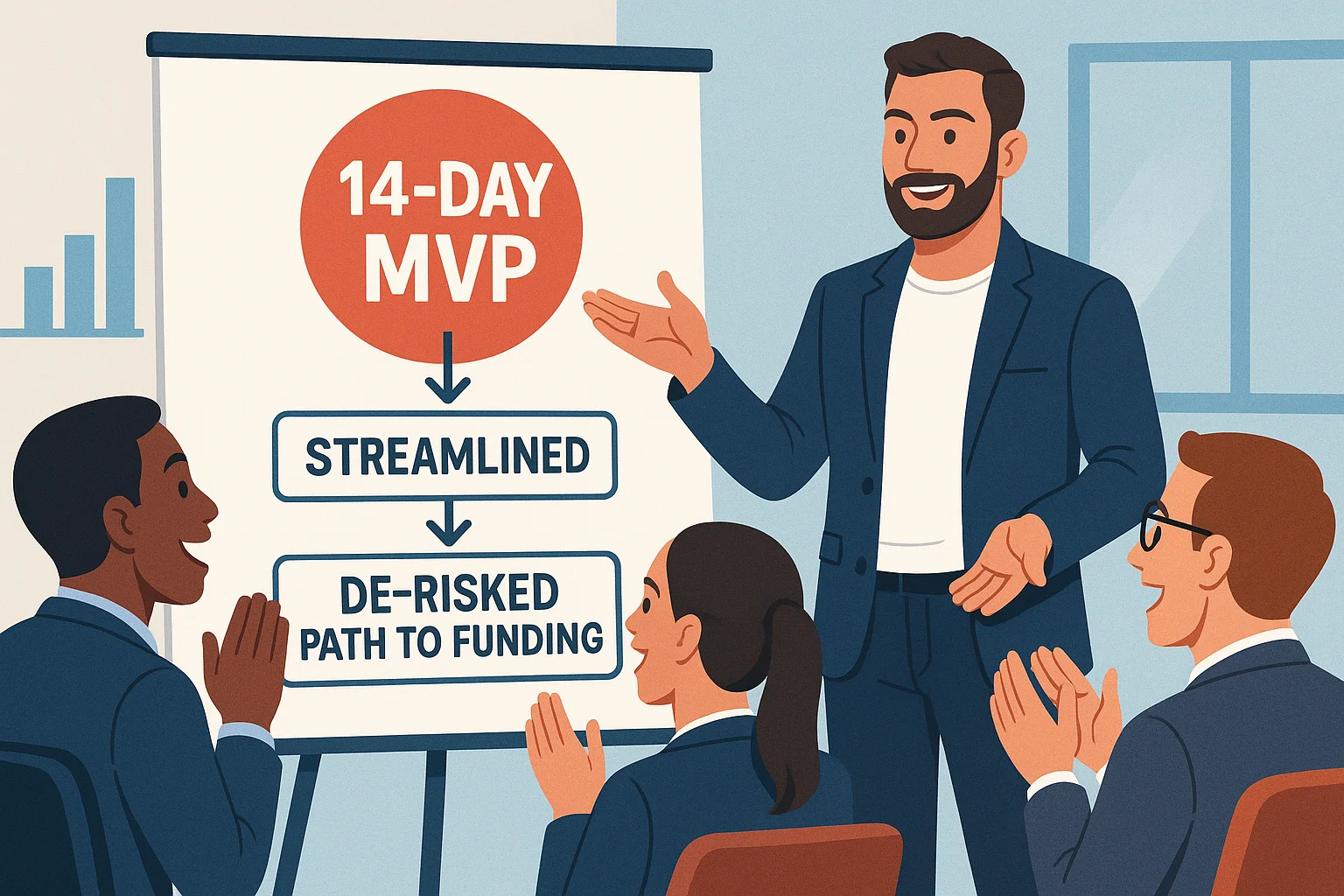
In the fundraising race, momentum is everything. While competitors are trapped in months-long development cycles, a rapid, two-week prototyping model gives you an almost unfair advantage. This isn't just about building faster; it's about fundamentally changing the conversation with investors. For founders looking to master this, a guide like The 14-Day MVP: A Founder's Guide to Launching for a Fixed $4,990 offers a structured approach. In the time it takes most teams to finalize a feature list, you can walk into a pitch meeting with a live, functioning product. This tangible asset immediately de-risks your venture in an investor’s eyes. You’re no longer selling a slide deck and a dream; you're demonstrating a solution. A 14-day turnaround is powerful proof of your team's ability to execute efficiently and focus on what truly matters. It shows you can ship, learn, and iterate at a pace that leaves others behind. By launching a core product this quickly, you compress the timeline for gathering crucial early data. Instead of saying, “We believe users will…”, you can present actual feedback and initial engagement metrics. This transforms your pitch from a speculative bet on an idea into a data-backed opportunity. You’re not just asking for capital to build something; you’re asking for fuel to scale something that already exists and is showing signs of life. This accelerated path to validation is what turns a good idea into an irresistible investment.
Fixed-Price Certainty: A De-Risked Investment for Founders and Investors Alike
Unpredictable development costs are a silent killer of early-stage ventures. The traditional hourly-rate model often leads to scope creep and spiraling budgets, burning through precious capital before you even reach the market. A fixed-price MVP development model eradicates this threat, establishing a concrete agreement: a specific set of core features delivered for a single, guaranteed cost, turning an unknown variable into a predictable line item. For a deeper understanding of how this approach ensures project success and mitigates financial exposure, explore 5 Fixed-Price MVP Benefits That Guarantee Your Launch & De-Risk Your Startup. For founders, this model provides critical financial control, allowing precise allocation of seed funding and protecting capital for marketing and growth. It also demonstrates fiscal responsibility to investors—a powerful signal of operational maturity. From an investor’s perspective, this certainty is even more compelling. They constantly assess risk, and an open-ended development budget is a major red flag. By presenting a fixed-cost path to a market-ready product, you significantly de-risk their investment, proving that their capital will validate your business model and generate traction, rather than being consumed by unforeseen technical hurdles. This financial discipline transforms your MVP from a potential liability into a defined, tangible asset, making your entire venture a more secure and investable proposition.
Elevating Your Pitch: How a Functional MVP Transforms Investor Conversations
Walking into a pitch with a slide deck is a request; walking in with a functional MVP is a demonstration of capability. This single distinction fundamentally transforms investor conversations. You immediately shift the dialogue from the abstract world of 'what if' to the tangible reality of 'what is.' Instead of just selling a vision, you are presenting a real, working asset that proves your team can execute. For those looking to understand the full spectrum of bringing a product vision to life, The Complete MVP Development Guide for 2024 offers invaluable insights. For an investor, every early-stage venture is a calculation of risk. A live MVP is the most powerful de-risking tool at your disposal. It provides direct answers to their most critical questions. Is there a market for this? Here's the initial user feedback. Can the team build the product? Here is the functioning application. You replace speculation with evidence, instantly building credibility and validating your core assumptions. This pivot allows the conversation to transcend the typical early-stage hurdles. You're no longer debating feasibility; you're discussing strategy, traction, and scale. The focus moves from whether your idea can be built to how quickly it can grow with their capital. A rapidly developed MVP doesn’t just get you a better meeting—it gets you a partnership-level conversation, turning a hopeful pitch into an undeniable investment opportunity.
Charting Your Course: Strategic Steps to Leverage Your MVP for Funding Success
Your MVP is more than a product—it's your most powerful fundraising asset. But simply having it isn't enough; you must strategically leverage it to transform your pitch from speculative to undeniable. The first step is to become obsessed with data. Track everything: user sign-ups, engagement rates, session lengths, and any early revenue. These hard metrics are your primary weapon, providing tangible proof that you have found a real market willing to engage with your solution. Next, supplement this quantitative data with qualitative feedback. Actively collect user testimonials, reviews, and detailed feedback. This human element demonstrates product-market fit and shows investors you are responsive and building something people genuinely want. Weave this compelling evidence—both the numbers and the stories—directly into your pitch deck. Your narrative shifts from "we believe" to "our users have shown." With a live product and early traction, you can target investors more effectively. You are no longer just selling an idea on a slide; you are presenting a de-risked opportunity with demonstrated momentum. You’re not asking for capital to start building, but for fuel to scale what is already working, outlining your strategy for going Beyond the MVP: A Founder's Roadmap to Scaling and Iteration. This proactive approach fundamentally changes the dynamic, putting you in a position of strength and control during funding conversations.
De-Risk Your Startup, Secure Your Future
Securing investor funding hinges less on a flawless idea and more on demonstrating tangible progress. The 14-day MVP is your most powerful tool for de-risking your venture, moving your pitch beyond a theoretical business plan and into the realm of validated learning. For those looking to understand the specifics of this rapid approach, consider the strategies outlined in SaaS MVP: How to Launch in 14 Days for a Fixed $4,990. By rapidly building and launching a core solution, you generate crucial early user data and prove you can execute efficiently under pressure. This critical shift provides the tangible traction that replaces speculation with evidence for potential investors. Don’t wait for the perfect product or a more polished deck. Embrace the two-week challenge to build the proof you need. This focused action is what truly mitigates investor risk, turning a promising concept into a fundable business and paving the way for your next round of growth.
Tired of investor rejections? De-risk your startup and make your pitch irresistible with a 14-day MVP. Book your free project consultation today.

Børge Blikeng
AuthorHelping startups build successful MVPs for over 5 years