Updated Jan 2026 (what changed)
- The examples and decision rules are refreshed for 2026.
- The goal remains the same: cut scope, avoid analysis paralysis, and ship a real MVP fast.
TL;DR: RICE vs MoSCoW (which should you use?)
- Use MoSCoW when you need speed and alignment (typical MVP / fixed deadline).
- Use RICE when you have real usage data and need to optimize a roadmap.
- Hybrid: Use MoSCoW to define your “Must-haves”, then use RICE as a tie-breaker inside Must/Should.
Why feature prioritization decides MVP success
Understanding the RICE Scoring Model: A Deep Dive into Its Components
While gut feelings have a place in entrepreneurship, they are a disastrous way to build a product roadmap. The RICE scoring model replaces subjective debates with a data-informed formula, forcing a level of ruthless prioritization that is essential for survival. It forces you to quantify what truly matters, preventing the feature bloat that leads to endless development cycles.
Here’s the breakdown:
- Reach: How many users will this feature impact in a specific timeframe? This isn't an abstract number; it’s a concrete estimate (e.g., 500 users in the next quarter) that grounds your decisions in potential market adoption.
- Impact: How much will this feature move the needle on your primary goal? Scored on a simple scale (e.g., 3 for massive impact, 1 for low), this metric forces you to define what success actually looks like—is it user acquisition, conversion, or retention?
- Confidence: How sure are you about your Reach and Impact scores? This percentage-based score (e.g., 100% for high confidence, 50% for a low-data hunch) is a crucial check against wishful thinking. Low confidence flags a feature as a high-risk gamble of your time and capital.
- Effort: How much time will this take from your team? Measured in "person-months" or development sprints, this is the denominator of the equation for a reason. Time is your most finite resource. Overly complex, high-effort features are the primary cause of budget overruns and fatal launch delays.
The final score—(Reach x Impact x Confidence) / Effort—provides an objective starting point. It systematically de-prioritizes time-consuming features with speculative returns, championing quick wins that deliver immediate, measurable value to your first users.
How to Calculate and Apply RICE: Practical Steps and Examples
The power of RICE lies in its structured approach to what is often a chaotic, opinion-driven process. It replaces "we should" with a data-informed decision, forcing you to confront the true cost and potential of every idea. The goal isn't perfect prediction; it's to escape analysis paralysis and build what matters now.
The formula is: (Reach x Impact x Confidence) / Effort = RICE Score
Here’s how to assign a value to each component:
- Reach: Estimate how many users a feature will affect within a specific timeframe (e.g., a month or a quarter). For a new user onboarding flow, this might be "500 users per month." Be realistic.
- Impact: Quantify how much the feature will contribute to your primary goal, like conversion or adoption. Use a simple scale: 3 for massive impact, 2 for high, 1 for medium, and 0.5 for low.
- Confidence: This is your gut-check against speculation. How certain are you about your Reach and Impact scores? Use a percentage: 100% for high confidence (backed by data), 80% for medium, and 50% for low (purely a hunch). Honesty here prevents you from building on a foundation of guesswork.
- Effort: Estimate the total time required from your entire team (design, development, testing). Use a simple unit like "person-months." A feature needing one developer and one designer for two weeks is 1 person-month.
Calculate the score for each feature and rank them. This ruthless prioritization is your defense against the feature bloat that derails projects and drains budgets. It focuses your limited resources on a core set of features designed for one purpose: validation.
Advantages of Using RICE for Product Roadmapping and Prioritization
The primary advantage of the RICE framework is its ability to replace emotional debates with data-driven decision-making. It forces founders and product teams to move beyond "I think we should..." and instead justify feature priority with a clear, objective formula. This systematic approach is a powerful antidote to the feature bloat that stalls so many promising projects.
Breaking it down, the Reach and Impact scores compel you to focus squarely on validating your core business assumption. Instead of building what’s easy or what a competitor has, you’re forced to quantify how a feature will actually move the needle with real users.
The real game-changer, however, lies in Confidence and Effort. The Confidence score introduces a crucial layer of self-awareness, challenging you to admit when you're speculating versus operating on solid data. Meanwhile, the Effort score provides a non-negotiable reality check. It forces ruthless prioritization by making the development cost of every feature explicit. This prevents roadmaps from becoming endless wish lists, ensuring you build and launch a core product that can start generating feedback in weeks, not years. The result is a defensible roadmap that prioritizes speed and learning over speculation.
Limitations and Potential Pitfalls of the RICE Framework
While RICE brings a quantitative lens to prioritization, its biggest strength can also be its fatal flaw, especially for early-stage MVPs. The framework relies heavily on estimations that are difficult, if not impossible, to make accurately before you have real users.
For a new product, 'Reach' is pure guesswork. 'Impact' and 'Confidence' scores often become battlegrounds for stakeholder opinions rather than objective facts. This subjectivity can lead to endless debates, delaying the one thing that provides real answers: launching. The pursuit of numerical precision can trap founders in "analysis paralysis," spending weeks in spreadsheets instead of shipping code. This is time your competitors are using to get actual market feedback.
Furthermore, the 'Effort' estimate is notoriously unreliable. A single miscalculation on a key feature can derail your entire timeline, turning a structured plan into a source of friction and uncertainty. For a founder whose primary goal is to validate an idea quickly, the risk is that RICE prioritizes the planning process over the launching process. It creates a false sense of scientific certainty while delaying access to the only data that truly matters—user behavior with a live product.
Understanding the MoSCoW Prioritization Method: Basics and Application
The MoSCoW method offers a straightforward yet powerful way to categorize features and escape the "feature creep" that derails so many promising projects. It forces founders to make decisive choices by sorting potential features into four distinct, non-negotiable buckets:
-
Must-Have (M): These are the absolute core requirements. Without them, the product is non-functional or fails to solve the primary user problem. If you can't deliver on these, the launch is a non-starter.
-
Should-Have (S): Important features that add significant value, but are not critical for the initial launch. The product remains viable without them.
-
Could-Have (C): Desirable "nice-to-have" features that have a smaller impact on the core user experience. These are the first to be deferred to protect your timeline.
-
Won't-Have (W): Features explicitly defined as out-of-scope for the current development sprint. This is the most critical category for maintaining velocity. Acknowledging what you won't build eliminates ambiguity and keeps the team focused on a rapid launch.
The true power of MoSCoW lies in its commitment to clarity. By forcing a ruthless distinction between "Must-Haves" and everything else, it provides the certainty needed to build and ship fast. It’s the ultimate antidote to the endless development cycle, ensuring you launch a viable product that can start gathering real user feedback, not a bloated collection of unvalidated ideas.
Breaking Down MoSCoW Categories: Must-have, Should-have, Could-have, Won't-have
The MoSCoW method forces a level of clarity that can feel uncomfortable but is essential for launching on time and on budget. It’s a framework for ruthless prioritization, not a wishlist.
-
Must-have (M): These are the non-negotiable, mission-critical features. Ask yourself: “If we launched without this, would the product even work or solve the core problem?” For a true MVP, this list should be brutally short. It’s the absolute minimum needed to validate your core hypothesis with real users. Anything more introduces risk and delay.
-
Should-have (S): These features are important but not vital for the initial launch. They often add significant value or improve the user experience, but the product can function without them. Think of these as top candidates for your V2 release, to be built after you’ve gained market feedback.
-
Could-have (C): These are the “nice-to-have” features or minor improvements. While they have some merit, their absence won’t impact the initial user experience. Including these in a first version is the fastest way to bloat your scope and miss your launch window.
-
Won't-have (W): This is the most powerful category for a founder. It’s not a list of bad ideas; it’s a strategic decision to explicitly de-scope features for this specific launch. Defining what you won't build protects your timeline, your budget, and your focus. It’s your shield against the “endless development cycle.”
Advantages of Using MoSCoW for Team Alignment and Clarity
Where other frameworks can lead to analysis paralysis, MoSCoW’s power lies in its brutal simplicity. By forcing every feature idea into one of four unambiguous buckets, it vaporizes the "what if" discussions that stall progress indefinitely. The "Must-Have" category is non-negotiable; it represents the absolute minimum required for a viable launch. This clarity is a founder's greatest asset.
When your team—from developers to stakeholders—agrees on the Must-Haves, alignment is no longer a goal; it's a given. This shared understanding acts as a powerful defense against the silent killer of great ideas: scope creep. A new feature request can't derail the timeline because the immediate question becomes, "Is this truly a Must-Have for our initial launch, or can it wait?"
This ruthless focus is what separates projects that launch from those that linger in development hell. It allows you to define a fixed scope for your initial version, providing the certainty needed to manage resources and get to market fast. By concentrating effort on the essentials, you can ship a product, gather real user feedback, and start validating your business model while competitors are still stuck in planning meetings.
Limitations and Challenges of the MoSCoW Framework
While MoSCoW offers a semblance of order, its greatest strength—simplicity—is also its biggest weakness. The framework's categories are inherently subjective. When every stakeholder can champion their pet feature as a "Must-have," the model quickly breaks down. It becomes a recipe for scope creep, not ruthless prioritization, paving the way for the endless development cycle that drains budgets and morale.
Furthermore, MoSCoW lacks crucial context. It categorizes features without weighing them against the most critical resource for any startup: time. A "Must-have" that takes six weeks to build offers far less immediate value than a "Should-have" that can be shipped in a single day to validate a core assumption with real users.
Unshackled from a hard deadline, MoSCoW allows for a dangerously flexible scope. The "Must-have" list expands, launch dates become a moving target, and the very certainty founders need to survive evaporates. True prioritization isn’t about democratic categorization; it’s about making the tough, surgical decisions required to get a core, value-driven product into the market fast. Speed provides the data that speculation never can.
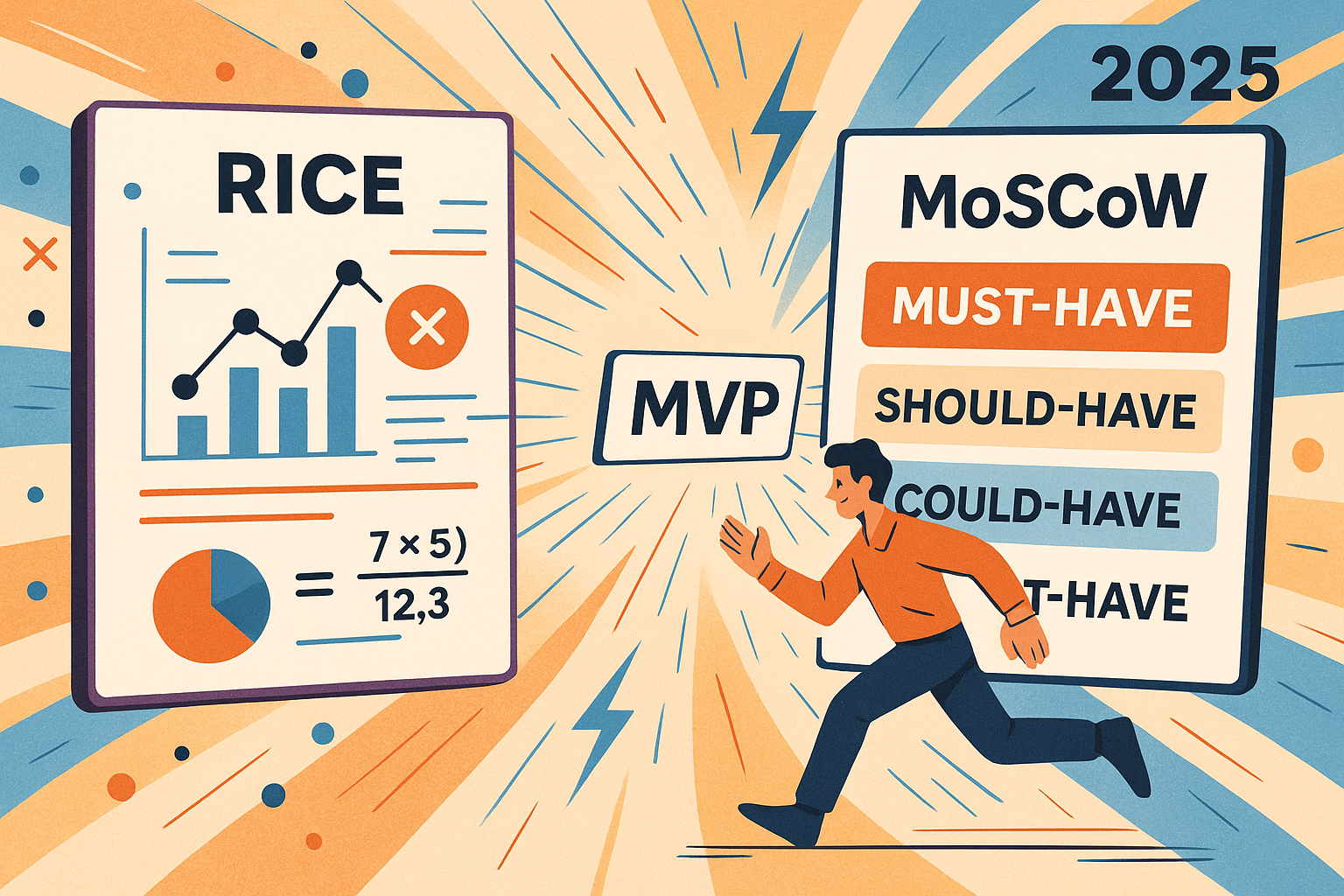
RICE vs. MoSCoW: A Comprehensive Head-to-Head Comparison (2025 Perspective)
Choosing between RICE and MoSCoW is choosing between two fundamentally different launch philosophies. RICE—scoring features on Reach, Impact, Confidence, and Effort—is an analytical powerhouse. For mature products with rich user data, it offers a quantitative method for optimization. However, for a pre-launch MVP, it's a trap. Founders are forced to substitute hard data with pure speculation, turning prioritization into an exercise in guesswork that often leads to analysis paralysis and costly delays.
MoSCoW—categorizing features as Must-have, Should-have, Could-have, or Won't-have—is built for decisive action. Its strength lies not in complex formulas but in forcing uncomfortable, necessary conversations. By demanding a clear consensus on what is absolutely essential for a viable launch, it ruthlessly cuts through the feature bloat that sinks startups.
In 2025, speed to market is non-negotiable. The most successful founders aren't the ones with the most complex spreadsheets; they're the ones who get a working product in front of users the fastest. While RICE excels at refining an existing engine, MoSCoW is purpose-built to get you off the ground. It creates a fixed, non-negotiable scope, providing the certainty required to build and launch without getting lost in the "what-ifs" that kill great ideas before they ever see the light of day.
Hybrid Approaches: Combining RICE and MoSCoW for Enhanced Prioritization
Smart founders know that slavishly following a single framework is less effective than adapting the best parts of several. Combining the strategic clarity of MoSCoW with the data-driven precision of RICE creates a powerful system for defining a lean, high-impact MVP.
Start with MoSCoW. Use it to make the tough, high-level calls. What is absolutely, non-negotiably essential for your first launch? This is your "Must-Have" bucket. Be ruthless here; this initial list should be painfully small. Everything else falls into "Should," "Could," or "Won't." This step alone prevents the feature bloat that derails projects and inflates budgets.
Now, apply RICE only to your "Must-Haves" and "Should-Haves." If you still have more features than you can build within a tight, predictable timeline, the RICE score becomes your tie-breaker. It forces an objective, unemotional assessment of Reach, Impact, Confidence, and Effort, ensuring you build the highest-value features first.
This two-tiered approach provides the ultimate defense against the "endless development cycle." It gives you a clear, validated, and defensible scope, allowing you to build and launch with speed and certainty while your competitors are still debating their roadmaps.
Conclusion
Choosing the “best” framework is less important than choosing a framework that forces decisions. If you’re building an MVP with a deadline, prioritize clarity and speed over spreadsheet perfection.
Want a production-ready MVP built fast? Start here:
Or book a call: Book your free project consultation.

Børge Blikeng
AuthorHelping startups build successful MVPs for over 5 years