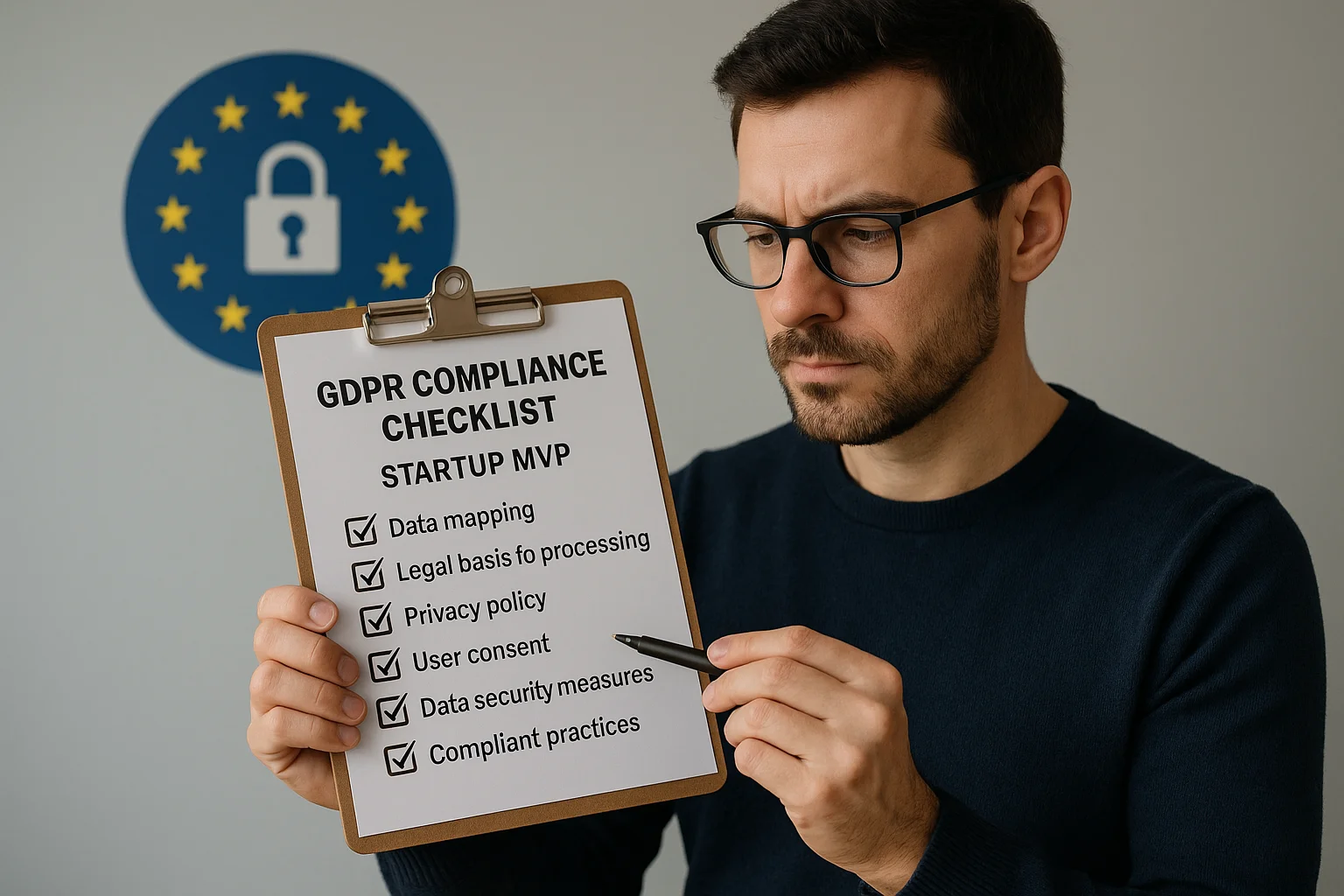
TL;DR: MVP GDPR compliance (the founder version)
- Collect the minimum data you need (everything else is liability)
- Be clear about purpose + consent (no pre-ticked boxes)
- Secure the basics (HTTPS, hashed passwords, least privilege)
- Publish a plain-English privacy policy and contact email
Navigating the GDPR Minefield: Your Fast-Track to MVP Compliance Without Delay
You’re on the verge of launching your MVP, driven by momentum and a clear vision. But a single, four-letter acronym looms over your European launch plans: GDPR. For many founders, it feels like a complex legal minefield, threatening to bog your lean startup down in another endless development cycle. It doesn't have to be this way. Forget the dense legal texts and confusing jargon written for corporate lawyers. Here's your definitive, no-nonsense guide built for non-technical founders like you: Future-Proof Your Launch: The 2025 Legal Checklist for Software MVPs in Europe. In line with MVPExpert’s core mission of delivering speed and certainty, this actionable checklist demystifies what you actually need for GDPR compliance at the MVP stage, ensuring you can protect user data and your business without sacrificing your launch timeline. Let’s get you compliant and back to building.
GDPR for MVPs: Cutting Through the Jargon (What You Really Need to Know)
GDPR can feel like a mountain of legal text designed to slow you down, particularly when developing an MVP in sensitive sectors like EdTech. However, achieving uncompromising student data privacy doesn't have to be a barrier; resources like The 2025 Playbook: EdTech MVP Development for Uncompromising Student Data illustrate that for your MVP, it's simpler than you think. Forget the complex clauses for a moment and focus on the core principle: treating user data with respect. This isn’t about becoming a lawyer; it’s about building trust from your very first user.
At its heart, GDPR for an MVP boils down to four key ideas:
- Data Minimisation: Only collect what you absolutely need. If your MVP can function without a user’s phone number, don’t ask for it. Every extra data point is a liability.
- Purpose Limitation: Be clear about why you need the data and stick to that reason. If you collect an email for login, you can't just add it to a marketing list without separate, explicit consent.
- Clear Consent: Users must actively agree to give you their data. This means no pre-ticked boxes on your sign-up form. Consent must be a clear "yes."
- Transparency: Tell users what you're doing in plain English. A simple, honest privacy policy is your best friend.
Ready to take action without delaying your launch? Follow this quick-start checklist:
MVP GDPR Sanity Check
- Map Your Data: List every piece of user information you plan to collect (e.g., email, name).
- Justify Everything: Next to each item, write down why it's essential for the MVP to work. If you can't, cut it.
- Implement Clear Consent: Add an unticked checkbox for your terms and privacy policy.
- Secure the Basics: Ensure data is stored securely (e.g., encrypted passwords).
- Draft a Simple Privacy Policy: Explain what you collect, why, and how users can contact you.
The Cost of Non-Compliance: Why Ignoring GDPR is a Founder's Riskiest Bet
"We're just an MVP; we'll worry about GDPR later when we have more users." This is a tempting, but dangerous, gamble. Thinking your startup is too small to be on a regulator's radar is a critical miscalculation. Non-compliance isn't just a potential legal headache down the road; it's a direct threat to your launch, your funding, and your product's long-term viability.
Let's address the big question: what are the penalties? The fines are severe, reaching up to €20 million or 4% of your company's global annual turnover, whichever is higher. For a startup, either figure is an existential threat.
But the financial penalty is only the beginning. For an MVP, the secondary costs are even more devastating:
- Total Loss of Trust: A data breach or compliance order right after launch will destroy the user trust you’ve worked so hard to build. Without trust, you have no users.
- Operational Shutdown: Regulators can order you to stop processing data, effectively freezing your MVP and halting user acquisition.
- Investor Red Flag: Non-compliance spooks investors. It signals a high-risk, poorly managed operation, making it much harder to secure that crucial seed or Series A funding.
Ignoring GDPR isn't a shortcut; it's planting a landmine in your growth path. Building data protection in from day one isn't about slowing down—it's about building a resilient, trustworthy product that’s ready to scale.
Core GDPR Principles in Practice: A Simple Guide for Your MVP
Don’t get lost in legal jargon. GDPR’s core principles are just common sense for building a trustworthy product. For your MVP, this isn’t about hiring lawyers; it’s about building good habits from the start. Your goal is to treat user data with respect: collect only what you need, be clear about why you need it, and keep it safe.
This approach builds trust and prevents a major compliance headache later on. Use this checklist to quickly audit your MVP’s data handling processes.
Your MVP's GDPR Principle Checklist
- Collect Only What You Need (Data Minimisation): Does your sign-up form really need a user’s full name and phone number, or will an email address suffice for your MVP's core function? Every extra data field adds friction and compliance risk. Stick to the absolute minimum.
- State Your Purpose Clearly (Purpose Limitation): Be upfront and specific. If you collect an email for a beta waitlist, don't automatically add it to your marketing newsletter. A simple sentence explaining why you need the data is usually enough.
- Set an Expiry Date (Storage Limitation): You can't keep user data forever. You don’t need a complex policy yet, but have a simple rule. For example, decide to delete data from inactive trial accounts after 90 days.
- Keep it Secure (Integrity & Confidentiality): Basic security is non-negotiable. Use strong passwords for admin accounts, enable two-factor authentication (2FA), and confirm your cloud provider has strong default security settings.
Mapping Your Data Journey: What Data Does Your MVP Collect, Store, and Process?
Before you can protect user data, you need to know exactly what you’re handling. Think of this as creating a simple inventory—a "data map"—for your MVP. This isn't a complex legal exercise designed to stall development; it’s a foundational step to gain clarity and avoid GDPR-related surprises post-launch. By understanding the journey your data takes from collection to storage, you can build compliance into your product from day one, rather than trying to bolt it on later.
To get started quickly without involving lawyers, create a simple spreadsheet. Use the checklist below to document every piece of personal data your MVP touches, from an email address to analytics cookies. This quick audit demystifies your obligations and forms the backbone of your compliance strategy.
Your MVP Data Map Checklist
| Category | Question to Answer | Example |
|---|---|---|
| Data Point | What exact information are you collecting? | Email Address, IP Address, First Name |
| Purpose | Why do you absolutely need it for the MVP to work? | "For user login & password resets." |
| Collection Point | Where does the user provide this data? | "On the user sign-up form." |
| Storage & Processing | Where is it stored and what tools process it? | "Stored in AWS (Ireland); Processed by SendGrid for emails." |
| Third-Party Sharing | Is it shared with any other services? | "Yes, with Intercom for customer support." |
| Retention Period | How long will you keep it? | "For the lifetime of the user's account." |
Completing this map provides a clear, at-a-glance view of your data responsibilities. It’s a pragmatic tool, not a legal document, designed to give you certainty. It makes drafting your privacy policy infinitely easier and helps you confidently answer questions about your data practices. This isn't about slowing your launch; it’s about building a solid foundation for secure, sustainable growth in the EU market.
Establishing Lawful Basis: Your MVP's 'Right to Process' Data
Under GDPR, you can't just collect user data because it might be useful later. You must have a valid legal reason for every processing activity. This is your "lawful basis"—your MVP's 'right to process' data. Don't get bogged down in legal complexities; for an MVP, focus on the most direct justifications.
Before you launch, map every piece of data you collect to one of these common lawful bases.
Your MVP's Lawful Basis Checklist:
-
Is it necessary for your service? (Contract)
If a user signs up for your service, you need their email to create an account. If they buy something, you need their address to ship it. This is a contractual necessity. You don't need separate consent for these core functions. -
Did the user clearly agree? (Consent)
For anything non-essential, like marketing newsletters or tracking cookies for advertising, consent is your clearest path. This must be a specific, freely given, and unambiguous action—think unticked checkboxes. Make it easy for users to give and withdraw consent. -
Is it a reasonable business need? (Legitimate Interest)
You might use analytics to find bugs or analyze usage patterns to improve your product. This can be a "legitimate interest," but only if your business need doesn't override the user's rights and privacy. If you use this, briefly document why it's necessary and fair.
Your pre-launch task is simple: create a list of data points (e.g., email, name, IP address) and assign one of the bases above. This document is a foundational step toward compliance without delaying your launch.
Privacy by Design & Default: Baking Compliance into Your MVP from Day One
Don't treat GDPR as a legal hurdle to clear before launch; think of it as a core feature of your product architecture. This is the essence of "Privacy by Design and Default." It means you’re not bolting on privacy features at the end but baking them into your MVP's DNA from the first wireframe. This proactive approach, key to Future-Proof Your Product: Avoiding Common Pitfalls in MVP Development Strategy, saves you from costly rebuilds and builds user trust from day one.
"Privacy by Design" is about anticipating and preventing privacy issues before they happen. "Privacy by Default" ensures that when a user signs up, the most privacy-friendly settings are already selected for them. They shouldn't have to navigate complex menus to protect themselves; your MVP should do it automatically.
Use this simple checklist during your product planning to ensure you’re on the right track:
- Data Minimisation: For every data field you plan to collect (e.g., name, email, location), ask: "Is this absolutely essential for the core function of the MVP right now?" If the answer is no, don't collect it.
- Default to Private: Are user profiles public or private by default? Are marketing communications opt-in or opt-out? The default setting must always be the most protective of the user's privacy.
- User Control Blueprint: Have you mapped out how a user will eventually access, edit, or delete their data? You don't need to build it all now, but the user flow should be planned from the start.
- Purpose Limitation: Clearly define the single purpose for each piece of data you collect. Data collected for login verification cannot be used for marketing without separate, explicit consent.
Crafting Your MVP's GDPR-Compliant Privacy Policy: The Non-Negotiables
Your privacy policy is not just a legal document; it's a pact of trust with your earliest users. For an MVP, it doesn’t need to be a 50-page legal epic. It must be clear, honest, and transparent about your data practices. Using jargon or copying a generic template without customisation erodes trust and creates compliance risks.
Focus on clarity over complexity. Write in plain English and directly address what your users want to know. While starting with a template is a smart way to accelerate, you must tailor it to reflect exactly what your MVP does. Here is a non-negotiable checklist of what your privacy policy must contain to be GDPR-compliant from day one.
- Your Identity & Contact Info: State your company name and provide a dedicated contact email (e.g., privacy@yourmvp.com) for any data-related queries.
- What Data You Collect: Be specific. List the exact types of personal data you process, such as "email address, name, IP address, and in-app usage behaviour."
- Why You Collect It (Purpose): For each type of data, explain its purpose simply. For example, "We collect your email to create your account and communicate service updates."
- Who You Share It With: Disclose all third-party services that will process user data, such as Stripe for payments or Google Analytics for product metrics.
- How Long You Keep It: Define your data retention period. A simple and defensible starting point is "for as long as the user's account remains active."
- User Rights: Clearly state that users have the right to access, amend, or delete their personal data, and provide a straightforward process for them to make these requests.
Understanding Data Subject Rights: Empowering Your Users & Staying Compliant
GDPR empowers your users by giving them specific rights over their personal data. Think of this not as a legal burden, but as a foundational way to build trust. For your MVP, you don't need a complex, automated dashboard to manage these rights from day one. You simply need a clear and reliable process to handle user requests.
Your users have the right to access, correct, delete, and take their data with them. Your privacy policy should clearly state how they can make these requests—often, a simple "email privacy@yourmvp.com" is a sufficient starting point. The crucial part is having a documented internal plan to act on those requests promptly.
Focus on having a plan for these core rights:
| User Right | MVP Action Plan |
|---|---|
| Right to Access | Be prepared to manually export a user's data (e.g., into a CSV file) and send it to them upon request. |
| Right to Rectification | This is often built-in. Ensure users can easily edit their own information, like in a profile settings page. |
| Right to Erasure | Have a straightforward, irreversible process to permanently delete a user's account and all their data. |
| Right to Data Portability | Similar to access, be ready to provide a user's data in a common, machine-readable format like CSV or JSON. |
Don't let this block your launch. The goal is compliance and responsiveness, not perfect automation. A manual, well-documented process is a perfectly valid and fast way to get your MVP to market while respecting user rights.
The DPO Question: Does Your Startup MVP Need a Data Protection Officer?
Let's cut to the chase: for most startups at the MVP stage, the answer is likely no, you do not need to appoint a formal Data Protection Officer (DPO). This is one area where you can save time and resources without taking a major compliance risk.
GDPR only makes a DPO mandatory if your core activities involve specific high-risk data processing. Your MVP, by design, is likely not operating at the "large scale" that triggers this requirement. However, you can't ignore data protection entirely. The key is to understand if you fall into one of these categories.
Use this quick checklist to assess your need:
Is a DPO mandatory for my MVP?
- Public Authority: Are you a public body or authority? (Almost certainly no.)
- Systematic Monitoring: Is the core function of your MVP to conduct large-scale, regular, and systematic monitoring of individuals? (e.g., a behavioural analytics platform or a location-tracking app for a massive user base).
- Sensitive Data: Is the core function of your MVP to process large volumes of "special category" data (like health, genetics, biometrics, race, or sexual orientation) or data about criminal convictions?
If you answered "no" to all three, you don't need a formal DPO right now.
Your Fast-Track Action: Instead of hiring a DPO, designate a "data privacy lead" within your founding team. This person is the go-to contact for all data protection matters, ensuring someone is responsible. This simple step demonstrates accountability without the formal overhead. As your product grows and you scale your data processing, you can and should re-evaluate this decision.
The Founder's Fast-Track GDPR Compliance Checklist for Your MVP
GDPR compliance can feel like a roadblock, but for your MVP, it's about covering the essentials without derailing your launch. This isn't about achieving legal perfection overnight; it's about building a solid, compliant foundation quickly. To ensure a successful and compliant launch, and to navigate the complexities of MVP development more broadly, choosing the right partners is paramount. Use this checklist to validate your core processes before you go live and prove you're taking user privacy seriously from day one. For comprehensive guidance on selecting a suitable development partner, particularly for specialized fields like HealthTech, founders can refer to How to Choose a HealthTech MVP Development Partner: The Founder's Checklist. This fast-track checklist focuses on what truly matters at the MVP stage, ensuring you can launch with confidence and certainty.
Downloadable/Printable: Your Essential GDPR Compliance Checklist for MVPs
Don't let GDPR compliance become a launch blocker. We've distilled the complex legal requirements into a straightforward checklist designed specifically for the MVP stage. This isn't about becoming a legal expert; it's about implementing the core principles of data protection efficiently so you can launch with confidence.
Think of this as your pre-flight check for data privacy. By ticking these boxes, you're not just avoiding potential fines—you're building trust from day one. Use this list to quickly audit your product, identify gaps, and take decisive action without getting bogged down in red tape.
- Data Map: Can you list every piece of personal data your MVP collects, explain exactly why you need it, and know where it’s stored?
- Lawful Basis: Have you identified and documented your legal reason for processing data (e.g., explicit user consent)?
- Clear Consent: Is your consent request unambiguous and obtained via an affirmative action, like an unticked checkbox? It must not be buried in your T&Cs.
- Simple Privacy Policy: Is a clear, easy-to-understand privacy policy written and prominently accessible to all users before they sign up?
- Data Minimisation: Are you truly only collecting the absolute minimum data required for your MVP's core function to work?
- User Rights Plan: Do you have a basic process (even a manual email flow) to handle user requests to access, edit, or delete their data?
- Vendor Check: Have you reviewed the compliance of third-party services (e.g., analytics, hosting) and signed Data Processing Agreements (DPAs)?
- Core Security: Are fundamental security measures, such as SSL/TLS encryption and access controls, in place?
Your MVP, GDPR Compliant, On Time, On Budget
Navigating GDPR compliance for your MVP can feel like a roadblock, but it's actually a foundational step towards building a sustainable business. The key isn't perfection, but intention. By embedding privacy by design from your first line of code, practicing strict data minimization, and maintaining transparency with a clear, simple privacy policy, you address the biggest risks upfront. These principles aren't just legal hurdles; they are powerful tools for building user trust from day one, especially when developing secure and compliant MVPs, a topic thoroughly explored in resources such as Accelerate & Secure: MVP Development Services for HIPAA-Compliant Healthcare.
Your immediate next step isn't to become a legal expert, but to critically review your MVP’s data flow. Does every piece of data you collect serve an essential purpose? Starting with this focused, user-centric approach ensures you’re not just compliant, but building a product that customers will trust and advocate for long after launch.
Don't let GDPR compliance become another endless development cycle; get your MVP launched fast and legally with MVPExpert. Book your free project consultation today.

Børge Blikeng
AuthorHelping startups build successful MVPs for over 5 years