The Procurement Trap: Why a Formal RFP Process Will Kill Your MVP's Success
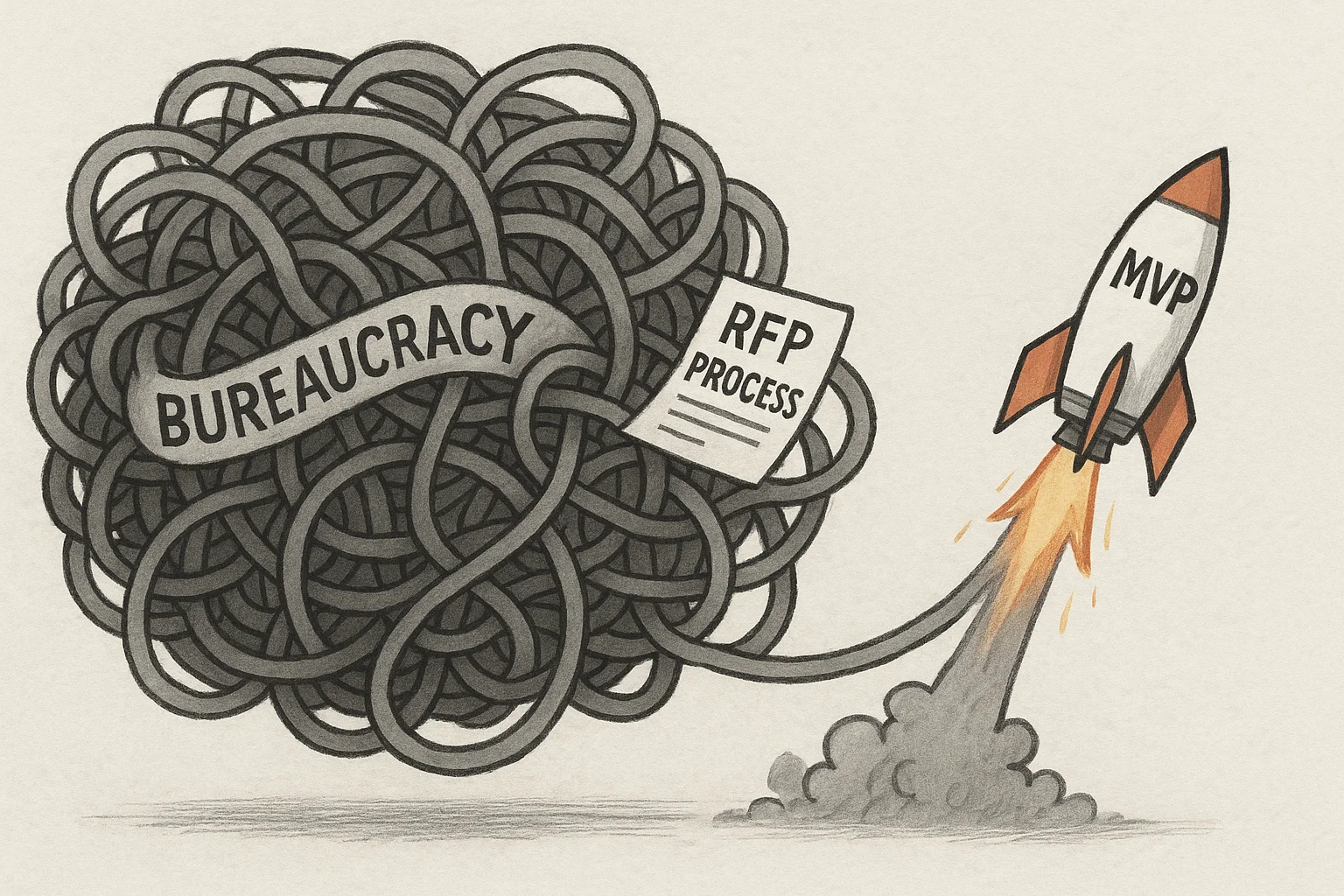
The MVP Paradox: Why Your Best Intentions with Procurement Could Sink Your Next Big Idea
As a corporate leader, your instinct for sourcing a development partner is grounded in due diligence: the formal Request for Proposal (RFP). This process is designed to mitigate risk and ensure budget alignment through comprehensive vetting and competitive bidding. However, for a Minimum Viable Product (MVP), this established methodology is the very thing that stifles success. The goal of an MVP isn't perfection; it's speed and validated learning. A rigid RFP forces premature and exhaustive scoping, locking you into a slow, bureaucratic cycle before a single line of code is written. This is the procurement trap, a common pitfall that often results in the 'typical $10k-$100k cost & vague timelines' highlighted in expert analyses such as MVP Agency: Why The Typical $10k-$100k Cost & Vague Timelines Are A Trap.
We propose a modern framework that bypasses this outdated approach. Instead of an endless vendor comparison and negotiation process, consider a fixed-price, productized service designed specifically for rapid MVP execution. This guide will show you how to escape the endless development cycle and get your idea validated in weeks, not quarters.
The Imperative of Speed: Why MVPs Don't Play by Traditional Rules
In corporate procurement, your process is your shield. A formal Request for Proposal (RFP) is meticulously designed to mitigate risk, ensure budget compliance, and deliver a predictable, feature-complete solution. For large-scale software implementation, this methodical approach is non-negotiable. However, a Minimum Viable Product (MVP) operates on a completely different premise. Its primary goal isn’t to deliver a finished product, but to test a core business hypothesis as quickly as possible in the real market. The greatest financial risk isn’t scope creep; it’s spending months building a perfect version of the wrong thing.
When you apply a traditional RFP timeline—often spanning three to six months—to an MVP, you sacrifice its single greatest asset: speed. That’s an entire business quarter spent on vendor selection paperwork while your market window closes and competitors advance. The imperative for an MVP is not exhaustive documentation and comparative bidding, but rapid execution and validated learning. Success is measured in weeks, not fiscal years.
This fundamental conflict in objectives requires a different procurement mindset, one that prioritizes speed and validated learning over traditional exhaustive processes. Understanding and implementing such an agile approach is crucial, as detailed in resources like Quick MVP Development for Startup Validation: The 2025 Blueprint. Consider the key differences:
| Factor | Traditional Software Project | MVP Development |
|---|---|---|
| Primary Goal | Deliver a pre-defined scope | Validate a core hypothesis |
| Key Metric | Budget adherence & feature completion | Speed to market & user feedback |
| Success Horizon | 12-18 months | 10-14 weeks |
| Greatest Risk | Scope creep & budget overruns | Building the wrong product |
For an MVP, the process must be optimized for velocity, not exhaustive vetting. The opportunity cost of a multi-month delay to find the "perfect" partner far exceeds the risk of launching an imperfect-but-fast experiment to gain invaluable market data.
Dissecting the Traditional RFP: A Step-by-Step Walkthrough of the "Old Way"
For established organizations, the Request for Proposal (RFP) is the bedrock of de-risked procurement. It’s a structured, compliance-driven process designed for clarity and comparability when purchasing complex services. However, when applied to a Minimum Viable Product, this methodical approach often becomes a bottleneck, trading speed for a false sense of certainty.
Understanding this formal process is crucial to seeing its friction points. Here’s a typical step-by-step breakdown:
- Exhaustive Requirements Documentation: Internal teams spend weeks, sometimes months, creating a meticulous document detailing every assumed feature, technical specification, security requirement, and deliverable. This locks the project into a rigid scope before a single line of code is written.
- Vendor Sourcing and Distribution: The procurement team identifies and vets a long list of potential agencies, distributing the RFP and managing formal communications.
- Q&A and Proposal Submission Period: A fixed period allows vendors to submit questions, followed by a hard deadline for their multi-page proposals. This stage alone can easily consume 30-45 days.
- Committee Evaluation and Scoring: A cross-functional team uses a predetermined scoring matrix to painstakingly compare proposals, weighing factors like technical approach, team composition, and cost.
- Finalist Demos and Due Diligence: Shortlisted vendors present their solutions, followed by rigorous reference checks and financial viability assessments.
- Protracted Contract Negotiations: The final step involves lengthy legal and commercial negotiations to finalize the Master Services Agreement (MSA) and Statement of Work (SOW).
While thorough, this entire cycle can take a full quarter—time your market opportunity simply doesn’t have.
The Hidden Costs of Bureaucracy: How Formal Procurement Kills Innovation and Budget
Formal procurement is a powerful tool for controlling costs and mitigating risk on large, well-defined projects. However, when applied to a Minimum Viable Product, this same process becomes a liability. The goal of an MVP is speed-to-learning, an objective fundamentally at odds with the lengthy cycles of RFP creation, vendor evaluation, and contract negotiation. The "hidden costs" quickly outweigh the perceived benefits.
First, consider the cost of delay. The weeks or even months spent managing a formal RFP process represent a critical loss of market opportunity. While your team is buried in paperwork, a more agile competitor could be launching, gathering feedback, and iterating. This opportunity cost is rarely tracked but is often the most significant expense.
Second is the internal resource drain. Calculating the man-hours from your procurement, legal, technical, and product teams dedicated to the RFP process reveals a substantial upfront investment before a single line of code is written. This "soft cost" inflates the true total cost of ownership and diverts key personnel from value-creating activities.
Finally, and most damagingly, is the cost to innovation. A rigid RFP forces you to pre-define a solution to a problem you don't fully understand yet. It locks you and your chosen vendor into a fixed scope, eliminating the agility needed to pivot based on user feedback—the very purpose of an MVP. To understand how to avoid the pitfalls of such rigid contracting, which can lead to horror stories, explore MVP Budget vs. Fixed-Price Contract: How to Avoid Both Horror Stories. The process designed to ensure you build the right thing often guarantees you build the wrong thing, just very formally.
The Vendor Vetting Vortex: Why Standard Evaluation Metrics Fail for MVPs
Your standard procurement playbook likely involves a weighted scorecard, comparing vendors across dozens of metrics like hourly rates, team certifications, and adherence to a detailed technical specification. This process excels at purchasing known quantities, like software licenses or hardware. For an MVP, it’s a trap. An MVP is not a known quantity; it is an experiment designed to reduce uncertainty. Applying a rigid evaluation matrix to a project defined by ambiguity creates a vortex of false precision. You end up selecting a vendor optimized for executing a fixed plan, not one skilled in navigating the discovery process.
This traditional approach penalizes the very traits an MVP partner needs: the agility to pivot, the courage to challenge your assumptions, and a focus on market validation over feature completion. You risk choosing the cheapest "order taker" instead of the strategic partner who will get you to a learning outcome the fastest.
To escape the vortex, shift your evaluation criteria from outputs to outcomes. Instead of comparing detailed proposals, compare proven processes for launching V1 products under pressure. While traditional metrics prioritize the lowest blended hourly rate or adherence to a rigid technical spec, the smart way emphasizes a fixed price for a defined outcome, a proven process for rapid iteration, and a focus on the core user validation loop. This strategic shift in procurement thinking is vital for startups, especially when considering the true MVP Development Cost for Startups: The One Fixed Price You Need to Know and avoiding the pitfalls of hourly billing.
Ultimately, you are not buying developer hours. You are buying speed to market and the certainty of a conclusive business experiment. Vet for the partner who can deliver that outcome, not just the one who checks the most boxes on a spreadsheet.
Contractual Complexities and Legal Labyrinth: Navigating Terms in an Agile World
Traditional, multi-year Master Service Agreements (MSAs) are fundamentally misaligned with the speed required for an MVP. Built for predictable, waterfall projects, they become a source of friction when applied to agile development. Endless negotiations over vague Statements of Work (SOWs), time-and-materials billing that incentivizes delays, and complex change order processes can stall your project before a single line of code is written. The legal framework itself becomes a bottleneck to innovation.
For an MVP, the contract must be an accelerator, not an anchor. It should protect your interests while enabling the flexibility to learn and pivot. Your goal is to de-risk the project legally and financially by focusing on a tightly-defined initial scope with clear deliverables, often best achieved through a fixed-price model. This approach helps eliminate hidden fees and provides clarity on the true cost of your MVP, a topic explored further in The True Cost of an MVP: How to Eliminate Hidden Fees with a Fixed-Price Model. Instead of a 50-page document covering every eventuality, seek an agreement that prioritizes a specific, time-boxed outcome.
Before signing, use this checklist to distinguish a partnership-focused agreement from a traditional vendor contract designed to trap you in a long-term billing cycle.
| Traditional Contract Red Flag | MVP-Ready Contract Essential |
|---|---|
| Time & Materials Billing | Fixed-Price for a Defined Scope |
| Vague Scope of Work (SOW) | Concrete Deliverables & Success Metrics |
| Complex Change Order Process | A Lean Process for Post-Launch Iteration |
| Ambiguous IP Ownership | Unambiguous, Full IP Assignment Upon Delivery |
| Long-Term Retainers | A Time-boxed, Project-Based Engagement |
The "Endless Development Cycle": The Unforeseen Consequence of Rigidity
A formal RFP process, designed for predictable projects, inadvertently creates the "endless development cycle" for an MVP. It begins with a rigid Statement of Work (SOW) that attempts to specify every feature and outcome before a single line of code is written, providing a false sense of security for procurement and technical stakeholders. The core purpose of an MVP, however, is to learn and adapt based on real market feedback. The moment that feedback arrives—invalidating an assumption or revealing a critical user need—your meticulously crafted SOW becomes a liability.
Every necessary pivot or feature adjustment triggers a cascade of bureaucratic friction: formal change requests, scope renegotiations, budget re-approvals, and contract amendments. Development stalls while administrative processes take over. This cycle of ‘build, get feedback, stop, renegotiate’ repeats, turning a nimble 12-week project into a year-long resource drain. The very mechanism intended to control scope and budget becomes the primary driver of delays and cost overruns.
To escape this trap, the procurement model itself must shift. Instead of contracting for a comprehensive, fixed feature list, organizations should focus on securing a fixed-cost, time-boxed delivery aimed at achieving a specific business outcome, such as validated learning. This approach offers clear advantages and can guarantee your launch and de-risk your startup, as detailed in 5 Fixed-Price MVP Benefits That Guarantee Your Launch & De-Risk Your Startup, thereby aligning the commercial structure with the strategic goal of the MVP.
Beyond the RFP: Introducing the MVPExpert Model for Rapid Validation
The traditional RFP process, designed for purchasing known commodities, is fundamentally misaligned with the goals of an MVP. It forces you to define a complete solution before you've validated the problem, locking you and a vendor into a rigid scope based on assumptions. This creates a procurement paradox: the very process designed to mitigate risk actually increases the single greatest risk—building something nobody wants.
A more effective approach bypasses the comparative RFP entirely in favor of a productized service model. This shifts the focus from comparing bespoke proposals to selecting a standardized, rapid validation package. For an extreme example of what's possible in this domain, consider approaches like Rapid MVP Development: The Guaranteed 14-Day Launch Plan.
The framework is built on certainty and speed:
- Fixed-Scope, Fixed-Timeline: Instead of negotiating features, you procure a pre-defined package designed to deliver a core functional MVP within a non-negotiable timeframe, typically 4-6 weeks. This eliminates scope creep and ensures budget predictability.
- Standardized Strategy Phase: The engagement begins with a structured, time-boxed workshop to refine the core user journey and define the critical-path features for validation. This ensures alignment without endless discovery cycles.
- Pre-defined Deliverables: The output is clear: a deployed, market-ready application with a specific set of foundational features. You are buying a known outcome, not an open-ended project estimate.
- Focus on Validation, Not Volume: Success is measured by one metric: launching a tool that can generate real user feedback. This aligns the vendor's incentives with your core business goal of de-risking a larger investment.
This model transforms procurement from a lengthy negotiation into a strategic purchase of a validation asset, allowing you to get to market faster and with greater capital efficiency.
Fixed-Price, Productized, and Proven: How MVPExpert Eliminates the Need for Lengthy RFPs and Vendor Comparisons
The traditional vendor evaluation matrix, designed for large-scale IT procurement, breaks down when applied to the speed and agility required for an MVP. Instead of getting trapped in a cycle of creating detailed RFPs and comparing dissimilar agency proposals, you can adopt a streamlined approach focused on productized services, such as Fixed Price MVP Development Packages: Your Predictable Path to Product Launch. This transforms procurement from a lengthy comparative analysis into a clear, efficient go/no-go decision.
Here’s how to reframe your evaluation process:
- Demand a Fixed Price for a Fixed Scope. This immediately de-risks the project financially. You bypass complex quote comparisons and eliminate the threat of budget overruns common in time-and-materials contracts. Your evaluation becomes a straightforward question of ROI against a single, transparent number, not a protracted negotiation over hourly rates and unforeseen costs. This drastically simplifies and accelerates financial sign-off.
- Evaluate a Standardized Deliverable, Not a Custom Pitch. A productized service offers a pre-defined package: a specific set of features, a clear technology stack, and a guaranteed timeline. This removes the ambiguity of trying to compare bespoke proposals. Your task simplifies to a single assessment: does this specific, transparent offering provide the necessary functionality to validate our core business hypothesis?
- Vet the Proven System, Not Just the Team. Your due diligence shifts from assessing a theoretical project plan to validating a proven, repeatable delivery system. Instead of spending months on reference calls, focus on the provider’s track record with their specific model. Look for a portfolio of successfully launched products built through their exact process—the proof is in the system’s repeatable success.
Accelerating Success: The Tangible Benefits of a Streamlined MVP Partner for Procurement and CTOs
For procurement leaders and CTOs, the ultimate goal is to achieve maximum value with predictable costs and minimal risk. A traditional RFP process, while thorough, often introduces the very uncertainties it aims to prevent—scope creep, timeline extensions, and budget overruns that jeopardize ROI. A streamlined partnership model fundamentally changes this dynamic. It transforms vendor selection from a protracted negotiation into a strategic acquisition of a well-defined, productized service.
This approach delivers the cost certainty that procurement demands, alongside the speed and technical execution that CTOs require. By opting for a partner with a fixed-scope, fixed-timeline model, you de-risk the entire engagement from day one. You are not just buying ambiguous development hours; you are securing a guaranteed business outcome on a set schedule. This frees up valuable internal resources from lengthy vendor management and allows your technical teams to focus on core strategy rather than granular project oversight.
The tangible benefits are clear when directly compared:
| Metric | Traditional RFP Process | Streamlined Partnership Model |
|---|---|---|
| Time-to-Launch | 6-9+ months (incl. sourcing) | 8-12 weeks (post-kickoff) |
| Budget Control | Variable, prone to overruns | Fixed-price, predictable investment |
| Risk Profile | High (scope creep, vendor lock-in) | Low (defined scope, clear deliverables) |
| Resource Drain | High (procurement, legal, tech) | Minimal (focused on onboarding & strategy) |
| Innovation Cycle | Slowed by bureaucracy | Accelerated by rapid market feedback |
By shifting the procurement mindset from sourcing a bespoke project to acquiring a defined service, you align financial prudence with the urgent need for market validation. This modern approach ensures your innovation initiatives don't just start—they launch successfully and on budget.
Make the Shift: Validate Your Ideas Faster and More Efficiently with MVPExpert
The traditional RFP process, designed for purchasing known commodities, is fundamentally misaligned with the speed and uncertainty of innovation. For an MVP, the goal isn't just to procure a service; it's to purchase learning and validation at maximum velocity. Trying to force this dynamic into a rigid procurement framework introduces friction, delays, and unnecessary cost overhead.
Instead, to de-risk the process and accelerate your time-to-market, pivot to a more agile, product-centric sourcing model. This approach prioritizes certainty and speed over exhaustive comparison, particularly when you need to Define MVP Scope for a Fixed Price: The Guaranteed 14-Day Launch Plan.
Follow this framework to shift your procurement mindset from vendor vetting to idea validation:
- Define a Fixed Scope, Not a Wishlist: Radically narrow your project down to the single most critical user problem you need to solve. A tightly defined scope is the foundation for a fixed-price engagement, eliminating budget creep and endless change orders.
- Seek Productized Services, Not Custom Quotes: Identify development partners who offer a standardized, pre-packaged MVP service. This model provides transparent deliverables, a set timeline, and a fixed cost, turning a complex service into a predictable, purchasable product.
- Evaluate Process, Not Proposals: Instead of comparing bespoke proposals, evaluate the partner’s documented, repeatable delivery process. A mature, proven methodology for turning a fixed scope into a launched product in a guaranteed timeframe is more valuable than a well-written but unproven project plan.
By adopting this model, you transform procurement from a bottleneck into an enabler of innovation, getting you the validated learnings you need without the bureaucratic drag.
Don't Let Procurement Be the Trap; Unlock Your MVP's Full Potential Today
Ultimately, the rigid framework of a formal RFP is fundamentally at odds with the agile philosophy of an MVP. By demanding fixed scopes and detailed specifications upfront, the procurement process stifles the very iteration and learning a minimum viable product is designed to foster. This trap locks you into a transactional vendor relationship, prioritizing outdated assumptions over responsive development and guaranteeing a solution disconnected from real user needs.
To succeed, bypass the traditional RFP. Instead, seek a collaborative partner, not just a vendor. Engage potential teams through paid discovery phases or proof-of-concept projects. Evaluate them on their problem-solving approach and cultural fit, not their ability to fulfill a rigid checklist. Prioritizing partnership over prescription is the crucial first step toward building an MVP that delivers value. For a comprehensive guide on navigating this path and achieving success in enterprise applications, consider resources like Mastering MVP Development for Enterprise Applications: Your 2025 Strategic.
Don't let the procurement trap kill your MVP's speed; get a fixed-price, fast MVP with MVPExpert today. Book your free project consultation today.

Børge Blikeng
AuthorHelping startups build successful MVPs for over 5 years