The Post-Launch Playbook: 7 Growth Hacking Strategies for Your New B2C MVP
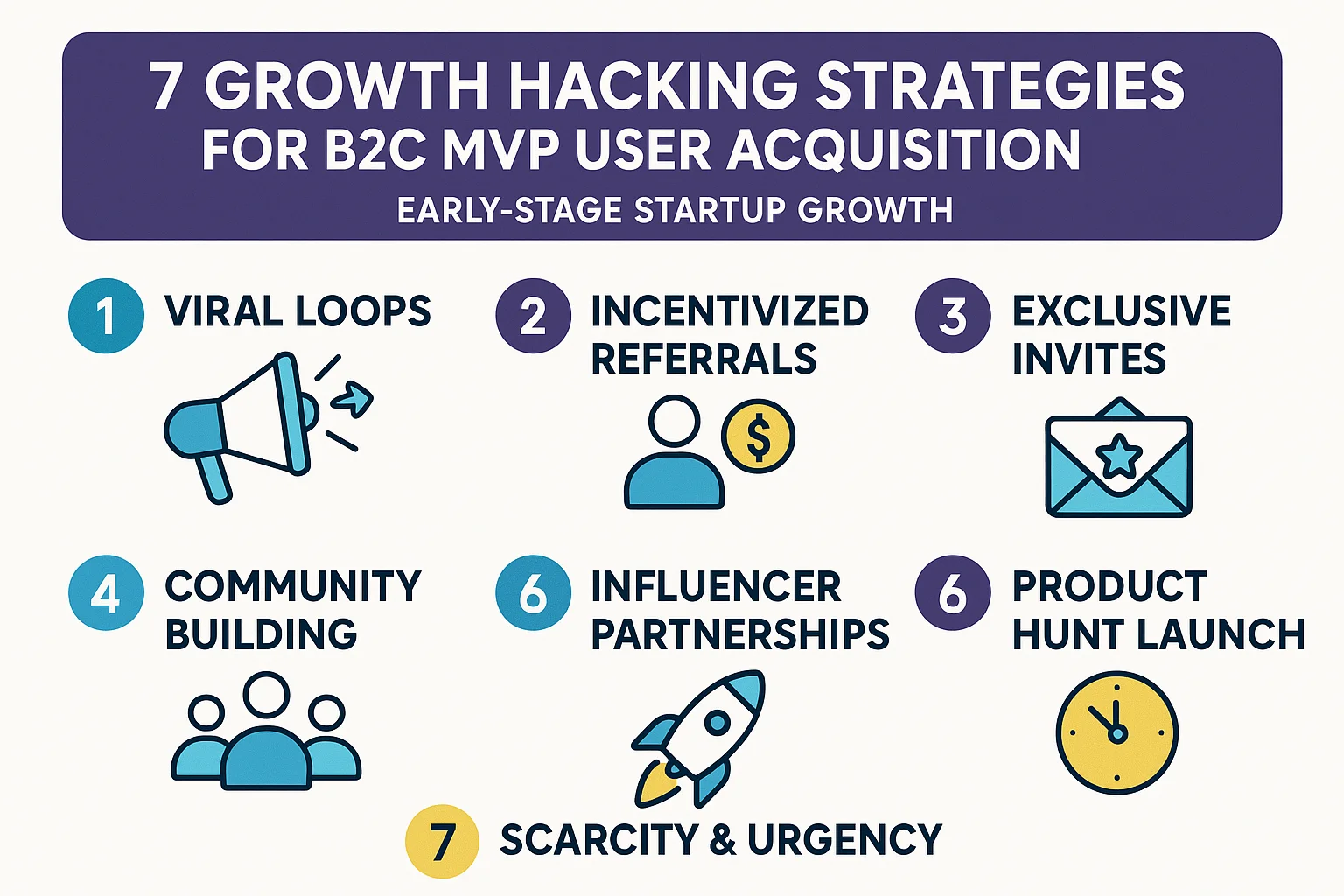
From Launch Day Buzz to Day 15 Reality – Your MVP's Next Critical Steps
The launch confetti has settled, and your B2C MVP is live. Congratulations. But now, around Day 15, a new feeling creeps in: the daunting quiet. The critical question isn't "Can we build it?" but "Will they come?" For a founder with limited resources, navigating this post-launch uncertainty to find those crucial first users can feel overwhelming. Forget scrolling through a random list of tactics. Consider this your definitive playbook—a prioritized, step-by-step guide designed for one specific mission: acquiring your first 100 users, much like what's outlined in The 2025 Playbook: Your Post-Launch Marketing Plan to Acquire First 100 MVP. Each of the seven strategies within is high-impact, low-cost, and engineered to do more than just boost numbers. They are designed to generate immediate traction while gathering the essential feedback needed to validate your core problem-solution fit. It's time to turn your launch into real momentum.
From Launch Day to Day 15: Why This Playbook is Your Next Step
Congratulations, you’ve launched! The initial adrenaline rush is giving way to a single, pressing question: “Now what?” You’re staring at a fresh analytics dashboard, and the pressure to gain meaningful traction is immense. It's easy to get paralyzed by the overwhelming lists of 101 marketing tactics, most of which assume you already have a budget and an audience. But the next 15 days are not about doing everything; they are about doing the right things in the right order. For a comprehensive strategy on validating your MVP during this crucial post-launch phase, a resource like The 14-Day Post-Launch Plan: How to Validate Your MVP with Real Users can be invaluable. This playbook acts as your strategic mission for that critical post-launch window. We've cut through the noise to give you a prioritized, step-by-step guide focused on one objective: acquiring your first 100 users with minimal spend. Think of this as your answer to "What specific growth hacks can I implement right now?" Each strategy is chosen for its high-impact potential and its ability to generate immediate feedback. This isn’t just about vanity metrics or random user acquisition. It’s about systematically testing your core assumptions and validating that you’ve built something people truly want. By Day 15, you won’t just have more users; you’ll have momentum, clarity, and the crucial data needed to prove your product’s value and confidently scale your growth.
Pillar 1: Re-Validate Your "First 100" Persona & Sharpen Your Value Proposition
Your MVP is live, and the first sign-ups are trickling in. Congratulations! But the persona you meticulously crafted pre-launch was a hypothesis. Now, it’s time to validate it against real user data. To guide this crucial process and ensure you're employing the best practices, consider insights from The 2025 Playbook: Essential User Testing Strategies for Your New MVP. This isn't about a full-scale pivot; it's about precision-tuning your targeting and messaging before you spend a single dollar on ads. Your first users hold the key to your next hundred. The goal is to move from a broad "ideal customer" to a hyper-specific "First 100" persona based on your most engaged early adopters. These are the people who truly get it. Finding them and understanding their "why" is the highest-leverage activity you can do right now. It directly answers the question: "Who finds our product most valuable, and why?"
Follow this simple, three-step validation process:
- Isolate Your Champions: Dig into your analytics. Identify the 10-20 users who have logged in the most, completed key actions, or spent the most time in your app. These are your true early adopters.
- Conduct "Problem & Value" Interviews: Reach out personally. Offer a $15 coffee gift card for 15 minutes of their time. Ask them:
- "What specific problem were you trying to solve when you found us?"
- "What is the single biggest benefit you've received so far?"
- "How would you describe this to a friend who has the same problem?"
- Refine Your Message: Listen for patterns. Use their exact words and phrases to update your website headline, ad copy, and app store description. This ensures your value proposition resonates powerfully with future users just like them.
Growth Hack 1: Hyper-Targeted Community Engagement & Direct Outreach Tactics
Your first users won't come from a Facebook ad; they'll come from direct, personal engagement. Forget mass marketing. This strategy is about finding the small, concentrated pockets of the internet where your ideal customers already congregate and complain about the exact problem you solve. It's the most direct, low-cost path to acquiring users who will provide the priceless feedback needed to validate your idea. Your goal isn't scale; it's surgical precision.
Follow this simple, four-step process to find your first true fans:
- Map Your Digital “Watering Holes”: Where do your target users live online? Get specific. Pinpoint subreddits (e.g., r/MealPrepSunday), niche Facebook Groups, Slack communities, or forums where they actively discuss their challenges. Create a spreadsheet listing 5-10 of these communities.
- Add Value Before You Ask: Before you post a single link, spend a week listening and contributing. Answer questions, upvote helpful content, and share expertise related to the problem space. Build social capital by genuinely helping people first.
- Execute the “Helpful Mention”: When you see a post describing the exact problem your MVP solves, respond thoughtfully. Then, introduce your product contextually: “I struggled with this too, so I built a simple tool to solve it. It might help you as well.”
- Initiate Personalized DMs: Identify the most active members or those expressing the most pain. Send a direct message: "Hey [Name], I saw your post about [problem]. I'm building a solution for this and would love your honest feedback. Would you be open to trying it out for free?"
This manual, unscalable work is the foundation for getting your first 20-50 users and confirming you've built something people genuinely need.
Growth Hack 2: Activating Your Personal Network & Structuring Early Adopter Programs
Your fastest path to the first 25 users is the network you already have. These individuals—friends, family, former colleagues—are your most accessible source for high-quality, candid feedback. This isn't just about vanity metrics; it’s about getting rapid validation from people who are more likely to give you the unvarnished truth. Don't overthink the outreach; the goal is speed and genuine feedback, not a perfect marketing pitch.
Structure your outreach by creating a simple "Early Adopter Program." This formalizes the relationship and makes people feel valued. Offer a clear incentive, like lifetime premium access or a personal onboarding call, in exchange for their time and insights.
Use a direct and personal message template to start.
Personal Outreach Template
Subject: Feedback on a new project?
Body:
Hey [Name],
Hope you're doing well.
I’ve just launched the first version of my new app, [Your App Name], which helps people [solve a specific problem, e.g., find local volunteer opportunities].
As someone whose opinion I really value, I was hoping you might spare 10-15 minutes to sign up and give it a try. I'm looking for brutally honest feedback on what works and what doesn't.
Here is the link: [Your App Link]
As a thank you for being one of our very first users, you'll get lifetime premium access for free.
Thanks so much,
[Your Name]
Create a simple spreadsheet to track who you've contacted and their feedback. This methodical approach turns personal connections into your first, most critical focus group.
Growth Hack 3: Crafting Viral Loops with Smart Referral Programs and Incentives
Instead of acquiring users one by one, a viral loop turns each new user into an advocate who brings in the next one. This is how Dropbox and Airbnb scaled explosively with minimal ad spend. For your MVP, this means building a simple, automated growth engine directly into your product. It’s about making your users your sales team.
The core of a successful viral loop is a smart referral program. Don’t overthink it; you can implement a basic version in a single afternoon.
Here’s a simple blueprint:
- Choose a Double-Sided Incentive: The best rewards benefit both the referrer and the new user. Crucially, it should be low-cost for you but high-value for them. Forget cash. Offer an extended free trial, unlock a single premium feature, or provide exclusive content.
- Make Sharing Effortless: Embed the referral mechanism directly into the user experience where they feel the most value. A prominent "Invite Friends, Get [Your Incentive]" button with a pre-generated, one-click shareable link is essential.
- Automate the Payoff: Ensure the reward is delivered instantly and automatically upon a successful referral (e.g., when their friend signs up). This immediate gratification builds trust and encourages repeat sharing.
Growth Hack 4: Amplifying Reach Through Micro-Influencers & Niche Partnerships
Forget chasing celebrity endorsements. Your MVP’s first champions are micro-influencers—creators with 1,000 to 50,000 highly engaged followers in your specific niche. Their recommendations feel like authentic advice from a trusted friend, not a paid ad. This strategy is perfect for a tight budget because the currency is often product access and genuine enthusiasm, not massive checks. The goal here isn't mass exposure; it's about gaining targeted visibility and social proof from the exact communities you want to serve.
This approach drives your first wave of passionate users and invaluable feedback. Here’s how to start today:
- Identify Niche Creators: Don’t just search for "fitness influencers." Search for hyper-specific hashtags like
#veganrunneror look for accounts followed by niche publications in your space. - Craft a Personal Pitch: Your outreach should show you’ve done your homework. Reference a specific post of theirs and explain exactly why your product would benefit their audience.
- Make a Clear, Simple Ask: Don't ask them to become a brand ambassador. Ask for one specific, low-effort action: a single Instagram Story with a link, a mention in their newsletter, or an authentic review post.
Growth Hack 5: Attracting Users with Problem-Solving Content & "Answer Engine Optimization"
Forget traditional, long-term SEO. In the early days, you need to focus on "Answer Engine Optimization" (AEO). Your potential users aren't just typing keywords; they're asking specific questions on Google, Reddit, and Quora, desperately seeking solutions. Your goal is to become the best, most direct answer to their problem.
Here’s your simple, three-step AEO playbook:
- Identify High-Pain Questions: Use free tools like AnswerThePublic or simply search relevant subreddits for recurring questions.
- Create the Definitive "Answer": Write a focused blog post, create a downloadable checklist, or record a short video that provides a comprehensive solution.
- Position Your MVP as the Next Step: Within your content, naturally introduce your MVP as the tool that automates or simplifies the solution you just outlined.
Growth Hack 6: Rapid A/B Testing Your Messaging with Micro-Budget Paid Campaigns
You have a strong hypothesis about why your product is valuable, but in the post-launch phase, guessing is expensive. Instead of waiting weeks for survey feedback, you can get definitive data on what message truly resonates with your target audience—in just a few days. Use a platform like Meta (Facebook/Instagram) to run hyper-focused A/B tests on your core value proposition.
Here’s the simple, three-step playbook:
- Isolate Your Message: Write 2-3 distinct headlines for your MVP, each focusing on a different core benefit.
- Launch Micro-Campaigns: Create identical ad campaigns for each message. Use the same image, audience targeting, and call-to-action.
- Measure the Winner: Ignore sales or sign-ups for now. Your key metric is Click-Through Rate (CTR). The variant with the highest CTR is your clear winner.
The Feedback Loop: Turning Early Users into Product Evangelists (and Your Best Data Source)
Your first 10-50 users aren't a vanity metric; they are your secret weapon for growth and validation. Forget complex analytics for a moment. The most potent data you have is sitting in their heads. Your job is to extract it, act on it, and in doing so, convert them from simple users into a volunteer marketing team.
Here’s a simple, four-step process you can implement today:
- Engage Personally: Send a personal email to every new user. Ask one simple, open-ended question: "What's the one thing you were hoping our product would do for you when you signed up?"
- Create a "Feedback Hub": Use a simple Trello board or spreadsheet to log every piece of feedback—complaints, feature requests, and praise.
- Close the Loop: When you fix a bug they reported or ship a feature they asked for, email them personally to let them know.
- Make the "Ask": Once a user feels heard and valued, they are primed to help. Now is the time to ask for a review, testimonial, or share.
Your First 100 Users: Essential Metrics for Day 15 & Beyond
You've launched, hustled, and the first users are trickling in. Congratulations! Your focus now pivots from pure acquisition to deep understanding. It's not just about reaching 100 users; it's about learning from them to reach 1,000.
Focus on these essential signals:
- Activation Rate: Of the users who sign up, what percentage completes the single most important action in your app?
- Day 1 & Day 7 Retention: How many users return the day after signing up? How many are still active a week later?
- Qualitative Feedback Rate: How many of your first 100 users have you personally spoken to?
- Referral Rate: Are users so impressed they're telling their friends?
These metrics are your compass. They show you which growth channels are attracting the right users and whether your product is truly solving their problem.
Your Day 15 Playbook for Immediate Traction
Ready to put these strategies into action? Download our 'B2C MVP Growth Hacking Toolkit' – complete with outreach templates, a referral program planner, and a feedback survey template to kickstart your Day 15 playbook!
Successfully launching your B2C MVP isn't the finish line; it’s the starting pistol for the real race. Post-launch success hinges on agile, data-driven growth hacking, not a massive marketing budget. The goal is to discover which channels and tactics uniquely resonate with your audience and deliver sustainable momentum.
If navigating your post-launch growth or validating your core problem-solution fit feels overwhelming, MVPExpert offers the strategic clarity to secure your first users and scale efficiently. Book your free project consultation today.

Børge Blikeng
AuthorHelping startups build successful MVPs for over 5 years