5 AI MVP Scoping Mistakes That Burn Your Budget (And How to Avoid Them)
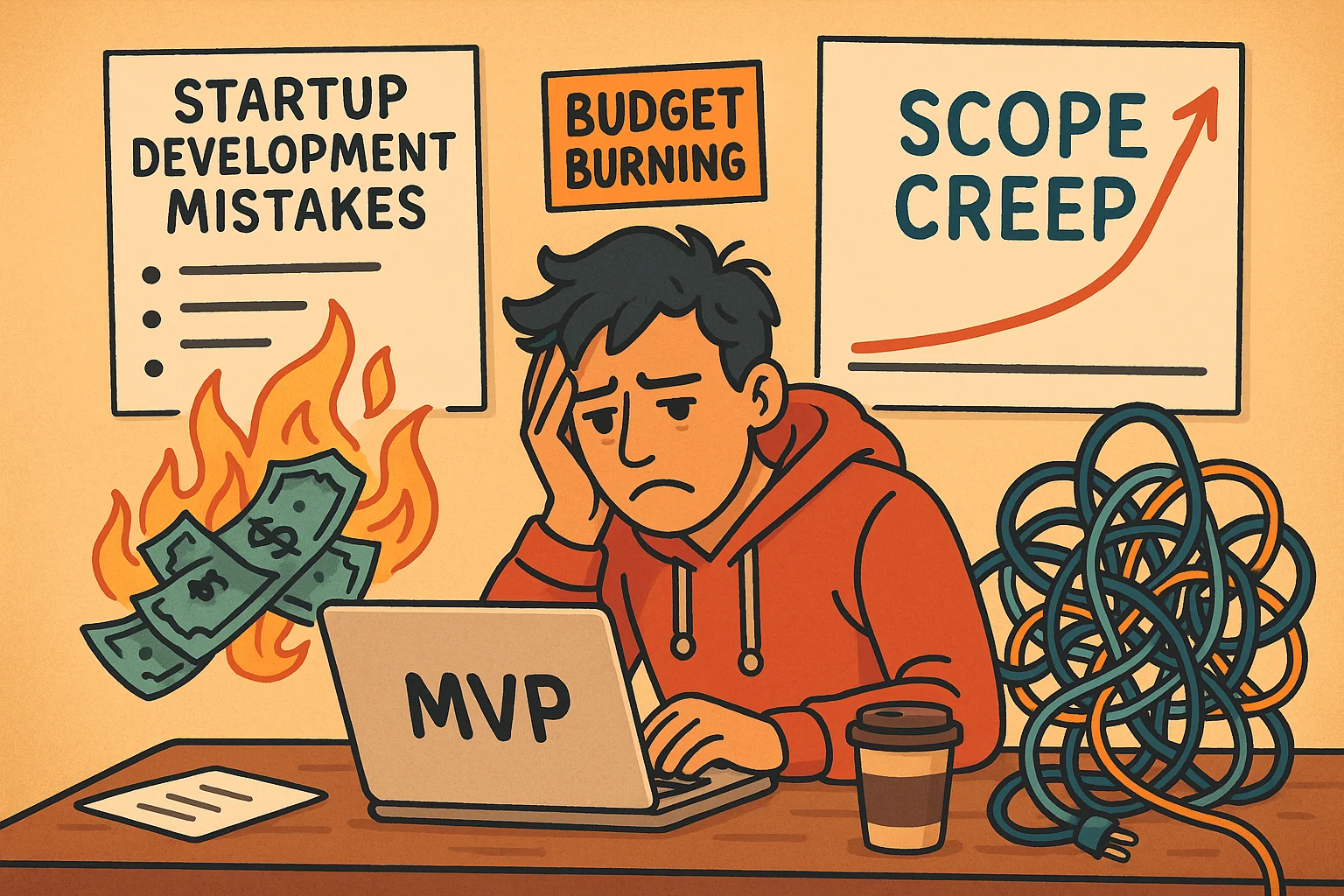
The AI MVP Dream vs. The Budget Nightmare: Why Most Founders Struggle
You have a game-changing idea for an AI product. But for many founders, the path from concept to MVP becomes a nightmare. Weeks turn into months as your budget evaporates in an endless cycle of R&D and refinement, with no launch in sight. The culprit isn’t a lack of engineering talent; it's a failure of strategy. These are critical scoping mistakes that can kill your startup before you ever validate your core idea with real users. This isn’t inevitable. By avoiding these common pitfalls, you can de-risk your project and accelerate your time-to-market. At MVPExpert, we’ve built our entire fixed-price process to prevent these budget fires. This includes our approach to Rapid App Development for Startups: The 14-Day, Fixed-Price Launch Plan. In this article, we’ll break down the five most common AI scoping mistakes and show how a disciplined, 14-day launch model is the ultimate antidote to scope creep and validation delays.
Mistake #1: Chasing AI Hype, Not a Real User Problem
The biggest sinkhole for an AI MVP budget isn’t a technical challenge—it’s starting with the technology itself. We see founders fall in love with a capability, like "using a Large Language Model for summarization," before they've validated who desperately needs it. This "AI-first" approach creates a solution looking for a problem, a classic recipe for building a product that is technically impressive but commercially irrelevant. This mistake is the number one cause of the endless development cycle. When your goal is simply "to use AI," the finish line is always moving. You burn through your runway adding sophisticated features and tweaking algorithms for a user who may not even exist. You get stuck building a cool tech demo instead of a lean, problem-solving machine. The critical question you need to answer—"Does this solve a painful enough problem for someone to pay for it?"—gets dangerously postponed. The Fix: Start with a user problem, not an AI solution. Before any scoping, define the single most valuable outcome you can deliver. Don’t build an “AI-powered marketing assistant.” Instead, scope your MVP to “help a solo founder draft three engaging social media posts from a blog URL in under 60 seconds.” This laser-focused, problem-first approach creates a clear definition of "done." It forces discipline and provides the fastest path to getting a real product in front of real users to validate your core assumption, fast. This strategic approach is crucial for teams looking to Accelerate Innovation: The Premier MVP Development Company for AI-Powered solutions, ensuring they build what truly matters.
Mistake #2: Over-Engineering Your AI MVP with Unnecessary Features
The temptation to build an "impressive" AI product is immense. Founders often believe that more AI-powered features will create a stronger "wow" factor, leading them to add functionalities like sentiment analysis, image generation, or complex predictive analytics to an MVP that doesn't need them. This common misstep is a classic strategic error that confuses complexity with value, echoing the crucial advice to Future-Proof Your Product: Avoiding Common Pitfalls in MVP Development Strategy. Each additional AI feature isn't just another item on a to-do list; it's a new dimension of complexity. It requires more data, more model training, and introduces new potential points of failure. This is how the "endless development cycle" begins, burning through your budget and delaying the single most important milestone: getting real user feedback on your core solution. You end up building a Swiss Army knife when your user just needed a sharp blade. The fix is ruthless simplification. Define the single, most critical job your AI must perform for your initial user. Your entire MVP should be built to execute that one job flawlessly. Before adding any feature to the scope, ask yourself these critical questions:
| Scoping Question | Why it Matters |
|---|---|
| Does this directly solve the user's #1 problem? | Avoids building "nice-to-have" features that don't drive adoption. |
| Is my core value proposition impossible without it? | Distinguishes essential functionality from future enhancements. |
| Can I get to market validation faster by omitting it for now? | Prioritizes speed-to-feedback over a perfect, all-in-one product. |
If a feature doesn't pass this test, it doesn't belong in your MVP. A focused product that launches quickly is infinitely more valuable than a complex one that never leaves the lab.
Mistake #3: Ignoring Data's Critical Role in Your AI's Success
Many founders believe the complex algorithm is the most challenging part of an AI MVP. The reality? Your AI is only as good as the data it’s trained on. Think of your AI as a brilliant engine; data is its fuel. If you try to run it on dirty, low-quality fuel, it will inevitably stall and break down. Ignoring your data strategy is a direct path to budget overruns and the dreaded "endless development cycle." When your initial data is poor, irrelevant, or insufficient, your team gets trapped trying to "fix" the model. They spend weeks tweaking an algorithm that simply can't learn from garbage inputs. This isn't a technical problem; it's a strategic failure that burns through your runway with nothing to show for it. For businesses aiming to successfully navigate the complexities of AI and Future-Proof Your Business: Building a Predictive Analytics ML MVP in 2025, a disciplined approach to data from day one is paramount. The solution isn't to spend six months building the "perfect" dataset. It's to de-risk your data assumptions before development begins. A disciplined, time-boxed approach forces you to validate your data viability early, preventing a costly dead end.
The Fix: Plan Your Data Strategy as Meticulously as Your Features
For an AI model, data isn't just a resource; it's the fuel. Treating it as an afterthought is like designing a high-performance engine with no plan for how to get gasoline. This mistake is a primary driver of the dreaded "endless development cycle," where projects stall for weeks or months while the team scrambles for usable data, burning through your budget with zero progress. Instead of a vague goal like "we'll get data," create a concrete data acquisition and preparation blueprint. This isn't about building a massive data warehouse; it's about defining the absolute minimum required to get a functional model working for your core use case. By answering these questions before a single line of code is written, you transform data from a potential blocker into a predictable asset, ensuring your project stays on a strict timeline and within a fixed budget, much like the strategies for efficient development detailed in Building a SaaS MVP in 2025: Your Realistic Timeline for Rapid Development.
Use this simple Data MVP Checklist to get started:
- Source: Where will our Day-1 data come from? (e.g., Public dataset, manual annotation, synthetic generation?)
- Quantity: What is the minimum viable dataset size needed to test our core hypothesis? Be specific (e.g., "200 annotated images," not "a lot").
- Quality: What does "good enough" look like for the MVP? Define a simple, non-negotiable standard for labeling and formatting.
- Pipeline: What is the simplest process to get this data ready for the model? Can it be done manually in a spreadsheet for the MVP?
Mistake #4: Building in Isolation – Forgetting User Validation
The "if you build it, they will come" mantra is a startup graveyard. For AI products, the equivalent is, "if the model is accurate, they will use it." This is a catastrophic assumption. Building your AI MVP in a silo, based only on internal hypotheses and clean datasets, is like training a pilot in a simulator and then expecting them to fly through a hurricane. Real-world users are messy, unpredictable, and the ultimate source of truth. Without early and continuous user validation, you aren’t building a product; you’re funding a research project with no guaranteed return. You risk spending your entire budget perfecting a powerful algorithm that solves a problem nobody has or in a way nobody wants. This is how the endless development cycle begins: you launch, discover your core assumptions were wrong, and are forced into costly re-engineering and model re-training, burning through capital with every iteration.
The Fix: Integrate Continuous User Feedback from Day One
Waiting for a "perfect" AI model before engaging users is a direct path to an endless development cycle. Unlike traditional software, an AI product isn't just code; it's a learning system that improves with real-world interaction. The biggest mistake is treating user feedback as a post-launch activity rather than a core development input from day one. Your AI might perform brilliantly on clean test data but fail spectacularly on the messy, unpredictable inputs from actual users. The fix is to launch a hyper-focused MVP to a small, controlled group of beta users as fast as possible. Their interactions, confusion, and bug reports are not failures—they are the most valuable training data you can acquire. This feedback loop allows you to understand where your model’s assumptions break down and what users actually value. For example, is the AI's output helpful but too slow? Is it accurate but hard to interpret? Answering these questions early prevents you from spending months perfecting a feature no one understands or needs. By forcing this validation cycle to begin within weeks, not months, you shift from building in isolation to co-creating with your market. This disciplined approach ensures every iteration is grounded in reality, saving you from burning your budget on an elegant AI solution to a non-existent problem.
Mistake #5: Letting Your AI MVP Budget Spiral Out of Control
AI development is notorious for its hidden costs. Unlike traditional software, you’re not just paying for code; you’re funding research and experimentation. Unforeseen expenses for cloud computing, data acquisition, and model training can quickly turn a reasonable estimate into a runaway train, especially with open-ended, hourly-billed projects. This is the fast track to the "endless development cycle," where you’re constantly funding effort without a clear launch date. You’re paying for time, not for a tangible, market-ready product. The primary cause isn't technical complexity; it's a lack of strategic constraints. When the budget and timeline are flexible, so is the scope. Features are added, models are tweaked indefinitely, and perfection becomes the enemy of progress. You bleed cash while your validation window closes.
The Fix: Adopt a Disciplined, Time-Boxed Approach to Launch (The MVPExpert 14-Day Model)
The antidote to the endless development death spiral isn't more features; it's a non-negotiable deadline. An aggressive, time-boxed launch forces ruthless prioritization and eliminates the “what-if” scenarios that bloat your scope and budget. Instead of an open-ended project, commit to a fixed 14-day cycle structured for maximum learning, an approach expertly guided by resources like The 14-Day MVP: A Founder's Guide to Launching for a Fixed $4,990. This framework converts ambiguity into a clear action plan:
- Days 1-3: Laser-Focused Scoping. Forget the long-term vision. Define the single, most critical problem your AI will solve for one specific user. Lock in the core feature set, the necessary data inputs, and the success metric. Anything else is noise. This becomes your immutable blueprint for the sprint.
- Days 4-10: Disciplined Development. With a locked scope, your development team can execute without distraction. The goal is not to build a polished, scalable masterpiece but a functional prototype that proves your core hypothesis. This sprint is purely about building what was defined in the first three days—nothing more.
- Days 11-14: User Validation & Deployment. The final days are for testing with real users, fixing critical bugs, and deploying. The objective is not a flawless launch but to get the product into the market to gather the crucial feedback that will inform your next iteration.
This compressed timeline creates immense clarity. It forces you to ship a tangible product, stop burning cash on unvalidated ideas, and start learning from actual user interaction. You trade the illusion of perfection for the certainty of market data.
Stop the Budget Burn: Launch Your AI MVP Smartly with MVPExpert
Navigating the complexities of an AI MVP is crucial to avoid costly overruns. Success isn’t about building a perfect, all-encompassing model from the start; instead, it hinges on a tightly defined scope that solves a single, high-value user problem. This requires prioritizing your data strategy, defining clear success metrics, and embracing a human-in-the-loop approach where necessary. Avoiding the temptation to chase flawless automation or an overly ambitious feature set is paramount to protecting your budget and timeline. Such disciplined approaches are key to launching any successful product, a sentiment explored in [The 2025 Playbook: Get Your App MVP Built for Under $5000], which offers further insights into achieving cost-effective MVP development. By sidestepping these common pitfalls, you shift your focus from pure technology to tangible business value. Take this opportunity to reassess your project's roadmap. A strategic, disciplined approach to scoping is your best defense against a burned budget and the surest path to launching an AI product that truly delivers.
Tired of scope creep and budget overruns killing your AI MVP? Discover how MVPExpert's 14-day launch model delivers your validated product on time and on budget. Book your free project consultation today.

Børge Blikeng
AuthorHelping startups build successful MVPs for over 5 years