Stop Managing Scope Creep: The 14-Day MVP Method That Guarantees Zero.
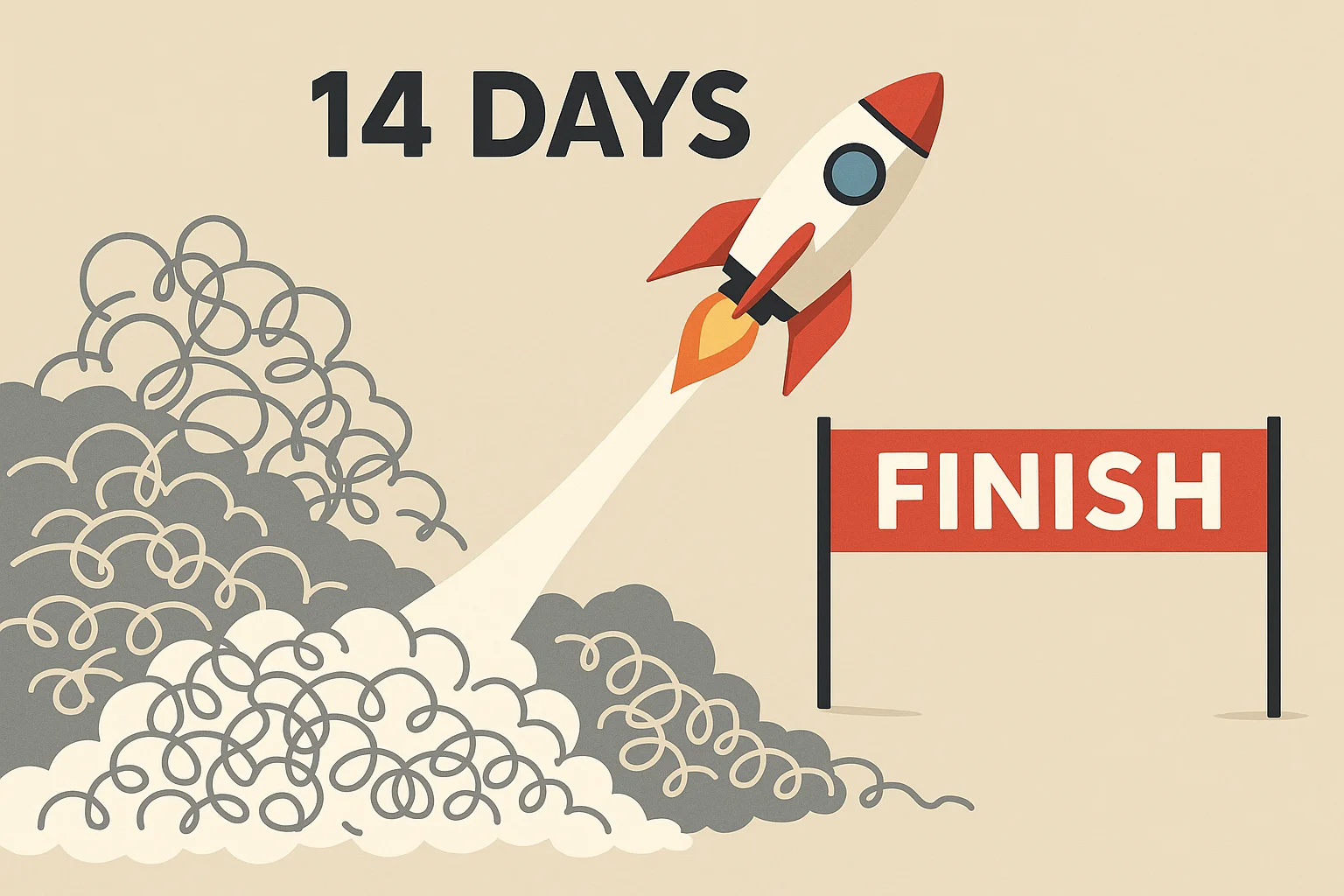
Introduction: The Silent Killer of Projects – Scope Creep
Introducing the 14-Day MVP Method: The Anti-Scope Creep Protocol That Guarantees Zero
Forget managing scope creep—it's a defensive, losing battle. The constant negotiation over "quick additions" and "minor tweaks" derails even the most disciplined teams. The 14-Day MVP Method isn’t another strategy to manage this chaos; it's a non-negotiable protocol designed to make scope creep impossible from the start.
The principle is simple: we create an ironclad, unchangeable scope before the 14-day clock ever starts. This isn't a loose plan; it's a fixed-price, fixed-scope contract for a hyper-focused Minimum Viable Product. Once the build begins, the gate is closed. There is no change control board, no process for new requests—because new requests are not an option.
All new ideas, no matter how brilliant, are automatically deferred to a "Version 2.0" backlog. This isn't about rejecting stakeholder input; it's about channeling it productively outside the protected 14-day sprint. This rigid framework forces ruthless prioritization and provides absolute clarity for your team, removing the distractions that lead to delays. The result? You don't just manage scope; you eliminate it entirely, guaranteeing you launch a functional product on day 14. Every time. This isn't a myth; it's our guarantee, as detailed in The 14-Day MVP: Not a Myth, It's Our Guarantee (Here's How We Do It).
I. Understanding the Enemy: Why Scope Creep Kills Projects
Scope creep is the silent killer of ambitious projects. It’s not the formal, approved change order; it’s the slow, insidious trickle of "quick additions" and "minor tweaks" that seem harmless in isolation. For project managers and founders under pressure, these requests—born from well-intentioned stakeholder suggestions or a team’s creative spark—act like a death by a thousand cuts. Each one seems manageable, but collectively, they derail your entire plan.
This uncontrolled expansion is the number one reason projects miss deadlines and obliterate budgets. In the context of a hyper-condensed 14-day timeline, it’s a guaranteed path to failure. It doesn’t just add work; it shatters momentum. Your team’s focus is diluted, morale plummets as goalposts shift, and quality is compromised as developers rush to implement unplanned functionality.
The fatal mistake is trying to manage this chaos reactively. Conventional strategies treat scope creep as an inevitability to be contained. But when your deadline is non-negotiable, containment isn’t enough. Trying to control it is a losing battle. The only way to guarantee a 14-day launch is to build a process where scope creep isn’t just discouraged—it’s structurally impossible.
A. Defining Scope Creep and its Devastating Effects on Deadlines and Budgets
Scope creep is the project manager’s silent assassin. It doesn’t announce itself with a bang but whispers its way into your project through a series of seemingly harmless requests: “just one more feature,” “a quick UI tweak,” or “a minor report.” Individually, they seem manageable. Collectively, they are fatal to your timeline and budget. This slow, uncontrolled expansion of project requirements beyond the original agreement is the number one reason high-stakes projects fail.
The devastating effects are all too familiar. Your meticulously planned 14-day sprint balloons into a month-long marathon. Your fixed budget evaporates, forcing uncomfortable conversations about unexpected costs. Team morale plummets as the finish line recedes with every new task, and the clear, motivating goal is replaced by a frantic scramble to integrate unvetted additions. The quality of work suffers, as rushed changes introduce bugs and technical debt that will haunt the product long after launch.
Ultimately, scope creep doesn't just delay a project; it fundamentally compromises its integrity. You risk delivering a bloated, buggy, and late product that no longer solves the core problem you set out to address. In a fast-paced environment, it’s not an inconvenience to be managed—it’s a threat to be eliminated entirely.
B. The Myth of 'Managing' Scope Creep: Why Traditional Approaches Fail
Let's be honest: "managing" scope creep is a losing game. For project managers and founders under pressure, it’s a high-stakes game of whack-a-mole where every "approved" change request is a hammer blow to your deadline. We’re taught to rely on change control boards, endless backlog grooming, and complex prioritization matrices. But in a hyper-fast 14-day build, these traditional tools are not just ineffective—they’re invitations for failure.
The fundamental flaw in these strategies is that they are reactive. They legitimize the idea that the original scope is a soft guideline, not a hard contract. They create a formal process for introducing the very distractions you need to avoid. Each “quick addition” or “small tweak” seems harmless, but this is death by a thousand cuts. Collectively, they cause the project to bleed out its time, focus, and budget, making your 14-day launch a fantasy.
The problem isn't a lack of discipline in managing change requests; it's the existence of a system that allows them in the first place. You can’t win a game that’s rigged against you. The only way to guarantee a 14-day delivery is to change the rules entirely, making scope creep structurally impossible from day one. For a comprehensive approach to achieving rapid MVP iteration through effective agile sprints, consider Mastering Agile Development Sprints: Your 2025 Blueprint for Rapid MVP Iteration.
II. The 14-Day MVP Method: Designed for Immutability
The 14-Day MVP Method achieves zero scope creep by making the project scope immutable from the outset. Unlike traditional projects that allow for flexibility, this model operates like a non-negotiable contract, embodying the principles of Ruthless Feature Prioritization: How We Build & Launch a Guaranteed MVP in 14 Days. The foundation is an intensive, pre-sprint ‘Scope Lockdown’ workshop where all stakeholders collaboratively define and commit to a final ‘Build Blueprint.’ This document is our unchangeable contract, detailing every feature, user story, and deliverable. Once signed, this scope is locked for a fixed price.
This creates powerful clarity and sets stakeholder expectations perfectly. There is no ambiguity. Any new requests or ‘brilliant ideas’ that emerge during the 14-day sprint are immediately and systematically triaged to a ‘Phase 2 Backlog.’ They are not debated or considered for the current build; they are deferred for a future project. This disciplined process eliminates distractions, allowing the development team to maintain laser focus on the agreed-upon goals. By treating the initial scope as sacred, we don’t just manage creep—we prevent it from ever taking root, guaranteeing your MVP launches on Day 14.
A. Core Philosophy: Fixed-Time, Fixed-Price, Fixed-Scope
Forget the endless battle against scope creep. Our 14-day MVP method doesn't just manage it—it makes it structurally impossible. The foundation of this guarantee is a simple but radical philosophy: Fixed-Time, Fixed-Price, and Fixed-Scope. This approach is deeply rooted in providing a predictable path to product launch, as detailed in our Fixed Price MVP Development Packages: Your Predictable Path to Product Launch.
Unlike traditional projects where scope is a fluctuating variable, our process treats the project's three core constraints as an unbreakable contract. The 14-day timeline (Fixed-Time) and the set budget (Fixed-Price) act as immovable bookends. These powerful constraints force a ruthless, upfront prioritization process that culminates in a meticulously defined and unchangeable Fixed-Scope before a single line of code is written.
This scope isn’t a wish list; it's the final blueprint. Once agreed upon, it is sealed. There are no channels for new requests or "quick additions" during the two-week sprint. By locking all three variables of the project management triangle, we eliminate the ambiguity that allows scope creep to thrive. This transforms the team's focus from accommodating changes to executing a precise plan with maximum efficiency. It's not a strategy to fight scope creep; it's a system that guarantees it never starts, ensuring you launch on day 14.
B. The 'Why': How Rigid Constraints Make Scope Creep Impossible by Design
Traditional project management treats scope creep as an inevitable disease to be managed. Our 14-Day MVP Method isn't about treating the symptoms; it’s about creating an ecosystem where the disease structurally cannot survive. The power lies in embracing radical, rigid constraints as your greatest asset, not as limitations.
Think of it like building a ship inside a bottle. The bottle's size is absolute and non-negotiable. You can't decide halfway through to add a taller mast or an extra cannon—it simply won't fit. Our 14-day timeline and fixed-scope, fixed-price contract are that bottle. This immovable deadline forces a level of ruthless prioritization from Day One that is absent in longer, more flexible projects. It fundamentally shifts the entire stakeholder dynamic from "What can we add?" to "What is absolutely essential to launch?"
This framework makes scope creep impossible by design. When the timeline, scope, and budget are locked in a "triple-bind" agreement before work begins, there is no procedural or financial mechanism for introducing new requests. The conversation about a “small tweak” is no longer a negotiation; it's a simple "no" for this sprint, immediately deferring the idea for consideration in a future project. This isn't just a policy; it's a law of the project's physics. By making the boundaries finite and unbreakable, we don’t just discourage creep—we engineer it out of existence, guaranteeing your MVP launches on Day 14. Every time.
The first 72 hours are not for gentle planning; they are a high-stakes, collaborative sprint to forge your project’s constitution. We call this the Scope Lockdown. The goal is simple: define every feature, user story, and acceptance criterion with absolute finality, leaving zero room for interpretation or addition later. For a comprehensive resource on mastering this critical stage, refer to How to Define Scope for an MVP Project: The Ultimate Guide.
This is achieved through intensive, mandatory workshops with all key stakeholders. Your only agenda is to identify the single, critical problem your MVP will solve and map the minimalist path to that solution. Forget nice-to-haves; this is a ruthless process of elimination. The output is a non-negotiable Scope Specification Document. This isn't a flexible guide; it's a signed contract. It must include explicit user flows, wireframes, and “what-done-looks-like” criteria for every single task.
Once signed by all parties on Day 3, this document is frozen. There is no change request process because changes are not an option. Any new idea, no matter how brilliant, is automatically deferred to a “V2” backlog. This disciplined rigidity is the secret: scope creep is impossible because there’s nowhere for it to creep into. Your project's DNA is set in stone.
A. Blueprinting the Absolute Minimum Viable Product (MVP)
Forget the traditional, flexible MVP. For a 14-day build, we create an Absolute MVP. This isn’t a backlog to be groomed; it’s a non-negotiable contract carved in stone before day one, aligning with the principles for rapid validation, as detailed in resources like Quick MVP Development for Startup Validation: The 2025 Blueprint. The process is about ruthless prioritization, not feature collection. Start by defining your product’s entire purpose in a single, unyielding sentence: “Our MVP will allow [user type] to achieve [primary goal] by doing [single key action].”
Every potential feature must then pass a brutal litmus test: “Can the user still achieve this primary goal without this feature?” If the answer is yes, the feature is immediately discarded. There are no “nice-to-haves” or “what-ifs”—only essential, critical-path functions. This isn't about building a product; it's about validating one core hypothesis through a single, functional user journey.
The output is your immutable blueprint: a locked-in specification sheet detailing the exact, unchangeable scope. This document is the single source of truth for your development team, eliminating all ambiguity and providing the laser focus required for a 14-day delivery. This blueprint isn’t a guideline; it’s the architectural foundation of your zero-scope-creep guarantee.
1. Defining the Single Core Problem Your Project Solves
The first step to eliminating scope creep isn't a feature list; it's a declaration of war on complexity. Before a single line of code is written or a design is mocked up, you must distill your project's entire purpose into a single, razor-sharp problem statement. This isn't a vague mission; it's a specific, measurable pain point you are committed to solving in 14 days. Forget the "what ifs" and "couldn't we alsos"—focus only on the absolute, must-have nucleus of your idea. For agencies seeking to master this crucial initial phase and ensure clarity from the outset, a valuable resource is available in Mastering 2025: The Essential MVP Project Proposal Template for Modern Agencies.
We achieve this by framing it as a "Job to Be Done": When [specific situation], the user wants to [motivation], so they can [achieve this outcome]. This sentence becomes your project's constitution—the ultimate filter for every subsequent decision. It is not a collection of user stories or a list of "nice-to-haves." It is the one thing your MVP must do perfectly.
If a proposed feature or change doesn't directly serve this core job, it's not debated; it's discarded. This isn't about flexibility; it's about ferocious focus. In our 14-day model, this problem statement is the scope. It’s the immutable foundation upon which your on-time, on-budget launch is built, making scope creep an impossibility from day one.
2. Feature Prioritization: The 80/20 Rule Applied to MVP (Only 'Must-Haves')
In a typical project, your feature list is a wish list. In our 14-day method, it’s a kill list. The key to eliminating scope creep is ruthless prioritization from day one, and we do this by applying the 80/20 rule with surgical precision. The Pareto Principle dictates that 80% of your value will come from 20% of your features. For a 14-day build, this isn't a guideline—it's law. Your job is to identify that vital 20% and have the discipline to build only that.
To draw this line in the sand, categorize every potential feature as either a “Must-Have” or a “Nice-to-Have.” Then, discard the entire “Nice-to-Have” list. It’s not for a later sprint; for the purposes of this 14-day launch, it doesn’t exist. The defining question for a “Must-Have” is brutally simple: "Can the product fulfill its single most important function for the user without this?" If the answer is even a hesitant “yes,” the feature is cut.
This isn’t about building a comprehensive solution; it’s about building a viable one that validates your core assumption. This aggressive filtering creates a feature set that is locked in stone, forming an unchangeable pact with your deadline and guaranteeing your team remains laser-focused on the launch.
3. Identifying the Non-Negotiables: What Absolutely Has to Be There for Launch
This isn’t your typical prioritization meeting where you debate "must-haves" versus "nice-to-haves." For a 14-day build, there is only one category: "non-negotiable." To define this, you must be ruthless. Start by answering one question: What is the single most critical problem you are solving for one ideal user? The answer reveals your product’s core value proposition. Everything in your scope must directly serve the absolute shortest path for that user to solve that one problem.
Map this "critical path" journey. If your MVP is a simple booking tool, the non-negotiables are the functions to select a service, pick a time, enter payment details, and receive a confirmation. That’s it. User profiles, past booking history, or custom notification settings are not on the path; they are distractions that will derail your launch.
The output of this exercise is your Immutable Feature List. Each item on it must pass a simple test: "If we remove this, does the product fundamentally fail to deliver its core promise?" If the answer is no, it gets cut. This list is not a guideline; it is the unchangeable blueprint for your 14-day sprint and the foundation of our zero scope creep guarantee.
B. The Ironclad Agreement: Stakeholder Buy-in & The 'No Changes' Mandate
Forget gentle persuasion; the 14-day MVP model is built on a non-negotiable pact. The process begins before Day 1 with a mandatory, all-hands “Scoping Summit.” Here, every key decision-maker is required to define, debate, and agree upon the exact deliverables. The goal isn’t a vague outline; it’s a granular, feature-by-feature specification that becomes your project’s constitution.
The trade-off you present to stakeholders is brutally simple: they exchange in-flight flexibility for the absolute certainty of a launch on a fixed timeline and budget. Once this summit concludes, the scope document is formally signed by all parties. This isn’t a guideline; it's a contract. The moment it’s signed, the scope is locked, the 14-day timer starts, and the “no changes” mandate is in full effect.
Any new ideas, brilliant “what-ifs,” or minor tweaks—no matter how small—are immediately and systematically moved to a documented “V2 Backlog.” This respects the stakeholder's input without derailing the mission. It reframes the conversation from a difficult “no” to a strategic “not now,” protecting your team’s focus and guaranteeing the project crosses the finish line on Day 14. This signed agreement is the single most critical tool for eliminating scope creep.
1. Setting Crystal-Clear Expectations and Project Boundaries from Day One
The battle against scope creep is typically lost before the first line of code is written, buried in the ambiguity of ‘nice-to-haves.’ Our 14-day MVP method flips the script by treating the project scope not as a guideline, but as a binding, unchangeable contract. Forget flexible roadmaps; success here demands absolute rigidity from the start.
Before Day 1, all key stakeholders enter a mandatory pre-sprint workshop. The sole objective: distill the project down to a single, critical problem and the minimalist feature set required to solve it. The output is a ruthlessly simple “What’s In, What’s Out” list. There is no ‘maybe’ pile. If a feature isn't essential for solving that one core problem within 14 days, it's definitively 'Out.'
This document is then signed by everyone, becoming the project's locked-in constitution. This isn't about being difficult; it's a strategic trade-off communicated clearly to stakeholders. We are trading an endless list of potential features for the certainty of a live product in two weeks. By establishing these concrete boundaries from the first hour, you create a shared, laser-focused definition of 'done' that makes scope creep impossible by design.
2. Formalizing the Scope: The 'Fixed Scope Contract' (Verbal or Written)
The foundation of our 14-day MVP method is the Fixed Scope Contract. This isn't just a project plan; it's a sacred agreement—a formal document or a firm, documented verbal commitment—that locks in the exact deliverables. It achieves this with brutal clarity. The contract exhaustively lists every single feature, user story, and function to be built. Crucially, it also includes an explicit 'Not-To-Do List,' defining what is intentionally out of scope to eliminate any ambiguity or assumptions.
Once this contract is signed or agreed upon, the scope is frozen. This is the non-negotiable core of the process: no additions, no swaps, no 'quick little tweaks.' Any new idea, no matter how brilliant, is automatically deferred to a 'V2 backlog.' This transforms the dynamic with stakeholders. The conversation shifts from "Can we add...?" to a simple "Is it in the contract?" It serves as the single source of truth for the entire team, eliminating distractions and making it impossible for scope creep to gain a foothold. This document isn't about restriction; it's your written guarantee of a successful 14-day launch.
3. Educating Stakeholders on the 14-Day Constraint and its Purpose
Proactive communication is your most critical tool. For many stakeholders, a project without the flexibility for mid-stream changes is a foreign concept. You must frame the 14-day constraint not as a limitation, but as the project’s greatest strategic asset.
From the very first conversation, establish that this accelerated model is designed for one purpose: to guarantee a launch by forcing ruthless prioritization on the absolute core function. Explain that while traditional projects often suffer "death by a thousand cuts" from well-intentioned additions, this method surgically removes that possibility.
Be explicit and set firm expectations during the kickoff: “To deliver a functional product in 14 days, the scope we finalize in our initial workshop is the only scope we will build. This process intentionally has no mechanism for change requests.”
This isn't about rejecting great ideas; it’s about deferring them. Reassure stakeholders that the goal is to get a lean, powerful V1 into the market to gather real-world data. That invaluable user feedback—not guesswork—will then inform a smarter, more effective V2. You’re trading hypothetical additions for market-validated direction, ensuring their investment yields a tangible, data-gathering asset in just two weeks.
C. Documentation for Immutability: Your Anti-Creep Bible
In a 14-day build, traditional, "living" documents are a liability. You need a project bible: a set of artifacts locked down and treated as immutable scripture before the first line of code is written. This documentation isn't a guideline; it's a rigid contract that makes deviation impossible. It consists of three core components.
First is the Carved-in-Stone Scope Statement. This document is ruthlessly specific, detailing not only every user story and feature but, crucially, an "Explicit Exclusions" list. This section preemptively kills potential additions by clearly stating what is not being built. Once signed, it's final.
Second is the Finalized Build Blueprint. This includes pixel-perfect, signed-off wireframes and user-flow diagrams. There are no "TBD" sections or placeholders for interpretation. If a screen or function isn't in this blueprint, it doesn't exist for the purposes of the 14-day sprint.
Finally, you need a "Version 2.0" Parking Lot. This isn't a complex change request system; it's a simple, shared document (like a Trello board or Google Sheet) where all new ideas are logged for consideration after launch. This reframes "no" into "not now," preserving stakeholder relationships while protecting the sprint.
Use tools that enforce this rigidity: password-protected PDFs, view-only access on Google Docs, or locked Figma files. This documentation is your ultimate guardrail, eliminating ambiguity and making your zero-creep guarantee a reality.
1. Lean Product Requirements Document (PRD) – Concise and Focused
Forget the encyclopedic Product Requirements Documents that take a week to write and another to read. In a 14-day build, your PRD is not a wishlist; it's a non-negotiable contract for success. This ultra-lean document is created in the first 24 hours and then locked. Its sole purpose is to ruthlessly define the absolute minimum required for launch, making it the bedrock of zero scope creep.
Your Lean PRD contains only four elements:
- The Core Problem: One clear sentence defining the single pain point you are solving.
- The Primary User Story: The one critical path a user must be able to complete. (e.g., "As a user, I can upload a photo and receive a filtered version.")
- The One Success Metric: The single, measurable outcome that defines a successful launch. (e.g., "100 users successfully download a filtered photo.")
- The ‘Out of Scope’ List: The most crucial section. This is a definitive “Not-Doing” list, explicitly naming features, tweaks, and “nice-to-haves” that will not be considered.
This document becomes your shield. When a stakeholder asks, “Can we just add…?” the answer isn’t a negotiation; it’s pointing to the locked-in PRD. It’s the single source of truth that keeps the team laser-focused and eliminates ambiguity from day one.
2. User Stories & Acceptance Criteria – Limited and Hyper-Specific
Forget the sprawling backlog. For a rigid 14-day build, your scope is defined by a ruthlessly curated set of 5-7 core user stories—and absolutely nothing more. The goal isn't just to list features; it's to forge an ironclad, unchangeable contract for what will be built. This is where hyper-specific Acceptance Criteria (AC) become your most powerful weapon, making scope creep impossible.
Each user story must be paired with AC so granular they leave zero room for interpretation or assumption. We're not talking about vague wishlists; we're talking about a "Given-When-Then" format that defines every single user action, system response, and edge case from the outset. For example, a story for "user login" must have separate AC detailing what happens on a successful login, a failed attempt due to a wrong password, a forgotten password click, and even how the "Remember Me" checkbox functions.
This level of detail is non-negotiable. It transforms your user stories from a flexible guide into a fixed blueprint. When a new idea or "minor" request inevitably emerges mid-sprint, the response is simple: does it align perfectly with the pre-approved AC? If the answer is no, it’s automatically out of scope. There is no debate or negotiation; it's a binary decision based on the documentation you locked in on Day 1, guaranteeing your team remains focused on the finish line.
3. Design Mock-ups – High-Fidelity, Low-Scope Visuals
Forget ambiguous wireframes; they are breeding grounds for scope creep. In our rigid 14-day sprint, we bypass them entirely for high-fidelity, pixel-perfect mock-ups created in tools like Figma. This step is non-negotiable and serves a critical dual purpose.
First, "High-Fidelity" means we design an exact visual replica of the final product. This isn't a sketch—it's a clickable prototype that shows stakeholders precisely how the application will look and function. This eliminates all interpretation, creating a "visual contract" that clearly defines the end result. What they see is exactly what they will get.
Second, "Low-Scope" is our enforcement mechanism. The design is strictly limited to the core user journey defined in the previous step. Any feature, button, or screen that doesn't directly serve that single purpose is ruthlessly excluded.
Once stakeholders provide final sign-off on these mock-ups, the scope is officially locked. There are no more design revisions or feedback loops. This locked-down visual blueprint becomes the developers’ sacred guide, providing them with absolute clarity and making it impossible for new requests to derail the 14-day timeline. Your build is now defined, de-risked, and ready for coding.
IV. Phase 2: The 14-Day Sprint – Execution & Fortification (Days 4-14 Focus)
The blueprint is final. The gates are closed. This 11-day execution phase is where the project is forged, driven by relentless focus and a fortified perimeter against distractions. Your team now operates in a heads-down sprint, executing only the tasks defined in the Immutable Scope Document. Daily stand-ups are not for brainstorming but for barrier removal—clearing the path to completion. Progress is tracked against the locked-down plan in your project management tool, which now serves as a guardrail, not a suggestion box. The board is frozen; no new tickets are created.
This is where we fortify. All stakeholder communication is channeled through a single point of contact. The response to any new request, no matter how brilliant, is consistent and firm: “Excellent idea for V2. It’s been logged in our post-launch backlog.” There is no change request process because, within this 14-day window, change is not an option. The phrase "just one small tweak" is the enemy of a guaranteed launch. By making the backlog the only destination for new ideas, you protect your team's energy and the project’s timeline. This disciplined approach isn't about being rigid for its own sake; it’s a strategic choice to trade in-flight "flexibility" for the certainty of a successful delivery.
A. Laser Focus: Daily Rituals for Unwavering Progress
In a 14-day build, progress isn’t measured weekly; it's measured hourly. Your success hinges on establishing a relentless daily cadence that makes deviation impossible. These non-negotiable rituals are your shield against the minor additions and "quick suggestions" that kill momentum.
First, the 10-Minute Morning Huddle. This is not a status meeting. It’s a rapid-fire alignment session where the team reviews the day’s tasks directly against the locked-down scope document—your single source of truth. The only question that matters is: "What are we completing from this list today?"
Next, enforce the "V2 Backlog" Rule. When a brilliant new idea emerges from a stakeholder or team member—and it will—it isn’t debated. It is immediately logged in a separate "Version 2.0" document without discussion. This respects the idea without derailing the mission, keeping everyone focused on the core deliverables.
Finally, conduct a 5-Minute End-of-Day Sync. This isn't for planning; it's for accountability. The team confirms the day’s objectives were met and identifies any blockers for tomorrow.
These rituals transform the project lead into a "Guardian of the Scope," whose primary role is to run this cadence and protect the project's rigid boundaries. This structure makes forward motion the only possible outcome.
1. Ultra-Short Daily Stand-ups: 'What's done?' 'What's next?' (No Discussions of New Features)
In a 14-day build, the traditional daily stand-up is a liability. It often devolves into a 30-minute discussion, a problem-solving session, or worse, a breeding ground for "quick" feature ideas. Our method reclaims this time with ruthless efficiency. The stand-up is a maximum of 10 minutes, and its sole purpose is synchronization, not discussion.
Each team member answers only two questions: “What’s done?” (confirming completion of a pre-agreed task) and “What’s next?” (stating the next task from the locked-in scope). This isn't a report on "what I worked on"; it's a binary confirmation of progress against the unchangeable plan.
The most critical rule: no new feature discussions are allowed. Full stop. Any “what if” or “it would be cool if” ideas are immediately deferred to a separate ‘V2.0’ backlog. This isn't the forum for creativity; it's the forum for execution. Blockers are identified, not solved. A quick "I'm blocked on X, need help from Y" is all that's needed. The actual resolution happens immediately after the stand-up, involving only the necessary people. This disciplined format eliminates the daily temptation to tweak the scope, reinforcing the finish line and keeping the team laser-focused on launching.
2. Protecting the Team: Dedicated Focus Time and Minimizing Interruptions
A non-negotiable scope demands a non-negotiable schedule. During the 14-day build, your development team enters a protected “sprint bunker.” This isn’t a suggestion; it’s a rule. The project manager becomes the sole gatekeeper for all communication, acting as a shield between the team and external stakeholders.
Practically, this means no ad-hoc stakeholder meetings, no “quick question” DMs, and developers are instructed to pause non-essential notifications. This communication protocol is established with stakeholders before the clock starts, framing it as a prerequisite for guaranteeing the deadline. The team is explicitly empowered to politely decline any direct requests and redirect them to the project manager.
This rigid structure does more than just boost productivity—it suffocates scope creep before it can breathe. Informal conversations are the number one entry point for “minor additions” that derail timelines. By creating an interruption-free zone, you eliminate the possibility. This isn't about isolating your team; it's about insulating the project's critical path. It provides the pure, unadulterated focus required to build exactly what was agreed upon and launch on day 14.
B. The 'Parking Lot' Protocol: Handling New Ideas and Change Requests
Even in a hyper-focused 14-day sprint, brilliant ideas will emerge. Instead of letting them derail you, you must implement the ‘Parking Lot’ Protocol—a non-negotiable holding area for any concept outside the initial, signed-off scope. This isn’t a suggestion box; it’s a disciplined process for future planning.
Here’s the exact procedure: When any new request or idea arises, the response is immediate and consistent. First, acknowledge its value: "That’s a fantastic idea." Second, state the unchangeable reality: "To honor our commitment to a 14-day launch, we cannot integrate it now, but I am adding it to our post-launch 'Parking Lot' backlog." This conversation is documented in a shared space, like a dedicated Trello board or a simple spreadsheet, visible to all stakeholders.
This protocol achieves two critical objectives. It validates the contributor by ensuring their idea is captured and respected, preventing them from feeling ignored. More importantly, it acts as a firewall, protecting your team from the distraction of "what-ifs" and context switching. By rigorously deferring all new concepts, you don’t just manage change requests—you make them irrelevant to the current build. The Parking Lot transforms potential scope creep into a strategic asset for V2, guaranteeing your 14-day MVP launches on time, every time.
1. Acknowledging Requests Graciously Without Derailing the Current Sprint
Even within a hyper-focused 14-day sprint, new ideas will surface. A key stakeholder will inevitably approach you, convinced their “small tweak” is essential. Your response here is critical. The instinct might be to debate its merits, but the 14-Day MVP Method demands a different reflex: Validate and Park.
First, graciously acknowledge the input: “That’s an excellent suggestion, and I can see the value it adds.” This immediately validates the person, not the request, and diffuses potential tension. Then, pivot directly to the process. Explain that to honor the commitment of a guaranteed launch in 14 days, the current scope is non-negotiable.
Introduce your “Idea Parking Lot”—a dedicated document, Trello board, or backlog section specifically for post-launch features. Log their request in real-time, in front of them if possible. This transforms the conversation from a rejection into a structured planning exercise for the future. You are not saying “no”; you are saying “yes, and it’s officially on the list for Phase 2.” This simple, respectful process protects the team’s focus, honors stakeholder input, and reinforces that the current sprint’s integrity is paramount.
2. Documenting New Ideas for Future Iterations, Not Current Scope (The 'Feature Backlog')
Brilliant ideas rarely respect timelines. Mid-sprint, a stakeholder or team member will inevitably have a flash of inspiration—a “small tweak” or a “must-have feature.” In our rigid 14-day model, the immediate answer isn’t a flat "no," but a strategic "not now." This is where the ‘Feature Backlog’ becomes your most critical communication tool.
The process is non-negotiable: when any new idea arises, you immediately thank the contributor for their insight, acknowledge its potential value, and formally add it to a pre-established, shared document. This can be a Trello board, a Jira epic, or a simple spreadsheet labeled "Phase 2 Ideas." By capturing the suggestion, you validate the stakeholder, ensuring they feel heard and respected. You’re not dismissing their idea; you’re officially scheduling it for future consideration.
This transforms a potential point of conflict into a collaborative exercise in future planning. For the team, it’s a powerful shield against distraction. It empowers them to say, "Great idea. Per our process, let’s add it to the backlog to keep our 14-day launch on track." The feature backlog isn't a graveyard for good ideas; it’s an incubator, protecting the sanctity of the current scope while building a valuable, pre-populated roadmap for your next iteration.
C. Proactive Communication: Steering the Ship Without Adding Features
In a 14-day sprint, communication isn't about negotiation; it’s about navigation. The goal is to constantly steer stakeholders and the team back to the pre-defined finish line. This begins at the project kick-off, which serves as your constitutional convention. Here, you don’t just present the scope; you secure a formal sign-off, framing it as the unbreakable contract that guarantees a successful launch in 14 days. The message is clear: the scope is locked to protect the deadline.
To handle the inevitable "what if" or "can we just add" moments, establish a non-negotiable “Version 2.0 Backlog” from day one. When a new idea arises, your response is immediate and positive: "That's a fantastic idea for the next version. I'm adding it to our V2.0 backlog right now so it’s captured." This validates stakeholder input without derailing the current mission.
Reinforce this boundary with relentless, transparent progress updates. Daily communications should explicitly reference the agreed-upon tasks. For instance, “Day 4 update: User login and dashboard widgets are complete, keeping us perfectly on track for our 14-day launch of the defined MVP.” This relentless focus on the original plan makes deviations feel disruptive, not helpful, ensuring the ship reaches its destination without unscheduled stops.
1. Regular, Brief Stakeholder Updates (Progress, Not Brainstorming New Ideas)
In a hyper-condensed 14-day cycle, traditional stakeholder meetings are a liability. They invite debate, ideation, and the very scope creep you’re trying to eliminate. Your communication must be a tool for reinforcement, not a forum for new requests.
Implement a non-negotiable daily progress update. This is not a discussion; it's a broadcast. Keep it brief—a 15-minute stand-up or a concise email—and structure it rigorously:
- What We Completed Yesterday: Demonstrates tangible progress against the locked-in scope.
- What We Are Completing Today: Sets clear, 24-hour expectations.
- Current Blockers: This is the only point where stakeholder input is solicited, and it's strictly limited to removing obstacles.
This format deliberately shifts the dynamic from brainstorming to monitoring. You are demonstrating relentless forward momentum toward the pre-agreed goal. When a stakeholder sees progress, their instinct may be to suggest an improvement. Your report pre-empts this by focusing their attention solely on execution velocity. Their role is not to add to the ‘what’ but to accelerate the ‘how’ by clearing roadblocks. Any new ideas are politely acknowledged and immediately deferred to a "Post-Launch V2.0" list. By controlling the flow and content of information, you make it structurally impossible for new requests to enter the sprint, ensuring the team’s focus remains absolute.
2. Reinforcing the Fixed Scope (Subtly and Firmly) in All Communications
Once your 14-day scope is locked, your most critical task becomes communication management. Every interaction—from a quick Slack message to a formal check-in—is an opportunity to reinforce the project’s rigid boundaries. This isn't about being defensive; it's about disciplined, proactive clarity.
Adopt a "broken record" approach. In every conversation, subtly reference the agreed-upon scope document as the single source of truth. When a stakeholder proposes a "small tweak," your response must be consistent and firm, yet positive. Avoid ambiguous phrases like "we'll look into it." Instead, use definitive language: "That's an excellent idea for V2. To guarantee our Day 14 launch, our development focus is exclusively on the features outlined in the signed-off scope."
Frame all progress updates through the lens of the fixed plan. Your daily status emails should read, "Day 6 of 14: Task 3.4 (User Profile Creation) is complete, exactly as specified. We are on track." This relentless messaging leaves no room for interpretation or "what if" scenarios. Immediately redirect all new ideas, no matter how brilliant, to a separate "Post-Launch" or "V2 Ideas" backlog. This acknowledges the idea's value without derailing the current mission. You aren't saying "no"; you're saying "not now," protecting the integrity of the 14-day promise and building trust through unwavering reliability.
D. Team Resilience: Staying Sidetrack-Proof
Even with a locked-down scope, the temptation to add “just one more thing” can derail a project. Building a sidetrack-proof team isn’t about individual willpower; it's about creating an environment where focus is the only option. In our 14-day model, the detailed, unchangeable project scope becomes the team's North Star. It’s printed, posted, and serves as the single source of truth for every daily stand-up.
These meetings become ruthless efficiency sessions. The only valid questions are: "What did you complete on the core feature list yesterday?" and "What are you completing today?" Any discussion of features not on that list is immediately parked. The project lead acts as a shield, not a conduit. All external requests are deflected with a simple, powerful phrase: "That's a great idea for V2. It's on the post-launch list."
This structure empowers every developer and designer. They are not just allowed to say "no" to out-of-scope work; they are required to. This eliminates ambiguity and decision fatigue, channeling all their energy into executing the predefined plan. This operational discipline transforms your team into a focused delivery engine, making the 14-day launch an inevitability, not just a hope.
1. Empowering the Team to Say 'No' to Scope Creep (Training and Support)
In a 14-day MVP sprint, "no" isn't a negative word; it's the most critical tool for guaranteeing on-time delivery. Your team, however, cannot wield this power without your explicit permission and unwavering support. This process begins on Day Zero, before any work starts.
During your project kickoff, you must formally establish the “Zero Creep” policy. This isn't just a memo; it's a training session where you equip your team with pre-approved language to deflect new requests politely but firmly. Arm them with phrases like:
- “That’s a fantastic idea for Phase 2. I’ll add it to our post-launch backlog immediately.”
- “To honor our fixed-scope agreement and guarantee our launch, we must park that suggestion for now.”
Crucially, you must publicly back your team. When a stakeholder inevitably tries to bypass the process and approach a developer directly, you must step in and reinforce the rule. This creates psychological safety, showing your team they won't be penalized for protecting the timeline. By making "no, but later" the default, you transform your team from passive implementers into disciplined guardians of the scope, making the 14-day launch an inevitability, not just a goal.
2. Celebrating Small Victories Aligned Strictly with the MVP Goals
In a typical project, a "small win" can unintentionally open the door to a "small addition." But in our 14-day, zero-creep model, celebrations are a strategic weapon for focus. They aren't just for morale; they are the guardrails that keep your team on the non-negotiable path to launch.
The rule is simple: we only celebrate the completion of tasks defined in the original, iron-clad scope document. Did the front-end team complete the user authentication flow exactly as specified on Day 1? That’s a victory we broadcast in our daily stand-up. Did the backend API deliver the precise data points agreed upon in the initial spec? We celebrate that milestone.
This practice does more than boost spirits; it relentlessly reinforces what matters. By celebrating only what was originally planned, you create a powerful psychological incentive. The team learns that the only path to recognition is through disciplined execution of the core MVP features, not through creative detours or “nice-to-have” additions that weren’t in the locked-down plan. This transforms celebrations from a potential source of distraction into a powerful mechanism for maintaining scope integrity, ensuring your team remains laser-focused on the only goal that counts: a guaranteed launch on Day 14.
V. Phase 3: Post-Build – Launch & Controlled Evolution
On Day 14, you don’t just have a finished product—you launch it. This non-negotiable deadline provides the ultimate closure to the initial scope, delivering tangible value to users and stakeholders. It’s the definitive full stop that makes scope creep impossible.
This is where your ‘Idea Parking Lot’—the documented repository of all out-of-scope requests—becomes your greatest asset. Instead of allowing these ideas to infiltrate your initial build, you now treat them as candidates for the next project. For a deeper dive into managing this transition and ensuring sustained growth, consider the strategies outlined in Beyond the MVP: A Founder's Roadmap to Scaling and Iteration.
On Day 15, you begin a new discovery phase. Armed with real-world user feedback and performance data from your live MVP, you and your stakeholders can now prioritize this backlog with surgical precision. The most critical new feature becomes the core of a new, tightly-defined scope.
Each new improvement is then scoped as a separate, fixed-time sprint, effectively starting the clock on another 14-day cycle. This transforms the chaotic nature of continuous development into a series of controlled, predictable, and successful launches, ensuring every addition provides maximum ROI without ever jeopardizing the timeline.
A. The Guaranteed Launch: Delivering the MVP on Day 14 (Or Sooner!)
It’s Day 14. Instead of the familiar chaos of last-minute bug fixes and frantic stakeholder calls pushing back your launch, your team is celebrating a successful deployment. This isn’t a hopeful projection; it’s the guaranteed outcome of the 14-Day MVP Method. Your launch is non-negotiable because the possibility of scope creep was eliminated on Day 1.
The secret is the surgically-defined, unchangeable scope. With the finish line immovably fixed, your team isn't distracted by "just one more feature" or "a quick little change." Their entire energy is channeled into execution and quality. This singular focus translates into higher-quality code, more robust testing, and a level of stability that’s simply unachievable when the goalposts are constantly moving.
This process transforms your launch date from a moving target into a concrete milestone. While other projects bleed past their deadlines, your MVP is delivered on schedule, ready for the market. In fact, the intense efficiency created by this laser focus often means we deliver sooner. You aren’t just buying a product; you’re buying certainty. You get a tangible, working MVP in your hands, precisely on Day 14, empowering you to immediately start the crucial next phase: gathering real user feedback and planning V2.
B. Embracing Iteration: When Scope Creep Becomes 'Feature Request'
Brilliant ideas rarely respect a project timeline. In our rigid 14-day model, these mid-sprint inspirations aren't a threat—they are an asset for the future. The key is to transform what would be "scope creep" in a traditional project into a "feature request" for the next iteration. This isn't just semantics; it's a fundamental process shift that protects your launch while valuing stakeholder input.
Here’s the process: when a new idea arises, it is never discussed in the context of the current 14-day build. Instead, the product owner immediately captures it in a dedicated and visible "V2 Backlog" or "Idea Parking Lot." This simple act has a powerful dual effect. First, it validates the stakeholder; their idea is heard, valued, and documented for future prioritization, not dismissed. Second, it gives the development team impenetrable protection. Their marching orders are unchanged, the 14-day scope remains sacrosanct, and focus is absolute.
This discipline turns a potential distraction into a strategic advantage. You aren’t saying "no," you're saying "not in this sprint." By systematically deferring new requests, you eliminate scope creep from the current build entirely, while simultaneously creating a pre-populated, prioritized roadmap for your product's evolution post-launch.
Your 14-day MVP is live—congratulations. The project is delivered, but the work isn't over; this is where the magic truly begins. Instead of letting feedback trigger chaotic, mid-stream changes, channel it into a structured ‘Feedback Vault’ for the next iteration. This crucial phase isn't about altering the finished product, but rigorously defining the scope for "Version 2.0."Immediately upon launch, establish a single, non-negotiable channel for all input—be it a dedicated Slack channel, a Trello board, or a feedback tool like UserVoice. This isn't a ‘to-do’ list; it’s a backlog for analysis. When stakeholders or users submit requests, the response should be clear and consistent: “Thank you, that’s a fantastic idea. We’ve added it to our backlog for consideration in the next development cycle.” This manages expectations perfectly, valuing their input without derailing the current victory.After a predetermined period (e.g., one week), you and your team will triage this vault, grouping feedback into themes, identifying critical bugs, and prioritizing new features. The highest-value items become the rigorously defined scope for your next 14-day sprint. This transforms user feedback from a source of scope creep into the fuel for your next guaranteed launch, providing a solid foundation for a Post-Launch Power-Up: How to Scale Your MVP to a Full-Fledged Product in 2025.
2. Planning Subsequent 14-Day Sprints for New Features and Enhancements
Your initial 14-day MVP is launched, but what happens to the brilliant ideas and user feedback that surfaced? They don’t disappear; they become the fuel for your next cycle. This is where the "zero scope creep" discipline transitions from a one-time project rule to a continuous operational rhythm.
All new requests, feature ideas, and stakeholder suggestions gathered during and after the initial sprint are funneled into a single, prioritized backlog—your “feature parking lot.” Instead of disrupting the current build, these items are formally captured and await the next planning phase. Once the current sprint concludes, you and your stakeholders will review this backlog.
Using data from your live MVP and clear business objectives, you’ll collaboratively select and bundle the highest-impact items into a new, tightly defined scope. This bundle becomes the unalterable scope for the next 14-day build. The process then repeats: a fixed scope, a fixed timeline, and a guaranteed new deliverable. This transforms the chaos of ongoing requests into a predictable, powerful cycle of innovation. Each 14-day sprint delivers concrete value, ensuring momentum is never lost to the slow drain of scope creep.
VI. Essential Tools & Practices for Immovable Scope Control
In our rigid 14-day model, your process is the ultimate weapon against scope creep. The following tools and practices aren’t for managing change—they’re for preventing it entirely, acting as the unbreachable walls around your project plan.
Your most critical asset is the Immutable Scope Document. This isn’t a fluid backlog; it’s a non-negotiable contract signed by all stakeholders before Day 1. It must be exhaustive, containing finalized user stories, approved wireframes, and precise technical specifications. Any ambiguity is resolved before the clock starts. This document is the single source of truth, and your project management platform (like Jira or Asana) should be configured to mirror it exactly—no more, no less.
Establish Communication Channels for Clarification, Not Ideation. Use platforms like Slack or Teams with a strict policy: these are for clarifying the existing plan, not for brainstorming. Daily stand-ups are purely for reporting progress against the locked-down tasks. The only question is, "Are we on track to deliver the agreed-upon scope?"
Finally, create a "Post-Launch Parking Lot." This is a separate board or document where all new ideas, feature requests, and stakeholder "what-ifs" are immediately sent. This practice validates the stakeholder’s input without derailing the sprint, making it clear that all new requests will be considered for a future project, not this one. These tools don’t just track the work; they enforce the discipline required for a guaranteed 14-day launch.
A. Minimalist Project Management Tools (e.g., Kanban Boards like Trello, Asana for Visibility)
In a 14-day sprint, project management tools aren't for managing complexity; they are for enforcing ruthless simplicity. Forget feature-rich platforms with sprawling Gantt charts. We leverage minimalist Kanban boards like Trello or Asana, not as flexible roadmaps, but as immutable visual contracts.
On Day 1, every task required for the MVP is placed in the "To Do" column. This list is then locked. It represents the entirety of the project—no more, no less. Crucially, there is no "Backlog" or "Ideas" column. These are gateways to scope creep and are forbidden in our 14-day method. Your board should only contain three columns: To Do (Locked), In Progress, and Done.
This board becomes your single source of truth for stakeholders. It provides radical transparency, clearly showing what is being worked on and, more importantly, what is not. When new ideas arise, you don’t need a difficult conversation; you simply point to the board. If a task isn’t in the original "To Do" list, it’s not part of the 14-day build. Period. The tool’s function shifts from managing a fluid process to guarding a fixed-scope fortress, ensuring the team remains laser-focused on launch-critical tasks.
B. Strict Version Control for All Documentation and Requirements
In our rigid 14-day MVP model, documentation isn't a living entity; it’s a stone tablet. Strict version control is your primary defense, creating an immutable Single Source of Truth (SSoT) before the first line of code is written. On Day Zero, all project requirements, user stories, wireframes, and design mockups are finalized and labeled “Version 1.0 - FINAL.” This isn't just a naming convention—it's a contract.
Using tools like Notion, Confluence, or even a locked Google Doc, we immediately set these artifacts to ‘read-only’ for the duration of the build. This master blueprint becomes the non-negotiable guide for the entire team. Similarly, for design files in Figma, the approved ‘v1.0’ components are locked. Developers work from a specific, tagged commit in your Git repository that directly corresponds to this final scope.
There are no ‘v1.1’ discussions during the sprint. If a feature isn’t in the locked documentation, it doesn't exist for this 14-day cycle. This practice eliminates ambiguity and forces every team member to pull in the exact same direction, making scope creep a structural impossibility.
C. Dedicated Communication Channels for Project Status vs. New Ideas
In a 14-day sprint, a single, chaotic communication channel is a direct invitation for scope creep. To make it impossible, you must enforce a strict separation between execution-focused dialogue and future-facing ideation from the very first hour.
First, establish your Execution Channel. This is your project’s sterile cockpit—a dedicated Slack channel, daily stand-up call, or project management tool thread. Communication here is exclusively for updates, blockers, and clarifications on the locked-in scope. The rule is absolute: if it’s not on the signed-off build list, the conversation doesn’t happen here. This keeps the team laser-focused on the deliverable.
Simultaneously, create an Idea Parking Lot. This is a designated Trello board, a shared "V2 Backlog" document, or a separate "Future-Ideas" channel. When a stakeholder proposes a new feature or a "quick tweak," this is its home. This powerfully reframes the conversation from a disruptive "Can we add this now?" to a productive "Great idea for V2—let’s log it." It validates stakeholder input without derailing the sprint, acting as a pressure-release valve that protects your timeline. This bifurcation isn’t a suggestion; it’s a non-negotiable mechanism that guarantees focus.
Conclusion: Reclaim Your Project – The Freedom of Fixed Scope
The endless battle against scope creep isn't a necessary evil; it's a symptom of a broken process. For too long, we’ve accepted that projects will inevitably swell, budgets will burst, and deadlines will slip. The 14-Day MVP Method isn't just another strategy—it's a fundamental shift. By embracing a non-negotiable, fixed scope from day one, you move from a defensive posture of managing change to a proactive one of eliminating it.
This isn't about restriction; it's about liberation. It’s the freedom from the constant negotiation of “quick additions” that derail timelines and the freedom to give your team a clear, achievable finish line. Through meticulous upfront scoping, ironclad change control, and radical transparency with stakeholders, you create a fortress around your project’s core objectives. The result is a guaranteed launch, a protected budget, and a focused team that can execute with precision and speed.
Stop negotiating your project’s soul away. Reclaim control by making the scope an unchangeable law, not a gentle suggestion. The ultimate freedom isn't endless flexibility—it's the absolute certainty of knowing you will deliver on time, every time.
Your Next Step: Implement the 14-Day MVP Method and Guarantee Your Next Launch
Stop the cycle of scope creep and missed deadlines; learn how our fixed-price 14-day MVP build guarantees your launch with zero surprises. Book your free project consultation today.

Børge Blikeng
AuthorHelping startups build successful MVPs for over 5 years